
Medieval archaeology and heritage of the Var
At Hyères Castle, excavations uncover a medieval church and burials
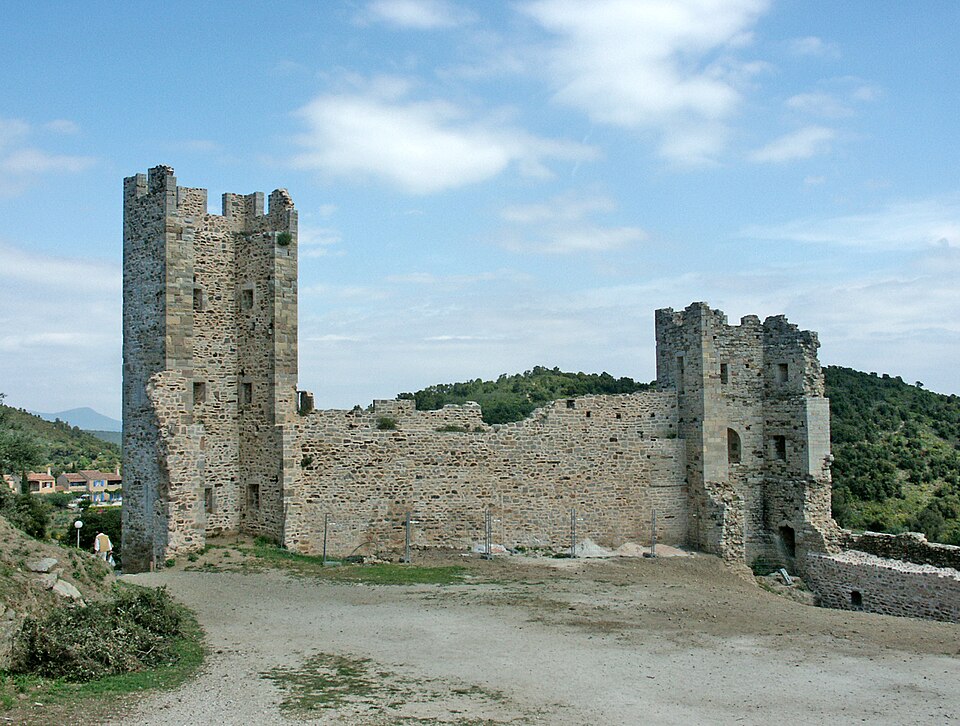
As part of the 2026 European Heritage Days, we look back at the archaeological excavations carried out in 2025 at Hyères Castle (Var), which uncovered a medieval church with a semi-circular apse and several burials near the fortress.
Editorial journal · Carte des Châteaux ·
On 19 September 2026, as part of the European Heritage Days, David Ollivier, archaeologist at the Laboratory of Medieval and Modern Archaeology in the Mediterranean (LA3M, CNRS/Aix-Marseille University) and director of the Hyères Castle excavations, will present the research conducted at this hilltop site on the Castéou hill to the public. This guided tour follows a particularly fruitful year in 2025: two excavation campaigns refined the castle’s defensive layout and uncovered an unexpected structure at its base—a medieval church with a semi-circular apse, accompanied by several burials. These discoveries, still under interpretation, could reshape our understanding of this site, which has been excavated since 2014.
01
Two excavation campaigns in 2025
The year 2025 was marked by two excavation campaigns at Hyères Castle, led by the LA3M (CNRS/Aix-Marseille University) under the direction of David Ollivier, with financial and technical support from the City of Hyères, the ARKAÏA Institute (MMSH-AMU), the Var Archaeological Centre, and the French State (DRAC/SRA PACA). In June, the team continued studying the area around the castle’s western enclosure, following the 2024 discovery of a blood mill nearly 3.50 m in diameter and the organised circulation along the curtain wall, including the uncovering of the access door to the north-west turret.
02
An unexpected structure at the foot of the castle
The September 2025 operation explored a new sector located at the foot of the castle, a few dozen metres from the south gate. What archaeologists had previously identified as a bastion with two towers turned out to be a completely different structure: a well-aligned church with a semi-circular apse. This discovery surprised the excavation team, who had not expected such a religious building in this precise location.
03
Burials around and inside the structure
Several graves are dug along the south wall of the church and appear to be contemporary with the building. Others, excavated inside the church itself, seem to have been dug into the rubble of an older, already vanished church: their presence attests to the enduring sacred and customary appeal of this site, which continued to attract burials long after its original use.
04
Castle church or parish church? An open question
Archaeologists remain cautious about the exact function of this structure. According to the City of Hyères, this new find « could be described as a castle church within the religious topography of Hyères, possibly linked to a settlement that was thought to be further from the castle ». The LA3M, for its part, poses the question without drawing conclusions: initial observations, in the absence of precise dating elements, suggest the existence of a place of worship associated with a burial zone predating the 13th century, though it remains unclear whether this was a castle chapel directly dependent on the fortress or a church linked to a nearby settlement, previously unknown. This second hypothesis opens up an unexpected lead: that of a civilian occupation closer to the fortress than researchers had previously imagined.
05
A site excavated since 2014, a history constantly reassessed
Hyères Castle, listed as a historic monument since 1862, has been the subject of an archaeological research programme initiated in 2014 by the LA3M, directed by David Ollivier, in partnership with the City of Hyères. The first four campaigns focused on the summit area of the site, covering around 500 m² of highly irregular terrain: they uncovered the original entrance gate and its defensive system, as well as a keep likely built around the year 1200. The 2016 campaign, confirmed in 2017, also uncovered an occupation from the 5th–7th centuries, previously unknown, and pushed back the earliest phases of the castrum’s construction to between the late 9th and the second half of the 10th century. The discovery of the church and burials at the foot of the castle in 2025 fits into this dynamic: it once again questions the organisation of this sector and the role played there, before the castle itself, by a religious—and perhaps civilian—occupation older than previously thought.
06
Mark your calendars for 2026
A new excavation campaign is already planned for 2026 to better understand this sector. Until then, the public is invited to discover the ongoing research during the European Heritage Days: a guided tour will be held on Saturday, 19 September 2026 at 10:00, with a meeting point on the castle esplanade. The tour is free but requires online booking. David Ollivier will present the archaeological research conducted near the south gate of the site.
Sources