
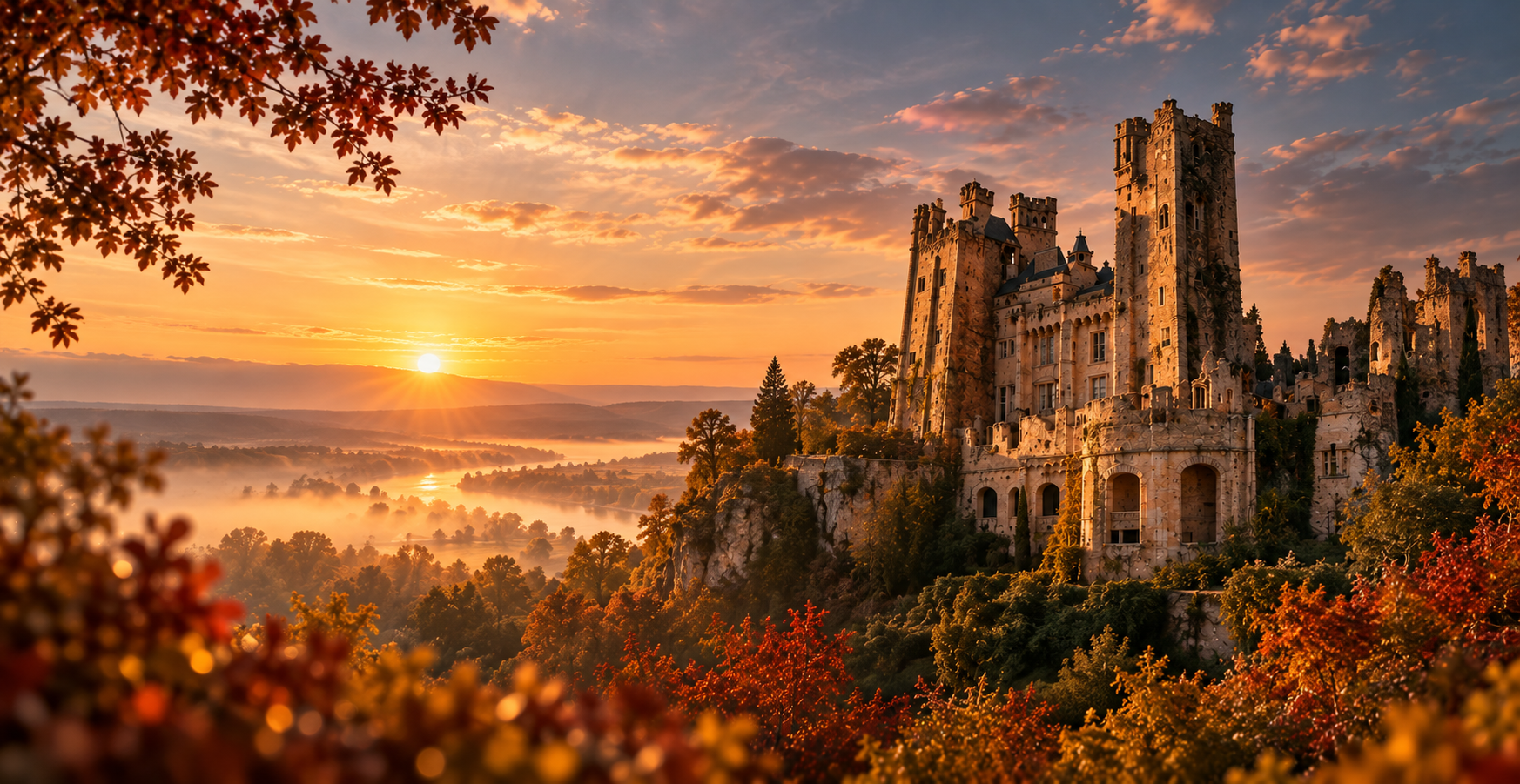
History of Château d'Anjony and the vendetta with the Tournemires
Château d'Anjony: three centuries of vendetta between neighbours in the Cantal
Built around 1435 by Louis d'Anjony, a comrade-in-arms of Joan of Arc, this basalt donjon with four towers was the stage for a bloody rivalry with the neighbouring Tournemire family for nearly three centuries.
Editorial journal · Carte des Châteaux ·
In the Cantal, at the heart of the village of Tournemire, a reddish basalt donjon with four round towers has dominated the landscape for nearly six centuries. Château d'Anjony is not merely a remarkable example of a 15th-century mountain fortress: it also carries the memory of a fierce rivalry that pitted the family who built it against their immediate neighbours, the lords of Tournemire, for three centuries.
01
Louis d'Anjony, comrade of Joan of Arc
The château owes its origins to Louis d'Anjony, a comrade-in-arms of Joan of Arc, who had the fortress built around 1435. Constructed from the region’s characteristic reddish basalt, the building is a 40-metre-high donjon flanked by four circular corner towers, typical of the small mountain fortresses of Haute-Auvergne at the time. Rare for a castle of this age, it has remained inhabited by the same family since its construction.
02
Explosive cohabitation with the Tournemires
Château d'Anjony stands in immediate proximity to the towers of Tournemire, which the two families have shared since 1351. Far from easing neighbourly relations, this joint ownership sparked a full-blown vendetta between the Anjonys and the Tournemires during the 16th and 17th centuries, as the two families became both close neighbours and bitter rivals. This feud lasted for three centuries, until the Tournemire family finally left the region around 1650.
03
The frescoes of Michel d'Anjony and Germaine de Foix
In the 16th century, Michel d'Anjony had the great hall of the château—known as the Knights’ Hall—decorated for his wedding to Germaine de Foix. He commissioned a series of frescoes depicting the Nine Worthies as well as the couple in period costume, a collection described as unique for the richness of its graphic style and the brilliance of its colours. The château’s chapel also preserves frescoes illustrating the life of Christ, along with a statue of a Black Madonna.
04
A listed château, still inhabited
In the 18th century, the Marquis d'Anjony—who served King Louis XV—added a residential wing with panelling and large windows reflecting the tastes of the era, contrasting with the severity of the medieval donjon. Listed as a historic monument since 1942, Château d'Anjony has been open to the public for over 90 years and remains inhabited by the descendants of the founding family, who lead tours of the fully furnished medieval section.