
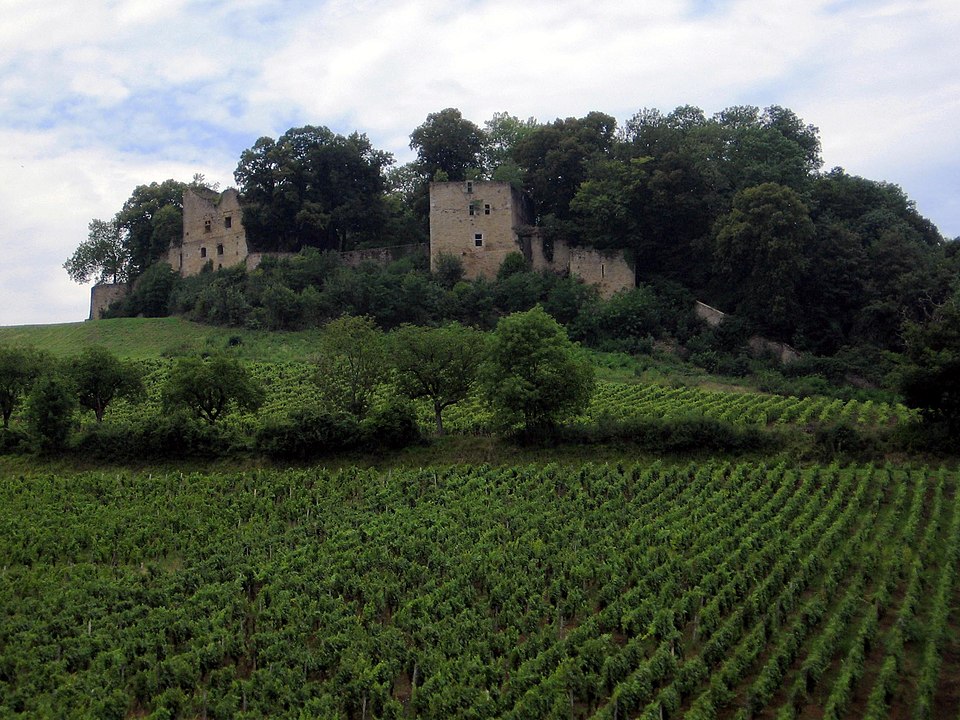
The history of Château d'Arlay and its wine estate in the Jura region
Château d'Arlay: the oldest château-vignoble in France, blending feudal ruins and vin jaune
Demolished on the orders of Louis XI in 1479, the medieval fortress of the Princes of Chalon-Arlay was replaced by an 18th-century residence, now surrounded by 21 hectares of vines under the AOC Côtes du Jura designation.
Editorial journal · Carte des Châteaux ·
Perched on a rocky outcrop in the Jura, the ruins of a medieval fortress still overlook the village of Arlay, while below stretches one of France’s oldest continuously inhabited wine estates. Between the 15th-century fortress razed by royal decree and the 18th-century residence that replaced it, the story of Arlay spans seven centuries of feudal power, political upheaval and viticultural continuity—right up to the vin jaune still produced on the estate today.
01
A fortress of the Princes of Chalon-Arlay
From the 13th century onwards, the Arlay estate belonged to the lords and later barons of Chalon-Arlay, a powerful feudal family from Franche-Comté who would later hold the title of Princes of Orange. Their medieval fortress, built on a rocky spur overlooking the village, served as a key seat of their power until the direct line died out: Philibert of Chalon, Prince of Orange, died in 1530 without an heir.
02
1479: destruction on the orders of Louis XI
The turning point in Arlay’s history came in 1479. After the death of Charles the Bold, the last Duke of Burgundy, King Louis XI of France sent his armies into the former Burgundian territories, including Franche-Comté. The medieval fortress at Arlay was demolished during this military campaign. Today, only remnants of the ramparts and towers remain, still dominating the landscape from the hilltop like silent witnesses to this feudal era.
03
From convent to the residence of the Arenbergs
It was not until the 18th century that a new residence emerged on the estate, this time at the foot of the hill rather than on the fortified spur. Around 1770, the existing building was converted from a Minimes convent under the direction of the Countess of Lauraguais. The estate later passed by marriage to the House of Arenberg: Pauline-Louise de Brancas wed Louis-Engelbert, Duke of Arenberg, in 1755. After the upheavals of the French Revolution—during which the estate’s owner was arrested in 1794—it was Pierre d’Arenberg who reclaimed the château in 1825 and had the residence remodelled in 1830.
04
A vineyard in continuous production for centuries
What sets Arlay apart from other Jura châteaux is the unbroken continuity of its viticultural activity, earning it the title of France’s oldest continuously inhabited ‘château-vignoble’. Today, the estate cultivates 21 hectares under the Côtes du Jura appellation, planted with five grape varieties: predominantly Pinot Noir, along with Trousseau, Poulsard, Chardonnay and Savagnin. The latter is key to producing vin jaune, the Jura’s iconic wine made through prolonged ageing under a layer of yeast. The estate also produces Macvin du Jura and vin de paille, and has farmed its vineyards organically since 2011.
The route on the map
Route map
Markers follow the suggested visiting order. Select a castle to open its page.