
Reopening and new immersive scenography of the Château de Castries in 2026
Château de Castries: the reopening of the Château de Lumières in September 2026
After several years of closure and restoration, the Château de Castries reopens on 18, 19 and 20 September 2026 under the name of Château de Lumières: history, immersive scenography and programme for the inaugural weekend.
Editorial journal · Carte des Châteaux ·
Nicknamed the 'Little Versailles of Languedoc', the Château de Castries is preparing to reopen its doors after several years of closure and restoration work. On 18, 19 and 20 September 2026, the Hérault landmark will unveil its new identity as the Château de Lumières, with an immersive scenography blending historical heritage and contemporary digital creation. This inaugural weekend coincides with the European Heritage Days. Here, with verified sources, is what visitors can expect.
01
A château at the heart of Languedoc’s history
The fief of Castries has its origins in the Middle Ages: the crusader knight Dalmace is said to have been its first known lord, before the land passed by alliance into the hands of the lords of Montpellier. In the 13th and 14th centuries, the village went through a difficult period, marked by plague, famine and wars. In 1495, the de La Croix family purchased the barony of Castries. Around 1520, the old medieval fortress was demolished and rebuilt in golden local stone, giving rise to the current building. In the 17th century, Louis XIV elevated the barony to a marquisate in favour of René-Gaspard de La Croix de Castries, who had the grand staircase and the great hall of the château built. The residence remained in the de Castries family for several centuries, before passing through the hands of several successive owners, including the d’Harcourt family in the 19th century.
02
A garden by Le Nôtre and an aqueduct designed by Riquet
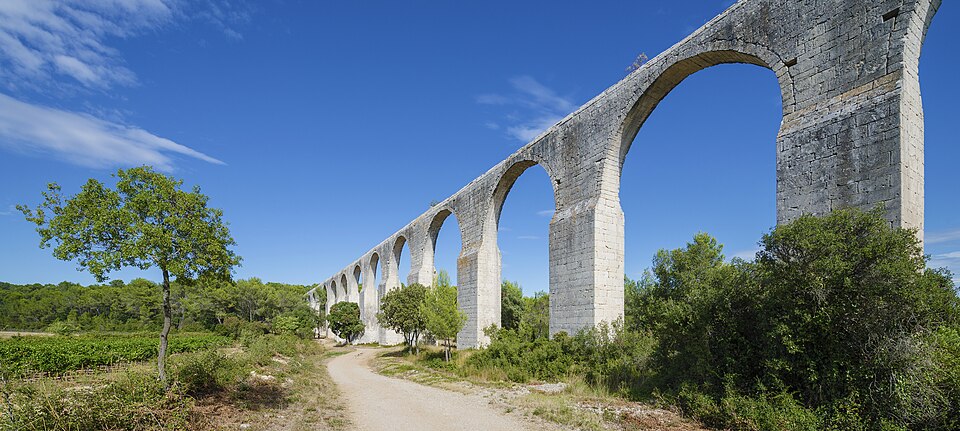
It was this same René-Gaspard de La Croix de Castries who, in 1666, commissioned André Le Nôtre—Louis XIV’s gardener at Versailles—to design the gardens, hence the nickname 'Little Versailles of Languedoc'. To supply water to the basins and fountains of this French-style garden, he then turned to Pierre-Paul Riquet, the engineer behind the Canal du Midi, who drew up plans between 1670 and 1676 for a monumental aqueduct over 6.8 kilometres long, now listed as a historic monument alongside the château’s façades and roofs. The fountain parterres and sumptuous gardens of the estate were largely destroyed during the Revolution, when the château was seized as national property. However, the aqueduct, with its spectacular 'Grand Arcs' rising some twenty metres high, remains one of the most remarkable testimonies to this architectural ambition of the Grand Siècle.
03
Several years of closure and a restoration project
For several years, the Château de Castries has been closed to the public while a major restoration project and a brand-new scenography were being carried out. The reopening, initially planned for summer 2026 with a programme of concerts and night-time projections from July, has been postponed: the château’s teams have chosen to push back the festivities to the weekend of 18 September to finalise the essential visitor route enhancements. This announcement has put an end to several years of waiting for the residents of Castries and the surrounding area, who are eager to rediscover this emblematic monument of Hérault’s heritage in a completely renewed light.
04
The reopening on 18, 19 and 20 September 2026
The date is now official: the Château de Castries will reopen its doors on Friday 18, Saturday 19 and Sunday 20 September 2026, marking the occasion with a grand inaugural weekend. This reopening heralds the château’s return to the cultural and heritage life of the region after years of inaccessibility to the public. Friday 18 September is dedicated to protocol events: an institutional inauguration with the press and partners in the afternoon, followed by free access to the visitor route for locals from 6pm (by reservation), and a monumental projection in the château’s courtyard from 9.15pm. On Saturday 19 and Sunday 20 September, the château will open its doors widely to the general public.
05
A new identity: the 'Château de Lumières'
For this new chapter, the Château de Castries adopts an entirely new cultural identity: that of the 'Château de Lumières'. The site is now presented as the only immersive château in Occitanie and southern France, with a visitor route designed by visual artist and artistic director Jérémie Bellot and his studio AV Extended. This new identity is underpinned by two complementary exhibitions presented within the same visitor route: 'Hereditatem', which offers a sensitive and contemporary reading of the château’s history and its successive owners, and 'Rêves Chromatiques' ('Chromatic Dreams'), a journey between art, science and heritage inspired by nature and geometry, which brings contemporary digital creation into dialogue with the monument’s ancient stones.
06
An immersive scenography: digital and light installations
The new scenography relies heavily on digital and immersive installations. Lighting installations engage with the château’s architecture: they reveal the volumes of the rooms, transform the spaces into true landscapes of light, and 'bring to life' the frescoes and paintings of the monument through video projections. The visitor route also features narratives, models and explanatory labels that allow visitors to rediscover, in a poetic and playful way, the life of the de La Croix de Castries family in the 19th century, while opening up to contemporary artistic creation. The aim is to offer a fresh perspective on heritage through the work of Jérémie Bellot and the artists invited to exhibit at the château.
07
The programme for the inaugural weekend
The inaugural weekend programme unfolds in several stages. Friday 18 September is reserved for locals and partners, with the evening monumental projection 'Les Lumières de Castries'. On Saturday 19 and Sunday 20 September, the château and its exhibition will be open to the general public: Saturday from 10am to 1pm (last entry 11.30am) then from 2pm to 5.30pm (last entry 4pm), and Sunday from 10.30am to 1pm then from 2pm to 7pm (last entry 5.30pm), at a single admission price of £10, free for children under 4. On Saturday 19 September evening, from 7pm, the château will also host the Eclipse Festival music evening, featuring pianist André Manoukian in a trio, followed by a second set by Ena Eno x Jérémie Bellot and an electronic music set. A 'Pass Eclipse' allows visitors to combine the daytime visit with the evening music event.
08
A reopening tied to the European Heritage Days
It is no coincidence that the official reopening of the Château de Castries has been set for the weekend of 19 and 20 September 2026: these two days coincide with the European Heritage Days (Journées européennes du patrimoine), France’s annual national event that invites the public to (re)discover monuments that are usually less accessible, often free of charge or at reduced rates. By aligning its reopening with this event, the château benefits from enhanced visibility among a national audience attuned to heritage, while offering, on this occasion, a single admission price of £10 instead of the usual rates for the Château de Lumières exhibition.
09
Practical information to prepare your visit
Address: 15 rue du Quartier bas, 34160 Castries. Pedestrian entrances are via avenue de la Gare and avenue de Sommières; parking is available at Espace Gare and the Hippolyte Paulet communal hall. After the inaugural weekend, the Château de Lumières exhibition will be open according to the following indicative rates (excluding JEP days and special events): adult full price £14.50, reduced rate £12.50 (students, jobseekers, people with disabilities and their companions), young person (11–17 years) £10.50, child (4–10 years) £7, free for children under 4, family pass (2 adults + 2 children up to 10 years) £36, 'Tribu' pass for 10 people £120, and a 10% discount for groups of 20 or more. As these opening times, rates and programmes are subject to change, it is advisable to check the up-to-date information and book directly through the château’s official ticketing system before any visit.
Sources