
The secrets behind the heritage restoration of Château Laurens in Agde
Château Laurens in Agde: the secrets of an extraordinary heritage restoration
To mark European Heritage Days 2026, Château Laurens celebrates 30 years as a listed Monument historique. A look back at two decades of exceptional restoration work in Agde.
Editorial journal · Carte des Châteaux ·
On the weekend of 19 and 20 September 2026, as part of European Heritage Days, Château Laurens will offer a unique themed tour focusing on the 'major challenges of restoration' for the monument, coinciding with the celebration of its 30 years as a listed Monument historique (1996–2026). This is the story of an extraordinary project: how to breathe new life into an Art Nouveau palace left to decay for over thirty years, without ever reinventing its past?
01
A 'house-world' for a dashing globetrotter
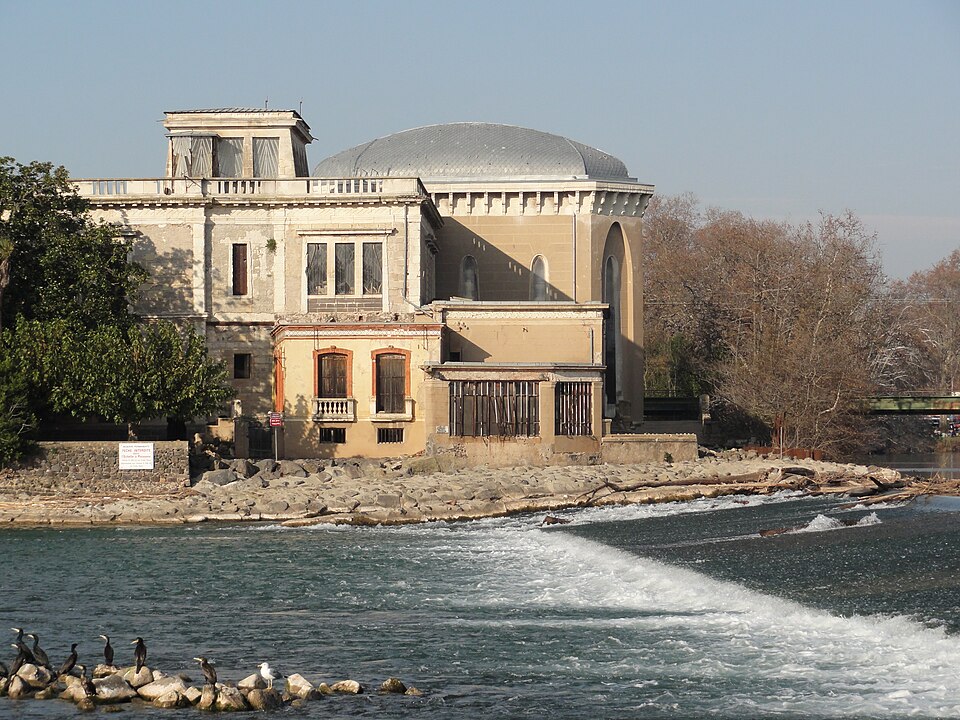
Château Laurens — also known as Villa Laurens — was never a castle in the strictest sense. It is the residence built between 1898 and 1901 by a young Agathois, Emmanuel Laurens (1873–1959). A medical student in Montpellier, he inherited a considerable fortune — estimated by the City of Agde to be worth around £280 million today — from a distant cousin, Baron de Fontenay, along with the family estate of Belle-Isle, a twelve-hectare property bordered by the Hérault River and the Canal du Midi. A well-travelled aesthete and music lover, Laurens commissioned Montpellier architect Jacques Février to design his villa. The result was an eclectic residence, blending antiquarian villa and Art Nouveau manifesto, conceived as the stage for a dreamt-up life between fantasised Orient and burgeoning modernism. According to the official press pack from the City of Agde, the château was 'less a home than a theatre': Laurens and his friends would re-enact key moments from his travels to the Orient, before hosting lavish receptions alongside his wife, the singer Louise Blot.
02
An eclectic palace between dreamt Orient and Art Nouveau
The building follows a principle inherited from Antiquity: a central axis organises the circulation. The grand vestibule leads to an atrium of four columns, lit by a zenithal skylight in an Egyptian-inspired style. From this atrium radiate the reception rooms: the dining room, the Moorish salon, the drawing room and the music room. A grand ceremonial staircase leads to the upper floor, where a separate passage serves Emmanuel Laurens’ private apartment. Rare for a monument of this scale: according to the historical documentation gathered by the City of Agde, the château has undergone no significant architectural transformations since its construction. Its layout and original decorative features have been preserved — precisely what made its restoration both possible and exacting. The decoration of the reception rooms, painted in 1901 by Marseille decorator Eugène Dufour (a childhood friend of Laurens), evokes a theatricalised antique villa: Pompeian-red walls adorned with lotus flowers, friezes of arums and hippocampi on green backgrounds, wisteria and bees, lotiform columns and stylised Egyptian figures. The Art Nouveau furniture, commissioned in 1898 from decorator Léon Cauvy and interior designer Paul Arnaveilhe, completes this universe. At the centre of the study ceiling is an exceptional piece: a composition depicting Apollo on his chariot, painted in 1898 by Louis Anquetin, an artist close to Van Gogh, Gauguin and Toulouse-Lautrec. This is the preparatory sketch for the stage curtain of the Théâtre Antoine in Paris, acquired by Laurens and exhibited at the Salon de la Société nationale des Beaux-Arts in 1898 — an original historical element, not a reconstruction. The private apartment, lit by multicoloured stained-glass windows by Parisian decorator Eugène Martial Simas (made by master glassmaker Théophile Laumonnerie) and Arts and Crafts lighting by William Arthur Benson, houses one of the most celebrated rooms in the monument: its bathroom. Designed by Simas, with wall decorations by sculptor Alexandre Charpentier and designer Félix Aubert, and a mosaic pavement signed Giandomenico Facchina, it was praised in 1898 in the magazines Art et Décoration and The Studio. According to the City of Agde, it is today one of the few intact and in-situ Art Nouveau ensembles of this scale.
03
After Emmanuel Laurens: three decades of neglect
The magic did not last. The economic crisis of the 1930s weakened Laurens’ fortune, and he sold the estate under a life annuity in 1938. The château was occupied by German forces between 1942 and 1944. Laurens died in 1959, after his wife’s death in 1954. Left to its own devices for over thirty years, the monument fell into severe disrepair. In 1994, the City of Agde purchased the estate and château. The building was listed as a Monument historique in 1996. Management was entrusted in 2003 to the Hérault Méditerranée Agglomeration Community (CAHM). The first operations, carried out in 2003, were urgent: primarily conservation measures to halt the building’s degradation. A defining study conducted in 2006 by chief architect for the Monuments historiques Dominique Larpin diagnosed numerous structural disorders and established a restoration plan. The absolute priority was the music room, whose roof no longer protected the interior from water ingress — a vital issue for preserving the decorative features.
04
The major stages of an extraordinary project
From 2007, a 'test bay' was created to define the restoration protocol for the decorative features. The following year, the timber roof structure and zinc roofing, along with the vault decoration, were fully restored. Divided into several phases, the complete restoration of the music room was completed in 2012. From 2015, a general restoration programme was launched across the entire monument. Work began in earnest in early 2017, under the direction of a new chief architect for the Monuments historiques, Antoine Madelénat. A scientific committee, organised by the Regional Conservation of Historic Monuments (Drac Occitanie), met six times during the works to arbitrate restoration choices. The restoration of painted and sculpted decorations was entrusted to conservator Cinzia Pasquali and her Paris-based studio Arcanes, with scientific support from the Interdisciplinary Centre for Conservation and Restoration of Heritage (Cicrp) in Marseille. According to figures provided by the City of Agde, this is the largest heritage restoration project in the Occitanie region: nearly £13 million in investment over nearly ten years of work, for a 12-hectare estate (including 5 hectares of historic parkland) and a 1,500 m² building spread over four levels. Funding was provided by the European Union (ERDF, 10 %), Drac (30 %), the Occitanie Region (15 %), the Hérault Department (10 %) and the Hérault Méditerranée Agglomeration (35 %). The château reopened to the public in June 2023.
05
How far to restore without reinventing the past?
This is the central question of any project of this nature — and the City of Agde does not shy away from it in its official communications: how to 'showcase the exuberant, multicoloured and luminous décor [...] while maintaining a balance between original and restored elements'? Three categories of elements now coexist in the visitor route, and it is important to distinguish between them. Original elements preserved: such as the painted ceiling by Louis Anquetin in the study, Simas’ bathroom, or the wall decorations by Eugène Dufour, unchanged since 1901. Restored elements: decorations cleaned, consolidated and retouched by Cinzia Pasquali’s teams based on existing features, such as the vault of the music room. Finally, reconstructed or re-furnished elements: to fill the gaps in the historic furnishings — dispersed after Laurens’ departure — the City of Agde has pursued a documented acquisition policy based on old photographs of the monument: a bedroom suite by Léon Cauvy acquired at a Paris auction in 2012, Arts and Crafts lighting, Indochinese ceramics for the ceremonial staircase, a Neo-Syrian stool and Uzbek ewers for the Moorish salon, and even a copy of Baudelaire’s Les Fleurs du mal with an Art Nouveau binding, found for the study. These objects are not inventions: they are period pieces, comparable or identical to those visible in old photographs, reintroduced to recreate the documented atmosphere of the rooms. It is precisely this question — the ethics of restoration, the balance between historical accuracy and aesthetic enhancement — that the themed tour on 19 September 2026 aims to illuminate for the public.
06
What visitors can rediscover today
The visitor route takes in the grand vestibule, the columned atrium, the dining room, the Moorish salon, the music room and the private apartment, leading to the study and Simas’ bathroom. The tour combines human mediation with sensory and digital experiences (sound and scent ambiences, holograms) to evoke the atmosphere of the Belle Époque without overshadowing the heritage elements themselves. For European Heritage Days 2026, the programme includes an anniversary week (15–20 September), with 'An exceptional restoration' tours including a recreated restoration workshop, a mini-exhibition and a documentary, followed by a free weekend: Saturday 19 September by advance booking (with the 40-minute themed tour on restoration challenges), and Sunday 20 September with open access.
Sources