

Archaeological investigation at Fort du Coudray, Royal Fortress of Chinon
Chinon Fortress: what the latest excavations at Fort du Coudray reveal
Since 2024, the archaeological department of Indre-et-Loire has been excavating Fort du Coudray at the Royal Fortress of Chinon. Why reopen the ground of a site already well known, and what are the archaeologists really looking for?
Editorial journal · Carte des Châteaux ·
The Royal Fortress of Chinon may be one of the most studied medieval sites in the Loire Valley, yet part of its history remains buried beneath the earth. Since September 2024, archaeologists have been excavating Fort du Coudray, the western tip of the fortress, as part of a three-year research programme led by the Department of Indre-et-Loire. The goal: to understand the succession of buildings that have stood on this rocky outcrop since the 10th century, up to the 15th-century Saint-Martin chapel. The 2026 campaign, the final stage of the programme, is currently underway. Here’s what we know so far about this archaeological investigation—and what remains speculative.
01
Beneath Fort du Coudray: a new archaeological investigation
Chinon is no stranger to archaeologists: between 2003 and 2009, a major campaign explored over 5,000 m² of the fortress, accompanying restoration work led by the chief architect of historic monuments, Arnaud de Saint-Jouan. However, this previous effort focused primarily on Fort Saint-Georges and the eastern tip of the Middle Castle; at Fort du Coudray, at the opposite end of the site, archaeologists had, for the most part, only followed the trenches dug for new technical networks, without conducting an in-depth excavation of this area. This gap is what the 2024 programme aims to fill. It is led by the Department of Archives and Archaeology of Indre-et-Loire, which oversees the departmental archaeological service (Sadil), established by the County Council in 2005. Its mission: to carry out surveys and excavations in Touraine and share their findings with the public. Three planned campaigns have taken place in September 2024, September 2025, and September 2026, forming a three-year research programme dedicated specifically to Fort du Coudray.
02
What the 2026 campaign seeks to uncover
According to the objectives set by the departmental archaeological service, the campaign aims to better understand the succession of buildings that have stood on Fort du Coudray since the 10th century, up to the 15th-century Saint-Martin chapel. In other words, the focus is not on searching for a single lost building, but on reconstructing several centuries of construction, transformation, and destruction layered upon this same promontory. The September 2026 campaign, the final stage of the programme, has an even more specific goal: to better understand the buildings partially uncovered during the 2024 and 2025 campaigns, and to trace their evolution up to their destruction. This wording, taken from the official announcements of the archaeological service, indicates that structural remains have indeed been uncovered during the first two campaigns, though no detailed inventory of these remains (exact nature of walls, floors, or structures, precise dating) has yet been made public beyond this general statement.
03
Preliminary findings shared on-site, not yet published in detail
This is a key point for anyone seeking to understand the current state of this research: the detailed results of the 2024 and 2025 excavations (nature of the uncovered structures, any recovered artefacts, proposed dating) have, to our knowledge, not been published or released in a detailed public communiqué. Instead, these initial findings are shared directly on-site: each year, the archaeologist leading the excavations presents their observations to visitors during guided tours of the site, particularly during European Heritage Days. This communication approach—prioritising on-site visits over public publications—is common for ongoing archaeological operations: working hypotheses evolve from one campaign to the next, and a comprehensive scientific synthesis is typically only written once the programme is complete. Therefore, we will not present any specific discoveries here that we have not been able to verify with an institutional source—but we will update this article as soon as detailed results are made public.
04
A fortress transformed over centuries
To understand the significance of this research, it is essential to place Fort du Coudray within the long history of the fortress. In the 10th century, the site was held by the Counts of Blois. The most powerful of them, Thibaud I, known as 'the Cheat', who was viscount from 941 and count from 956 to 974, had a stone tower built in 954 and enclosed this part of the site with its own wall, separating it from the older castrum attested as early as the 5th century. These works, concentrated on the western tip of the rocky outcrop, gave the structure to what would later be called Fort du Coudray. The site then entered the Plantagenet era: Henry II Plantagenet, King of England, died there in 1189. After the siege of 1204–1205, Philip II of France reclaimed the fortress from the English and had the powerful Tour du Coudray built—the keep that still dominates the site today. It was in this tower that Templars were imprisoned in 1308, and their graffiti can still be seen carved into the stone. In the 14th century, a new chapel was built in Fort du Coudray, dedicated to Saint Martin—this chapel, completed in the following century, marks the recent chronological boundary of the current excavation programme.
05
Why the research will continue
As the September 2026 campaign is presented as the final stage of the three-year research programme launched in 2024, its purpose is to consolidate the observations from the previous two campaigns rather than to open new excavation zones. Guided tours of the site are offered every Thursday from 10 September to 8 October 2026 at 3pm, allowing the public to follow the progress of the research first-hand. Over the European Heritage Days weekend on Saturday 19 and Sunday 20 September 2026, a special tour of the Fort du Coudray excavation is also scheduled for Saturday afternoon: the archaeologist leading the dig will share the initial findings of their investigations with visitors. This is, to date, the most direct opportunity to learn about the progress of this research from those conducting it.
06
Visiting the Royal Fortress of Chinon today
Beyond this excavation site, the Royal Fortress of Chinon (full details on the Châteaux Map) is open to visitors year-round, every day except 1 January and 25 December, with an immersive tour available via a multimedia guide (HistoPad) included in the admission ticket. The route takes in the three elements of the fortress—Fort Saint-Georges, the Middle Castle, and Fort du Coudray—separated by dry moats, as well as the royal lodgings, the Clock Tower, and, of course, the Tour du Coudray with its Templar graffiti. As opening hours and admission prices may vary by season, it is best to check the official website before visiting. While the Fortress of Chinon is an iconic stop on the Loire Valley trail, it is not the only site offering an archaeological perspective on its past: our article on the 2026 Heritage Days highlights other excavation sites open to the public that same September, from the Château des Rohan in Pontivy to the Château des sires de Faucigny in Bonneville. Just a few kilometres from Chinon, the Renaissance jewel Château d'Azay-le-Rideau, managed like Chinon by the Centre des Monuments Nationaux, is a perfect complement for those wishing to extend their discovery of the Loire Valley.
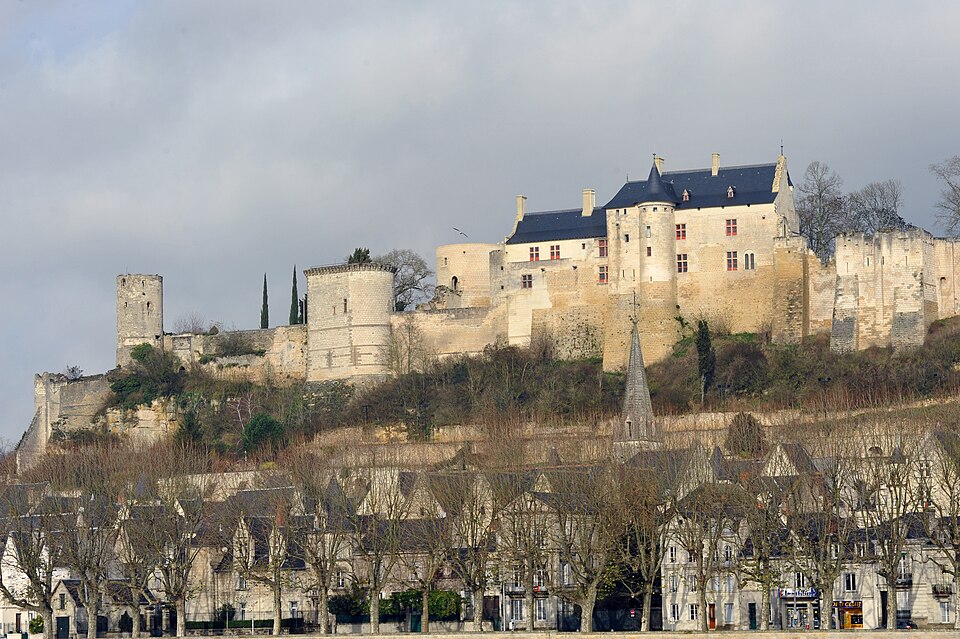
INDRE-ET-LOIRE · Chinon
Château de Chinon
La forteresse royale de Chinon, ensemble composé de trois châteaux : fort du Coudray, château du Milieu, et fort Saint-Georges, se situe sur la commune française de Chinon dans le département d'Indre-et-Loire, en région Centre-Val de Loire.
.JPG)
INDRE-ET-LOIRE · Azay-le-Rideau
Château d'Azay-le-Rideau
Le château d'Azay-le-Rideau est un monument classé appartenant à l'État et situé dans la commune du même nom, en Indre-et-Loire, en France. Il est accessible par la ligne TER Tours - Chinon qui marque systématiquement l'arrêt dans la commune. Le château fait l’objet d’un classement au titre des monuments historiques depuis le 18 avril 1914. Le château d’Azay-le-Rideau, comme une centaine d’autres monuments, propriété de l’État, est géré, animé et ouvert à la visite par le Centre des monuments nationaux.
The route on the map
The Royal Fortress of Chinon and Fort du Coudray
The Royal Fortress of Chinon, where the excavation campaign at Fort du Coudray is taking place, and nearby Château d'Azay-le-Rideau.
Markers follow the suggested visiting order. Select a castle to open its page.
Sources