
History and heritage
Gaston Fébus, the Sun Count: from Foix to Montaner, the fortresses of a Pyrenean prince
# Gaston Fébus, the Sun Count: from Foix to Montaner, the fortresses of a Pyrenean prince **SEO description:** Victor at Launac in 1362, author of the Livre de chasse, builder of Montaner and Orthez: follow Gaston Fébus from castle to castle, from Foix to Mauvezin, between documented facts and legend.
Editorial journal · Carte des Châteaux ·
# Gaston Fébus, the Sun Count: from Foix to Montaner, the fortresses of a Pyrenean prince ## Introduction On 5 December 1362, near Toulouse, a thirty-one-year-old Pyrenean count
Gaston Fébus, the Sun Count: from Foix to Montaner, the fortresses of a Pyrenean prince
**SEO description:** Victor at Launac in 1362, author of the Livre de chasse, builder of Montaner and Orthez: follow Gaston Fébus from castle to castle, from Foix to Mauvezin, between documented facts and legend.
Introduction
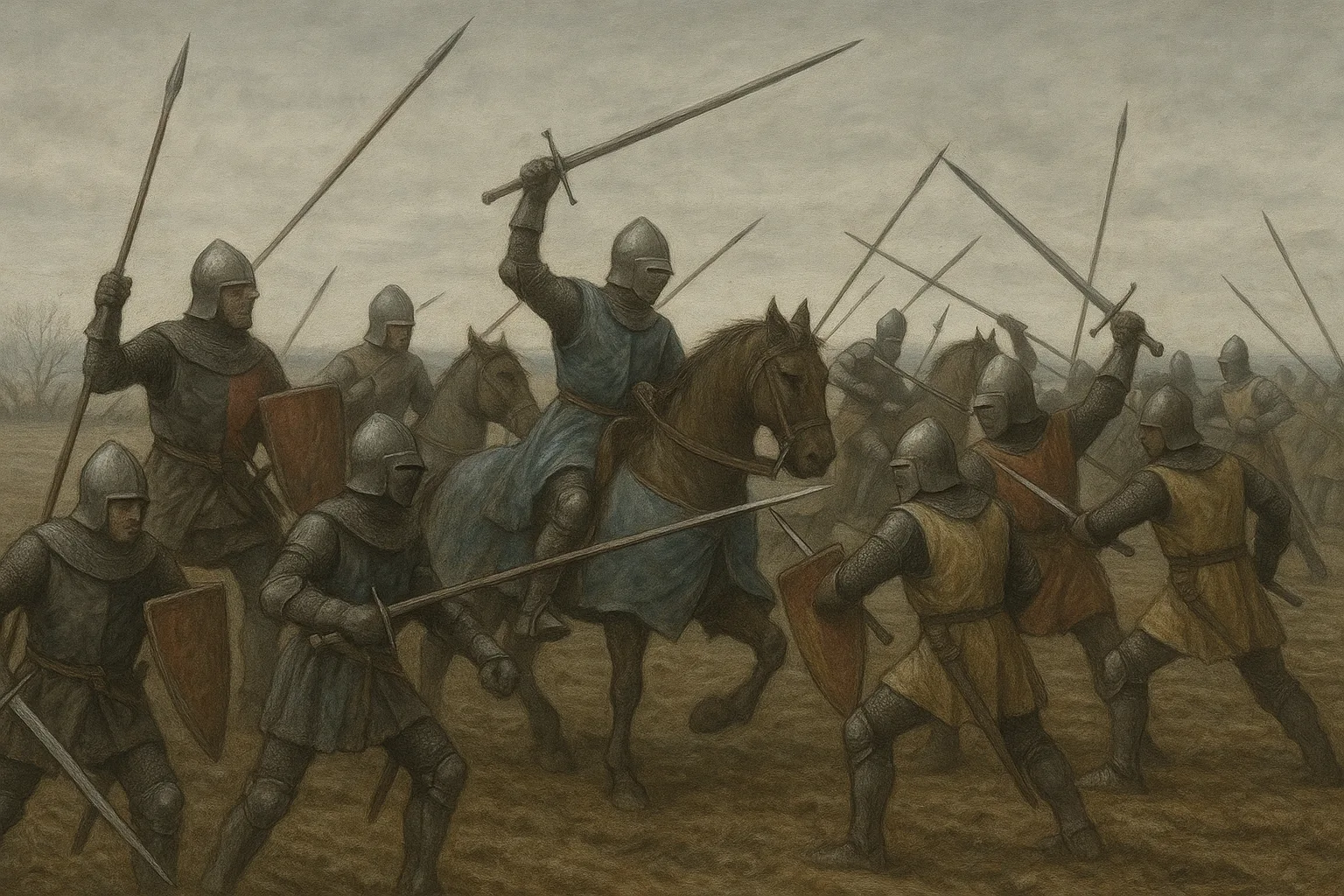
On 5 December 1362, near Toulouse, a thirty-one-year-old Pyrenean count routed the army of the Count of Armagnac and captured a part of the nobility of the South. The ransoms that followed made him one of the wealthiest princes of the realm, though never really its vassal. He was called Gaston III of Foix-Béarn, and he would be known as Fébus, ‘the brilliant one’. His castles tell of a rare ambition: to hold together two principalities, the county of Foix and the viscounty of Béarn, and to owe nothing to anyone. This feature follows that ambition stone by stone, separating what the sources establish from what tradition has embellished.
A twelve-year-old at the head of two principalities
Gaston was born on 30 April 1331, very probably in Orthez, at the Moncade castle. His father, Gaston II, died on 26 September 1343 before Algeciras, in Andalusia, where he was fighting alongside the King of Castile. The heir was twelve; his mother, Aliénor de Comminges, acted as regent until his majority on 30 April 1345. In the meantime, the young count toured his lands to receive the homage of his vassals, from December 1343 to January 1345. His power rested on a legal peculiarity. The county of Foix owed allegiance to the King of France; Béarn, however, was held of no one. On 25 September 1347, at Orthez, Gaston declared that he held Béarn ‘of God and of no man in the world’. The formula made him an almost sovereign prince, and it explains the care he took in fortifying the border between his lands and those of his neighbours, Armagnac to the north and Bigorre to the east.
Launac, 5 December 1362: the victory that funds the building works
In the mid-fourteenth century, the rivalry between Foix and Armagnac, fuelled by the Hundred Years’ War and the succession disputes of the South, was settled by arms. At Launac, Fébus, outnumbered according to historians, won the battle and captured Jean I of Armagnac along with many lords. Tradition holds a ransom of around 500,000 florins; the figure, given by modern historiography, should be treated with caution. An idea circulates everywhere: this money would have built Fébus’s castles. It is plausible and probably partly true, but the sources present it as a hypothesis rather than as a fact documented item by item. Let us retain the general link — new resources, a period of building works in the 1360s–1380s — without attributing a precise cost to every stone.
Foix, the cradle of the county
Perched on its rock, the castle of Foix has been the seat of the county since 1034. Its origins go back to the tenth century: the Arget tower is its oldest element, reinforced at the turn of the thirteenth and fourteenth centuries. The square tower dates from the thirteenth century and was vaulted in the fourteenth. Two enclosure walls, a barbican and small towers complete the ensemble. One point deserves correcting, because it is repeated everywhere: the famous round tower, 34 metres high, with walls 4 metres thick and vaulted hexagonal rooms, dates from the first half of the fifteenth century. Its construction may have begun under Fébus, but it was completed after his death. As for the link between ransoms and works, here too it remains probable rather than proven. After the Middle Ages, the castle became a garrison and then a prison, until 1864 — almost 200 inmates in 1859 —, escaped a demolition order issued by Richelieu (1632–1638) that was never carried out, was listed in 1840 and restored by Paul Boeswillwald, a former collaborator of Viollet-le-Duc. Since 1930 it has housed the departmental museum of Ariège. Its present appearance is therefore partly a nineteenth-century restoration.
Montaner, brick in the service of Béarn
Fébus did not stop at Foix. In Béarn, from 1375 he had the castle of Montaner rebuilt to a design attributed to Sicard de Lordat. The choice of brick, the material of the Gascon plains, contrasts with Pyrenean stone. The twenty-sided polygonal enclosure, reinforced by buttresses, houses a square keep 36 metres high, reached by a drawbridge. Above the keep’s doorway, the arms of Foix-Béarn sit alongside the motto ‘Fébus mé fé’ — ‘Fébus made me’. Montaner symbolises the union of the two principalities under a single prince. The castle has belonged to the Pyrénées-Atlantiques department since 1854; the site’s listing mentions medieval events in summer. For opening hours and prices, consult the official sources.
Orthez, Pau, Mauvezin: a network of strongholds
Orthez is the capital of Béarn. The Moncade castle, of which the 33-metre tower built from 1242 by Gaston VII survives, was remodelled by Fébus in the years 1368–1375; set on fire in 1569 during the Wars of Religion, it was largely dismantled at the Revolution. At Pau, between 1372 and 1378 the castle became the centre of the defensive system in eastern Béarn, and Fébus stayed there from 1375. Further east, Mauvezin, a stronghold in the Hautes-Pyrénées whose construction began in the twelfth century on a rocky spur, fell within Fébus’s orbit in the late 1370s: the Duke of Anjou besieged it in 1373 and, in 1379, after the War of the Succession of Comminges, Fébus received the châtellenies of Mauvezin and Goudon, which he attached to a new principality, the Nébouzan. The castle overlooks the road from Toulouse to Bayonne and today offers costumed tours and summer events. It would, however, be wrong to claim without a source that he carried out extensive works there: the texts consulted do not say so.
The learned prince: Livre de chasse and the court at Orthez
Fébus was also a man of letters. His Livre de chasse, composed between 1387 and 1389 and dedicated to Philip the Bold, Duke of Burgundy, is divided into four parts: gentle and wild beasts, hounds, hunting with hounds, and hunting with snares, nets and crossbows. Some thirty manuscripts survive, and their illuminations have made the text famous. He is also the author of a Livre des oraisons. In the winter of 1388–1389, the chronicler Jean Froissart stayed at Orthez. He brought back a picture of a court that was at once brilliant and unsettling, which constitutes a major source — and the only one for several episodes — with all the caution that this entails.
The shadow of 1380 and the end of a reign
The tragedy in Fébus's life came in 1380. His son Gaston, aged eighteen, was implicated in a plot to poison his father. Arrested and imprisoned at Orthez, he died in August 1380. Froissart speaks of death by starvation following a quarrel with his father; other sources point to a sentence of condemnation; no record of an execution survives, and Fébus had the documents destroyed. Historians probably hold him responsible, and the Livre des oraisons presents the death as an involuntary crime. Any more precise account is a matter of reconstruction. On 1 August 1391, returning from a hunt, Fébus died of a stroke at L'Hôpital-d'Orion, between Sauveterre-de-Béarn and Orthez. His funeral took place on 2 October. The Estates of Béarn named Mathieu de Foix-Castelbon as heir. Charles VI, who had been appointed legatee by the Treaty of Toulouse of 1390, renounced his claims in exchange for 250,000 francs and recognised him by letters patent of 20 December 1391. The counts of Foix later took the crown of Navarre, and one of their descendants became Henri IV, King of France in 1589; the county was annexed to the crown in 1607.
Visiting in the footsteps of Fébus
A coherent itinerary starts in Foix, passes through Mauvezin for the Nébouzan border, then joins Béarn via Pau, Orthez and Montaner. You could complete it with the neighbouring Ariège castles, such as Lordat (reopened to the public since 2016), or with our road trip through Occitanie. Before setting off, check opening times and visiting conditions with the site managers: this information has not been verified for this article.
Main sources
- Fr.wikipedia : Château de Foix ; Livre de chasse. - En.wikipedia : Gaston III, Count of Foix ; Battle of Launac. - Château de Mauvezin (official site) : Gaston Fébus, le comte-soleil. - Carte des Châteaux entries : Foix (991), Montaner (10312), Château de Moncade (10309), Mauvezin (6010), Lordat (1006).
Sources