
Heritage road trip in Occitanie
Road trip: 5 days through the castles of Occitanie
Five days on the roads of Occitanie, from the Pyrenean fortresses to the Cathar citadels, on to Carcassonne and the Côte Vermeille: a road trip built step by step around real castles.
Editorial journal · Carte des Châteaux ·
Some French regions are crossed in a straight line, while others are best told stage by stage. Occitanie belongs to the second kind. From the Pyrenean foothills to the Mediterranean, the route traces a continuous thread between feudal citadels, Cathar ruins perched on rocky peaks, city ramparts and coastal fortresses. This five-day road trip follows that thread without trying to tick off the region’s most famous castles. Instead, it favours a coherent route that is practical to drive. We begin in the Ariège, at the foot of the Pyrenees, before heading to the Corbières and its so-called ‘Cathar’ fortresses, set on dizzying ridges. Next comes Carcassonne, an unmissable stop but not the only highlight of the journey, before reaching the Roussillon plain and then the Mediterranean, where the route ends facing the sea. Each day brings together one or more castles close enough to visit without racing against the clock, and coherent enough to tell, together, a different facet of Occitan castle heritage: Pyrenean austerity, Cathar resistance, medieval grandeur, Renaissance military architecture and Mediterranean elegance.
01
Day 1 — The Ariège heights
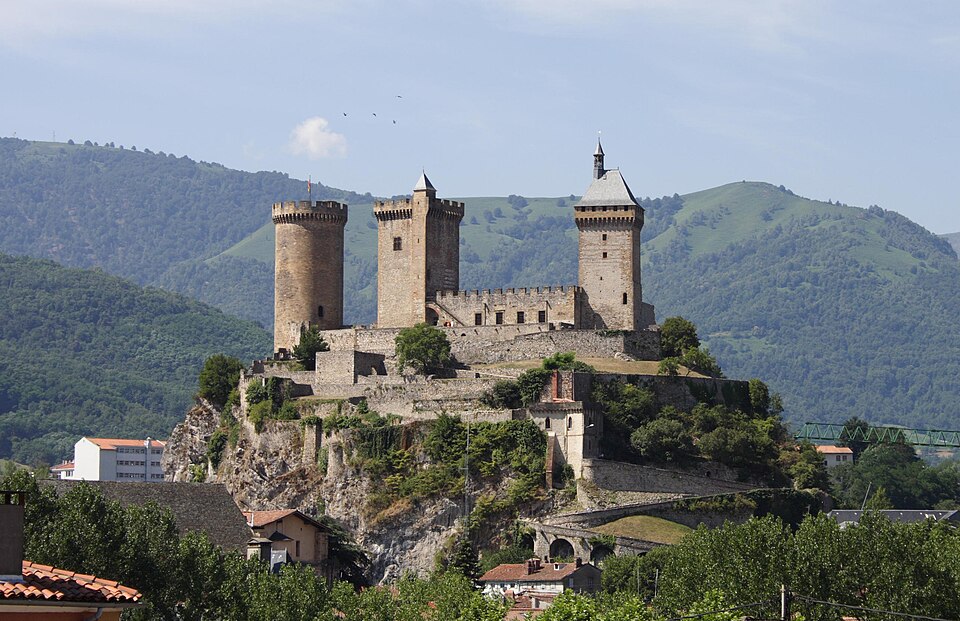
The journey begins in the Ariège, where the Château de Foix sets the tone from the first few miles: perched on its rocky outcrop, it dominates the town and the valley with an almost theatrical verticality. Heading south, the Lordat castle, less well known and surviving as impressive ruins, offers a rawer glimpse of Pyrenean military architecture, far from the crowds. The day ends at Montségur, whose name remains inseparable from the siege of 1244 and the Cathar resistance. The climb to the ruins, exposed to the winds, is one of the most intense moments of the early stages of the journey. Three sites, three faces of the same Pyrenean Middle Ages, between comital power, discretion and resistance.
ARIEGE · Foix
Château de Foix
Le château de Foix est un château fort du XIIe siècle, dont l'origine semble remonter au Xe siècle, il fut remanié à plusieurs reprises et très restauré au XIXe siècle. Il se dresse sur sur une plate-forme rocheuse dominant la ville de Foix dans le département de l'Ariège en région Occitanie. Le château qui abrite le Musée départemental de l'Ariège est classé monument historique depuis 1840.
ARIEGE · Lordat
Château de Lordat
The Château de Lordat, located in the commune of Lordat in the Ariège department, is one of the oldest and largest feudal castles of the upper County of Foix. It is a typical example of the medieval military architecture of the Ariège Pyrenees.
ARIEGE · Montségur
Château de Montségur
The Château de Montségur (Montsegur in Occitan) is a former fortified castle, known as a "Cathar" castle, rebuilt in 1206 but altered at the end of the 13th century. Its remains stand in the French commune of Montségur, in the Ariège department, in the Occitanie region.
02
Day 2 — The Cathar fortresses of the Corbières
Heading east into the Corbières massif, kingdom of the so-called ‘Cathar’ castles. Peyrepertuse opens the day with its extraordinary length along a ridge, a ruin that literally follows the rocky line for several hundred metres. A few kilometres away, Quéribus almost closes the landscape with its isolated keep, the last Cathar stronghold to fall, in 1255. From its summit, the panorama reaches as far as the Roussillon plain. The day ends at the Château de Termes, further north, whose ruins nestle in a natural cirque of limestone and tell of a different siege, conducted in the early 13th century. Three fortresses, three sieges, one limestone massif that seems to have been carved for resistance.
AUDE · Duilhac-sous-Peyrepertuse
Château de Peyrepertuse
The Château de Peyrepertuse (in Occitan: Castèl de Pèirapertusa) is a former fortified castle known as a "Cathar castle", now in ruins, whose remains stand in the French commune of Duilhac-sous-Peyrepertuse in the Aude department, in the Occitanie region. It is the centre of the small district and former seigneury of Peyrepertusès (in Occitan: Pèirapertusés), from Pèira pertusa, meaning "pierced stone". The ruins of the castle were classified as a historic monument by decree of 19 March 1908. It is a candidate for inscription on the UNESCO World Heritage List. The listing of the castle and its surroundings as a natural site was repealed in favour of the 2017 classification of the site of the "Puech de Bugarach and the northern ridge of the Fenouillèdes syncline", which encompasses the castle.
AUDE · Cucugnan
Château de Quéribus
A stone sentinel rising 728 m above the vineyards of the Corbières, the Château de Quéribus occupies one of the most vertiginous sites in Cathar Country. Its slender silhouette culminates in a pentagonal keep whose elegant Gothic vaulted hall contrasts with the military austerity of the whole. The last great stronghold to hold out against the crusade against the Cathars, it fell in 1255, bringing to a close the Occitan epic that had begun at Montségur. Turned into a royal bulwark facing Aragon and then forgotten after 1659, it endured three centuries of ruin before being reborn through the restoration campaigns undertaken since 1951, and today remains one of the major sites of the Five Sons of Carcassonne network.
AUDE · Termes
Château de Termes
Perched on an isolated rocky outcrop in the heart of the Corbières, overlooking the dizzying gorges of the Termenet, the Château de Termes embodies the archetype of the impregnable Cathar fortress, carved out of its karst surroundings. A fief of the powerful Termes family and a refuge of Catharism under Raymond de Termes, it passed into legend by holding out for sixteen weeks against Simon de Montfort's army in 1210, one of the most emblematic sieges of the Albigensian Crusade, brought to an end not by force of arms but by thirst and disease. Confiscated by the Crown and then rebuilt to become one of the "five sons of Carcassonne", it subsequently fell into slow decline until its methodical dismantling in 1653–1654. Purchased and restored by the commune since the late 1980s, the site today combines a visitor trail, active archaeological excavations and an educational presentation of Cathar history.
03
Day 3 — Carcassonne and the vineyards of the Aude
After the heights of the Corbières, the Cité de Carcassonne marks a change of scale: a double circuit of walls, fifty-two towers, a comital castle and a basilica. Together they form one of the largest fortified medieval cities in Europe still inhabited. It takes time to explore it fully, ramparts included, before leaving the town for a more intimate stop at the Château de Pennautier, only a few kilometres away. This wine estate, very different in spirit, offers a welcome architectural counterpoint to the raw stone of the previous day’s fortresses: here, the château is a country residence, designed for the pleasures of château life rather than for war.

AUDE · Carcassonne
Cité de Carcassonne
The Cité de Carcassonne is a medieval fortified town whose history spans more than 2,000 years, from the ancient ramparts of the Late Roman Empire to the royal double enclosure of the 13th century, by way of the comital castle of the Trencavel. Saved from ruin in the 19th century thanks to Cros-Mayrevieille, then restored by Viollet-le-Duc and Boeswillwald, it was inscribed on the UNESCO World Heritage List in 1997 — a date of listing, not of construction. Today the site combines a state-owned monument (managed by the Centre des Monuments Nationaux) and a living town under municipal ownership.
AUDE · Pennautier
Château de Pennautier
Five kilometres from Carcassonne, the Château de Pennautier unfolds its hundred-metre classical façade at the heart of a thirty-hectare French formal park inherited from the Grand Siècle, earning it the nickname of the "Versailles of Languedoc". Built in 1620 for a treasurer of the Estates of Languedoc, it received a visit from Louis XIII as early as 1622, before being enlarged around 1670 with wings and gardens traditionally attributed to Le Vau and Le Nôtre. Having passed by marriage in 1910 to the de Lorgeril family, who have occupied and run it for ten generations, it remains the seat of a renowned wine estate, combining aristocratic heritage with an active contemporary life: guided tours, a restaurant, accommodation, weddings and corporate seminars today bring life to this estate, which is still lived in and farmed.
04
Day 4 — The Roussillon plain
The route leaves the Aude for the Pyrénées-Orientales, with a first stop at the fortress of Salses, one of the most singular monuments on the journey. Built at the turn of the 15th and 16th centuries, it adopts an almost entirely sunken architecture, designed to withstand artillery rather than to impress with its height, a sharp break from the vertical silhouettes of the previous days. Further south, the Palace of the Kings of Majorca in Perpignan closes the day on a more refined note. A royal residence from 1309, it later became a garrison and retains that dual vocation of palace and stronghold, which sums up quite well the turbulent history of Roussillon.
PYRENEES-ORIENTALES · Salses-le-Château
Forteresse de Salses
Construit entre 1497 et 1502 par les rois catholiques, elle était à l'époque une importante place forte par-delà les Pyrénées.
PYRENEES-ORIENTALES · Perpignan
Palais des rois de Majorque
Résidence des rois de Majorque à partir de 1309, avant de devenir le siège d'une garnison, le palais est aujourd'hui un haut lieu de la culture locale.
05
Day 5 — The Mediterranean in sight
The final stage of the journey, the Côte Vermeille closes this road trip on the sea. The royal castle of Collioure, once a royal residence, later a fortress and then a prison, rises directly above the harbour, almost with its feet in the water, offering a total contrast with the Pyrenean silhouettes of the first day. A few hundred metres away, Fort Saint-Elme commands the bay from the heights, with the star-shaped plan characteristic of later military architecture. Seen together, the two monuments frame Collioure like two sentinels, one at sea level and the other above, and bring this Occitan journey to a close on a maritime image, far from the dry-stone fortresses encountered at the start of the week.
The route on the map
5 days along the Occitanie castle route
The route follows the five days of the road trip in order, from the Pyrenean Ariège to the Côte Vermeille.
Markers follow the suggested visiting order. Select a castle to open its page.
Day by day
The itinerary
Day 1 — The Ariège heights
Setting off at the foot of the Ariège Pyrenees, between the Château de Foix, the remains of Lordat and the fortress of Montségur, a major site of Cathar resistance.
Day 2 — The Cathar fortresses of the Corbières
Peyrepertuse, Quéribus and Termes: three so-called Cathar fortresses set on the limestone ridges of the Corbières, between dizzying ruins and panoramas over Roussillon.
Day 3 — Carcassonne and the vineyards of the Aude
The Cité de Carcassonne, UNESCO-listed, then the Château de Pennautier, a neighbouring wine estate, for a contrast between medieval ramparts and classical elegance.
Day 4 — The Roussillon plain
The semi-sunken fortress of Salses, a Spanish military masterpiece, then the Palace of the Kings of Majorca in Perpignan, a former royal residence turned garrison.
Day 5 — The Mediterranean in sight
The royal castle of Collioure, at the water’s edge, and Fort Saint-Elme, which overlooks the bay: an arrival on the Mediterranean to conclude the journey.