

Heritage news: 2026 UNESCO inscription
The Royal Fortresses of Languedoc inscribed on the UNESCO World Heritage List
On 26 July 2026, UNESCO inscribed the Capetian Royal Fortresses of Languedoc on its World Heritage List: Carcassonne, Peyrepertuse, Quéribus, Montségur, Aguilar, Lastours, Puilaurens and Termes have joined the roster.
Editorial journal · Carte des Châteaux ·
On 26 July 2026, in Busan, South Korea, the UNESCO World Heritage Committee inscribed a collection of eight fortified sites in southern France onto its list, united under the name 'Capetian Royal Fortresses of Languedoc'. This is not a single castle joining the exclusive circle of sites recognised for their outstanding universal value, but a serial property: the city of Carcassonne and its ramparts, alongside seven hilltop fortresses in the Aude and Ariège departments — Aguilar, Lastours, Montségur, Peyrepertuse, Puilaurens, Quéribus and Termes. Long dismissed under the popular label of 'Cathar castles', these sites actually tell a broader story than the tragic events of the Albigensian Crusade that bloodied the region in the 13th century. UNESCO has chosen a different, more precise name: one that highlights the role of these fortresses in asserting Capetian royal power over lands in the Midi that had until then escaped direct control of the French Crown, and in structuring a new administrative territory, the sénéchaussée of Carcassonne. This international recognition crowns nearly two decades of scientific and partnership work led by local authorities. It distinguishes not eight monuments taken separately, but a genuine defensive system, coherent and adapted with remarkable ingenuity to the rugged terrain of the Corbières, Montagne Noire and Pyrenees.
01
A new French inscription on the World Heritage List
The decision was made during the 48th session of the World Heritage Committee, held in Busan. The International Council on Monuments and Sites (ICOMOS), UNESCO's advisory body, had recommended this inscription, emphasising that it represented a remarkable example of Capetian defensive architecture, of unique coherence and perfectly integrated into its regional setting. As a serial property, the inscription does not focus on a single monument but on the coherent ensemble formed by the eight components, spread across more than 9,400 hectares in two departments — Aude and Ariège — six intercommunal districts and eight communes. It is this collective reasoning, rather than the mere addition of isolated monuments, that lies at the heart of the recognition granted by UNESCO.
AUDE · Carcassonne
Cité de Carcassonne
The Cité de Carcassonne is a medieval fortified town whose history spans more than 2,000 years, from the ancient ramparts of the Late Roman Empire to the royal double enclosure of the 13th century, by way of the comital castle of the Trencavel. Saved from ruin in the 19th century thanks to Cros-Mayrevieille, then restored by Viollet-le-Duc and Boeswillwald, it was inscribed on the UNESCO World Heritage List in 1997 — a date of listing, not of construction. Today the site combines a state-owned monument (managed by the Centre des Monuments Nationaux) and a living town under municipal ownership.
AUDE · Tuchan
Château d'Aguilar
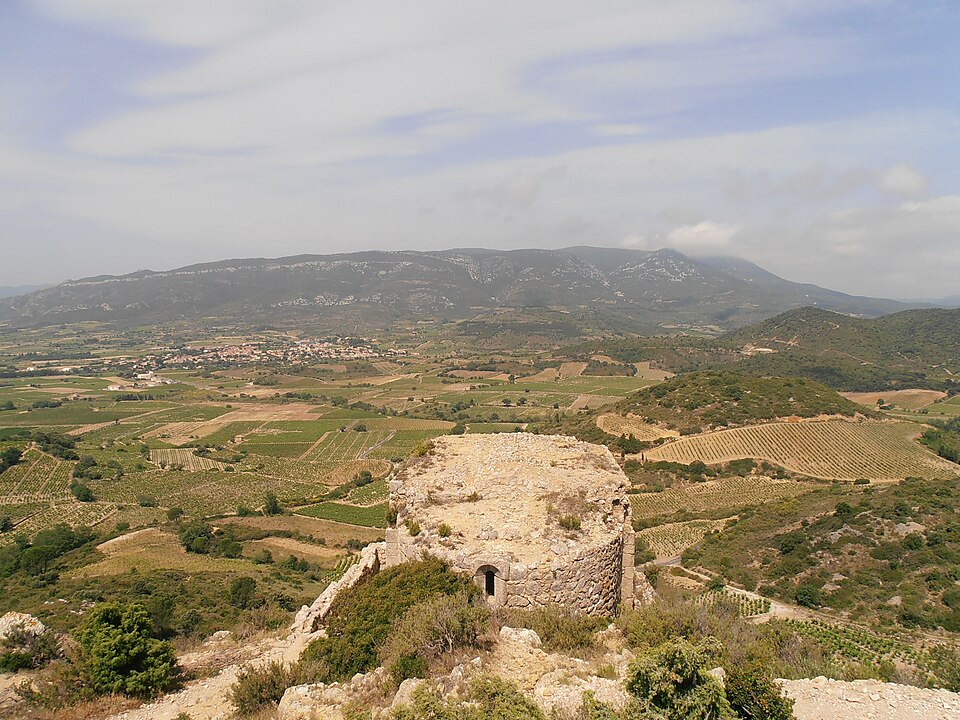
Le château d'Aguilar (Aguilar en occitan) est un château dit « cathare », situé à environ deux kilomètres à l'est du village de Tuchan, dans le département de l'Aude. C'est un château datant probablement du XIIe siècle dont la construction continue durant les XIIIe et XIVe siècles. Château féodal aux mains de la famille de Termes, il devient au XIIIe siècle une forteresse royale.
AUDE · Lastours
Lastours Castles
Perched on a rocky spur overlooking the Orbiel valley, the four castles of Lastours (Cabaret, Surdespine, Tour Régine, Quertinheux) form one of the most emblematic Cathar fortified ensembles of the Pays Cathare. Founded in the 11th century around the seigneury of Cabaret, they were the scene of Pierre-Roger de Cabaret's resistance against Simon de Montfort, before being razed and then rebuilt by the Crown after 1229. A tourist site listed as a historic monument, they offer guided visits, a discovery trail and an archaeological exhibition.
ARIEGE · Montségur
Château de Montségur
The Château de Montségur (Montsegur in Occitan) is a former fortified castle, known as a "Cathar" castle, rebuilt in 1206 but altered at the end of the 13th century. Its remains stand in the French commune of Montségur, in the Ariège department, in the Occitanie region.
AUDE · Duilhac-sous-Peyrepertuse
Château de Peyrepertuse
The Château de Peyrepertuse (in Occitan: Castèl de Pèirapertusa) is a former fortified castle known as a "Cathar castle", now in ruins, whose remains stand in the French commune of Duilhac-sous-Peyrepertuse in the Aude department, in the Occitanie region. It is the centre of the small district and former seigneury of Peyrepertusès (in Occitan: Pèirapertusés), from Pèira pertusa, meaning "pierced stone". The ruins of the castle were classified as a historic monument by decree of 19 March 1908. It is a candidate for inscription on the UNESCO World Heritage List. The listing of the castle and its surroundings as a natural site was repealed in favour of the 2017 classification of the site of the "Puech de Bugarach and the northern ridge of the Fenouillèdes syncline", which encompasses the castle.
AUDE · Cucugnan
Château de Quéribus
A stone sentinel rising 728 m above the vineyards of the Corbières, the Château de Quéribus occupies one of the most vertiginous sites in Cathar Country. Its slender silhouette culminates in a pentagonal keep whose elegant Gothic vaulted hall contrasts with the military austerity of the whole. The last great stronghold to hold out against the crusade against the Cathars, it fell in 1255, bringing to a close the Occitan epic that had begun at Montségur. Turned into a royal bulwark facing Aragon and then forgotten after 1659, it endured three centuries of ruin before being reborn through the restoration campaigns undertaken since 1951, and today remains one of the major sites of the Five Sons of Carcassonne network.
AUDE · Puilaurens
Château de Puilaurens
Rising like a stone sentinel atop Mont Ardu, the Château de Puilaurens towers from its rocky spur over the deep valley of the Boulzane, on the edge of the Fenouillèdes in the Aude. Born of a simple Carolingian fortified refuge attested as early as 958, at the height of the Middle Ages it became one of the kingdom's most formidable strongholds facing neighbouring Aragon, bristling with towers, chicanes and a barbican. A place of passage for fleeing Cathars before becoming a royal garrison under Saint Louis, it embodies the intertwined memory of the Albigensian Crusade and the building of France's frontier in the 13th century. Consigned to oblivion when the border shifted in 1659, it has preserved, beneath its romantic, ruined appearance, a defensive system of rare completeness. Owned by the commune of Puilaurens-Lapradelle, it is open to visitors from spring to autumn and is the subject of an extensive restoration programme that supports its candidacy, alongside the greatest Cathar sites, for inscription on the UNESCO World Heritage List.
AUDE · Termes
Château de Termes
Perched on an isolated rocky outcrop in the heart of the Corbières, overlooking the dizzying gorges of the Termenet, the Château de Termes embodies the archetype of the impregnable Cathar fortress, carved out of its karst surroundings. A fief of the powerful Termes family and a refuge of Catharism under Raymond de Termes, it passed into legend by holding out for sixteen weeks against Simon de Montfort's army in 1210, one of the most emblematic sieges of the Albigensian Crusade, brought to an end not by force of arms but by thirst and disease. Confiscated by the Crown and then rebuilt to become one of the "five sons of Carcassonne", it subsequently fell into slow decline until its methodical dismantling in 1653–1654. Purchased and restored by the commune since the late 1980s, the site today combines a visitor trail, active archaeological excavations and an educational presentation of Cathar history.
02
A network of fortresses rather than eight isolated monuments
The historical context of this inscription dates back to the Albigensian Crusade, waged in the early 13th century against the Cathar movement rooted in the Midi. At the end of this conflict, the French Crown — until then largely absent from the region — asserted its direct authority over former feudal territories. The inscribed fortresses bear witness to this shift: former seigneurial strongholds were reclaimed, transformed or rebuilt according to Capetian military architectural principles, forming the defensive backbone of a new administrative district, the sénéchaussée of Carcassonne. It is therefore not the religious function or the siege of a particular fortress that justifies their joint inscription on its own, but the coherence of this network: a chain of fortified points arranged according to a territorial and military logic, designed to monitor and control a southern border of the kingdom facing the Kingdom of Aragon.
AUDE · Carcassonne
Cité de Carcassonne
The Cité de Carcassonne is a medieval fortified town whose history spans more than 2,000 years, from the ancient ramparts of the Late Roman Empire to the royal double enclosure of the 13th century, by way of the comital castle of the Trencavel. Saved from ruin in the 19th century thanks to Cros-Mayrevieille, then restored by Viollet-le-Duc and Boeswillwald, it was inscribed on the UNESCO World Heritage List in 1997 — a date of listing, not of construction. Today the site combines a state-owned monument (managed by the Centre des Monuments Nationaux) and a living town under municipal ownership.
AUDE · Tuchan
Château d'Aguilar
Le château d'Aguilar (Aguilar en occitan) est un château dit « cathare », situé à environ deux kilomètres à l'est du village de Tuchan, dans le département de l'Aude. C'est un château datant probablement du XIIe siècle dont la construction continue durant les XIIIe et XIVe siècles. Château féodal aux mains de la famille de Termes, il devient au XIIIe siècle une forteresse royale.
AUDE · Lastours
Lastours Castles
Perched on a rocky spur overlooking the Orbiel valley, the four castles of Lastours (Cabaret, Surdespine, Tour Régine, Quertinheux) form one of the most emblematic Cathar fortified ensembles of the Pays Cathare. Founded in the 11th century around the seigneury of Cabaret, they were the scene of Pierre-Roger de Cabaret's resistance against Simon de Montfort, before being razed and then rebuilt by the Crown after 1229. A tourist site listed as a historic monument, they offer guided visits, a discovery trail and an archaeological exhibition.
ARIEGE · Montségur
Château de Montségur
The Château de Montségur (Montsegur in Occitan) is a former fortified castle, known as a "Cathar" castle, rebuilt in 1206 but altered at the end of the 13th century. Its remains stand in the French commune of Montségur, in the Ariège department, in the Occitanie region.
AUDE · Duilhac-sous-Peyrepertuse
Château de Peyrepertuse
The Château de Peyrepertuse (in Occitan: Castèl de Pèirapertusa) is a former fortified castle known as a "Cathar castle", now in ruins, whose remains stand in the French commune of Duilhac-sous-Peyrepertuse in the Aude department, in the Occitanie region. It is the centre of the small district and former seigneury of Peyrepertusès (in Occitan: Pèirapertusés), from Pèira pertusa, meaning "pierced stone". The ruins of the castle were classified as a historic monument by decree of 19 March 1908. It is a candidate for inscription on the UNESCO World Heritage List. The listing of the castle and its surroundings as a natural site was repealed in favour of the 2017 classification of the site of the "Puech de Bugarach and the northern ridge of the Fenouillèdes syncline", which encompasses the castle.
AUDE · Cucugnan
Château de Quéribus
A stone sentinel rising 728 m above the vineyards of the Corbières, the Château de Quéribus occupies one of the most vertiginous sites in Cathar Country. Its slender silhouette culminates in a pentagonal keep whose elegant Gothic vaulted hall contrasts with the military austerity of the whole. The last great stronghold to hold out against the crusade against the Cathars, it fell in 1255, bringing to a close the Occitan epic that had begun at Montségur. Turned into a royal bulwark facing Aragon and then forgotten after 1659, it endured three centuries of ruin before being reborn through the restoration campaigns undertaken since 1951, and today remains one of the major sites of the Five Sons of Carcassonne network.
AUDE · Puilaurens
Château de Puilaurens
Rising like a stone sentinel atop Mont Ardu, the Château de Puilaurens towers from its rocky spur over the deep valley of the Boulzane, on the edge of the Fenouillèdes in the Aude. Born of a simple Carolingian fortified refuge attested as early as 958, at the height of the Middle Ages it became one of the kingdom's most formidable strongholds facing neighbouring Aragon, bristling with towers, chicanes and a barbican. A place of passage for fleeing Cathars before becoming a royal garrison under Saint Louis, it embodies the intertwined memory of the Albigensian Crusade and the building of France's frontier in the 13th century. Consigned to oblivion when the border shifted in 1659, it has preserved, beneath its romantic, ruined appearance, a defensive system of rare completeness. Owned by the commune of Puilaurens-Lapradelle, it is open to visitors from spring to autumn and is the subject of an extensive restoration programme that supports its candidacy, alongside the greatest Cathar sites, for inscription on the UNESCO World Heritage List.
AUDE · Termes
Château de Termes
Perched on an isolated rocky outcrop in the heart of the Corbières, overlooking the dizzying gorges of the Termenet, the Château de Termes embodies the archetype of the impregnable Cathar fortress, carved out of its karst surroundings. A fief of the powerful Termes family and a refuge of Catharism under Raymond de Termes, it passed into legend by holding out for sixteen weeks against Simon de Montfort's army in 1210, one of the most emblematic sieges of the Albigensian Crusade, brought to an end not by force of arms but by thirst and disease. Confiscated by the Crown and then rebuilt to become one of the "five sons of Carcassonne", it subsequently fell into slow decline until its methodical dismantling in 1653–1654. Purchased and restored by the commune since the late 1980s, the site today combines a visitor trail, active archaeological excavations and an educational presentation of Cathar history.
03
Carcassonne, the heart of the system
The jewel in the crown of the ensemble, the fortified historic city of Carcassonne occupies a special place: its medieval urban architecture has been inscribed on the World Heritage List since 1997. With the 2026 inscription, the Château Comtal and the ramparts of Carcassonne join a second property, distinct in its logic: that of the Capetian defensive network of Languedoc, of which Carcassonne forms the administrative and military heart. Its double enceinte, construction of which began as early as 1228, exemplifies Capetian defensive expertise at its peak, bridging the gap between earlier fortification heritage and 13th-century military innovations.
04
Aguilar, sentinel of the eastern Corbières
In the eastern Corbières massif, about two kilometres from the village of Tuchan, the Château d'Aguilar overlooks the approaches to Roussillon from a hill dominating the surrounding vineyards. Of feudal origin — the site belonged to the Termes family — the fortress passed into royal hands in the 13th century and became one of the advanced sentinels of the Capetian system facing the Aragonese border.
05
Lastours, four castles on a single ridge
A distinctive feature of the network, Lastours does not refer to a single site but to a group of four distinct castles aligned along the same rocky ridge overlooking the Orbiel valley, north of Carcassonne. Today in ruins and still studied by archaeologists, these four fortresses bear witness, through their tight positioning on the same spur, to the strategic importance accorded to this bottleneck in the Montagne Noire within the Capetian defensive system.
06
Montségur, the sole Ariège site
The only one of the eight sites located in Ariège rather than Aude, the Château de Montségur crowns an isolated pog above the plain. The name of the place remains indissociable from the 1244 siege, one of the most documented episodes in the repression of Catharism in the region. Rebuilt after this event by the Crown, the fortress also illustrates how former feudal and religious resistance sites were reclaimed and redeveloped in the service of Capetian royal power.
07
Peyrepertuse, the fortress that clings to the ridge
The Château de Peyrepertuse stands out for its unusual development: the fortress stretches for several hundred metres along a limestone ridge in the Corbières, forming one of the most extensive fortified complexes in the network. This tight adaptation of architecture to the terrain, rather than sheer height, makes it one of the most spectacular examples of Capetian defensive engineering applied to a naturally inaccessible site.
08
Quéribus, the last bastion before Roussillon
Perched on an isolated crag in the Corbières, on the edge of Roussillon, the Château de Quéribus remained one of the last bastions under Occitan control after the Albigensian Crusade, before falling in 1255. Its position, overlooking the plain of Roussillon, made it a prime observation post on the southern border of the kingdom, a role confirmed by its integration into the royal system after its recapture.
09
Puilaurens, lock of the high Sault country
In the high Sault country, the Château de Puilaurens occupies a rocky spur difficult to access, on the border between the Corbières and the first foothills of the Pyrenees. Like several other sites in the network, this former feudal stronghold became, after its integration into the royal domain, a key support point in the Capetian defensive system in this frontier zone of the Midi.
010
Termes, the siege of 1210
The Château de Termes, nestled in a natural limestone cirque at the heart of the Corbières, was the scene of a siege led in 1210 by Simon de Montfort during the Albigensian Crusade. Its position, protected by the site's topography as much as by its fortifications, illustrates the challenge that the mountainous territory posed to the crusader armies and later to the Crown, before its full integration into the Capetian defensive network.
011
Why UNESCO recognises this ensemble
The inscription is based on two criteria of the World Heritage Convention: criterion (ii), which distinguishes properties that bear a significant exchange of influences on the development of architecture or technology, and criterion (iv), which recognises an eminent example of a type of construction illustrating a significant period of human history. UNESCO highlights the exceptional coherence of the Capetian defensive system built in the 13th and 14th centuries, as well as the authenticity of the sites, which have remained largely unchanged since their construction and serve as references for understanding medieval military architecture. It is also the landscape dimension of the ensemble that is recognised: the eight fortresses were built on rugged terrain — ridges, rocky crags, spurs — in mountain landscapes that have remained largely preserved, reinforcing the legibility of the defensive system in its original setting.
AUDE · Carcassonne
Cité de Carcassonne
The Cité de Carcassonne is a medieval fortified town whose history spans more than 2,000 years, from the ancient ramparts of the Late Roman Empire to the royal double enclosure of the 13th century, by way of the comital castle of the Trencavel. Saved from ruin in the 19th century thanks to Cros-Mayrevieille, then restored by Viollet-le-Duc and Boeswillwald, it was inscribed on the UNESCO World Heritage List in 1997 — a date of listing, not of construction. Today the site combines a state-owned monument (managed by the Centre des Monuments Nationaux) and a living town under municipal ownership.
AUDE · Tuchan
Château d'Aguilar
Le château d'Aguilar (Aguilar en occitan) est un château dit « cathare », situé à environ deux kilomètres à l'est du village de Tuchan, dans le département de l'Aude. C'est un château datant probablement du XIIe siècle dont la construction continue durant les XIIIe et XIVe siècles. Château féodal aux mains de la famille de Termes, il devient au XIIIe siècle une forteresse royale.
AUDE · Lastours
Lastours Castles
Perched on a rocky spur overlooking the Orbiel valley, the four castles of Lastours (Cabaret, Surdespine, Tour Régine, Quertinheux) form one of the most emblematic Cathar fortified ensembles of the Pays Cathare. Founded in the 11th century around the seigneury of Cabaret, they were the scene of Pierre-Roger de Cabaret's resistance against Simon de Montfort, before being razed and then rebuilt by the Crown after 1229. A tourist site listed as a historic monument, they offer guided visits, a discovery trail and an archaeological exhibition.
ARIEGE · Montségur
Château de Montségur
The Château de Montségur (Montsegur in Occitan) is a former fortified castle, known as a "Cathar" castle, rebuilt in 1206 but altered at the end of the 13th century. Its remains stand in the French commune of Montségur, in the Ariège department, in the Occitanie region.
AUDE · Duilhac-sous-Peyrepertuse
Château de Peyrepertuse
The Château de Peyrepertuse (in Occitan: Castèl de Pèirapertusa) is a former fortified castle known as a "Cathar castle", now in ruins, whose remains stand in the French commune of Duilhac-sous-Peyrepertuse in the Aude department, in the Occitanie region. It is the centre of the small district and former seigneury of Peyrepertusès (in Occitan: Pèirapertusés), from Pèira pertusa, meaning "pierced stone". The ruins of the castle were classified as a historic monument by decree of 19 March 1908. It is a candidate for inscription on the UNESCO World Heritage List. The listing of the castle and its surroundings as a natural site was repealed in favour of the 2017 classification of the site of the "Puech de Bugarach and the northern ridge of the Fenouillèdes syncline", which encompasses the castle.
AUDE · Cucugnan
Château de Quéribus
A stone sentinel rising 728 m above the vineyards of the Corbières, the Château de Quéribus occupies one of the most vertiginous sites in Cathar Country. Its slender silhouette culminates in a pentagonal keep whose elegant Gothic vaulted hall contrasts with the military austerity of the whole. The last great stronghold to hold out against the crusade against the Cathars, it fell in 1255, bringing to a close the Occitan epic that had begun at Montségur. Turned into a royal bulwark facing Aragon and then forgotten after 1659, it endured three centuries of ruin before being reborn through the restoration campaigns undertaken since 1951, and today remains one of the major sites of the Five Sons of Carcassonne network.
AUDE · Puilaurens
Château de Puilaurens
Rising like a stone sentinel atop Mont Ardu, the Château de Puilaurens towers from its rocky spur over the deep valley of the Boulzane, on the edge of the Fenouillèdes in the Aude. Born of a simple Carolingian fortified refuge attested as early as 958, at the height of the Middle Ages it became one of the kingdom's most formidable strongholds facing neighbouring Aragon, bristling with towers, chicanes and a barbican. A place of passage for fleeing Cathars before becoming a royal garrison under Saint Louis, it embodies the intertwined memory of the Albigensian Crusade and the building of France's frontier in the 13th century. Consigned to oblivion when the border shifted in 1659, it has preserved, beneath its romantic, ruined appearance, a defensive system of rare completeness. Owned by the commune of Puilaurens-Lapradelle, it is open to visitors from spring to autumn and is the subject of an extensive restoration programme that supports its candidacy, alongside the greatest Cathar sites, for inscription on the UNESCO World Heritage List.
AUDE · Termes
Château de Termes
Perched on an isolated rocky outcrop in the heart of the Corbières, overlooking the dizzying gorges of the Termenet, the Château de Termes embodies the archetype of the impregnable Cathar fortress, carved out of its karst surroundings. A fief of the powerful Termes family and a refuge of Catharism under Raymond de Termes, it passed into legend by holding out for sixteen weeks against Simon de Montfort's army in 1210, one of the most emblematic sieges of the Albigensian Crusade, brought to an end not by force of arms but by thirst and disease. Confiscated by the Crown and then rebuilt to become one of the "five sons of Carcassonne", it subsequently fell into slow decline until its methodical dismantling in 1653–1654. Purchased and restored by the commune since the late 1980s, the site today combines a visitor trail, active archaeological excavations and an educational presentation of Cathar history.
012
A new visibility for the castles of Languedoc
Beyond the international recognition it confers, this inscription ushers in a new phase of cooperation among the managers of the eight sites, which have hitherto often been promoted separately. It should also foster archaeological and historical research on this ensemble, as well as public mediation actions to better convey the coherence of a network long reduced, in the collective imagination, to the sole memory of Catharism. The conservation responsibility that accompanies this status now engages the State, the local authorities of Occitanie and the managers of each of the eight monuments. One final note on terminology: while the expression 'Cathar castles' remains widely used and understandable to the general public, it does not correspond to the name chosen by UNESCO. The fortresses of Languedoc are indeed linked to the history of Catharism and its repression, but their heritage recognition focuses above all on their role in the construction of Capetian royal power in Languedoc — hence the official name of 'Capetian Royal Fortresses of Languedoc'.
AUDE · Carcassonne
Cité de Carcassonne
The Cité de Carcassonne is a medieval fortified town whose history spans more than 2,000 years, from the ancient ramparts of the Late Roman Empire to the royal double enclosure of the 13th century, by way of the comital castle of the Trencavel. Saved from ruin in the 19th century thanks to Cros-Mayrevieille, then restored by Viollet-le-Duc and Boeswillwald, it was inscribed on the UNESCO World Heritage List in 1997 — a date of listing, not of construction. Today the site combines a state-owned monument (managed by the Centre des Monuments Nationaux) and a living town under municipal ownership.
AUDE · Tuchan
Château d'Aguilar
Le château d'Aguilar (Aguilar en occitan) est un château dit « cathare », situé à environ deux kilomètres à l'est du village de Tuchan, dans le département de l'Aude. C'est un château datant probablement du XIIe siècle dont la construction continue durant les XIIIe et XIVe siècles. Château féodal aux mains de la famille de Termes, il devient au XIIIe siècle une forteresse royale.
AUDE · Lastours
Lastours Castles
Perched on a rocky spur overlooking the Orbiel valley, the four castles of Lastours (Cabaret, Surdespine, Tour Régine, Quertinheux) form one of the most emblematic Cathar fortified ensembles of the Pays Cathare. Founded in the 11th century around the seigneury of Cabaret, they were the scene of Pierre-Roger de Cabaret's resistance against Simon de Montfort, before being razed and then rebuilt by the Crown after 1229. A tourist site listed as a historic monument, they offer guided visits, a discovery trail and an archaeological exhibition.
ARIEGE · Montségur
Château de Montségur
The Château de Montségur (Montsegur in Occitan) is a former fortified castle, known as a "Cathar" castle, rebuilt in 1206 but altered at the end of the 13th century. Its remains stand in the French commune of Montségur, in the Ariège department, in the Occitanie region.
AUDE · Duilhac-sous-Peyrepertuse
Château de Peyrepertuse
The Château de Peyrepertuse (in Occitan: Castèl de Pèirapertusa) is a former fortified castle known as a "Cathar castle", now in ruins, whose remains stand in the French commune of Duilhac-sous-Peyrepertuse in the Aude department, in the Occitanie region. It is the centre of the small district and former seigneury of Peyrepertusès (in Occitan: Pèirapertusés), from Pèira pertusa, meaning "pierced stone". The ruins of the castle were classified as a historic monument by decree of 19 March 1908. It is a candidate for inscription on the UNESCO World Heritage List. The listing of the castle and its surroundings as a natural site was repealed in favour of the 2017 classification of the site of the "Puech de Bugarach and the northern ridge of the Fenouillèdes syncline", which encompasses the castle.
AUDE · Cucugnan
Château de Quéribus
A stone sentinel rising 728 m above the vineyards of the Corbières, the Château de Quéribus occupies one of the most vertiginous sites in Cathar Country. Its slender silhouette culminates in a pentagonal keep whose elegant Gothic vaulted hall contrasts with the military austerity of the whole. The last great stronghold to hold out against the crusade against the Cathars, it fell in 1255, bringing to a close the Occitan epic that had begun at Montségur. Turned into a royal bulwark facing Aragon and then forgotten after 1659, it endured three centuries of ruin before being reborn through the restoration campaigns undertaken since 1951, and today remains one of the major sites of the Five Sons of Carcassonne network.
AUDE · Puilaurens
Château de Puilaurens
Rising like a stone sentinel atop Mont Ardu, the Château de Puilaurens towers from its rocky spur over the deep valley of the Boulzane, on the edge of the Fenouillèdes in the Aude. Born of a simple Carolingian fortified refuge attested as early as 958, at the height of the Middle Ages it became one of the kingdom's most formidable strongholds facing neighbouring Aragon, bristling with towers, chicanes and a barbican. A place of passage for fleeing Cathars before becoming a royal garrison under Saint Louis, it embodies the intertwined memory of the Albigensian Crusade and the building of France's frontier in the 13th century. Consigned to oblivion when the border shifted in 1659, it has preserved, beneath its romantic, ruined appearance, a defensive system of rare completeness. Owned by the commune of Puilaurens-Lapradelle, it is open to visitors from spring to autumn and is the subject of an extensive restoration programme that supports its candidacy, alongside the greatest Cathar sites, for inscription on the UNESCO World Heritage List.
AUDE · Termes
Château de Termes
Perched on an isolated rocky outcrop in the heart of the Corbières, overlooking the dizzying gorges of the Termenet, the Château de Termes embodies the archetype of the impregnable Cathar fortress, carved out of its karst surroundings. A fief of the powerful Termes family and a refuge of Catharism under Raymond de Termes, it passed into legend by holding out for sixteen weeks against Simon de Montfort's army in 1210, one of the most emblematic sieges of the Albigensian Crusade, brought to an end not by force of arms but by thirst and disease. Confiscated by the Crown and then rebuilt to become one of the "five sons of Carcassonne", it subsequently fell into slow decline until its methodical dismantling in 1653–1654. Purchased and restored by the commune since the late 1980s, the site today combines a visitor trail, active archaeological excavations and an educational presentation of Cathar history.
013
Sources
This article is based on the official file of the inscribed property, published by the UNESCO World Heritage Centre (whc.unesco.org/en/list/1755/), as well as on press releases from the French Ministry of Culture and the Occitanie Regional Directorate of Cultural Affairs (culture.gouv.fr) announcing the inscription on 26 July 2026.
AUDE · Carcassonne
Cité de Carcassonne
The Cité de Carcassonne is a medieval fortified town whose history spans more than 2,000 years, from the ancient ramparts of the Late Roman Empire to the royal double enclosure of the 13th century, by way of the comital castle of the Trencavel. Saved from ruin in the 19th century thanks to Cros-Mayrevieille, then restored by Viollet-le-Duc and Boeswillwald, it was inscribed on the UNESCO World Heritage List in 1997 — a date of listing, not of construction. Today the site combines a state-owned monument (managed by the Centre des Monuments Nationaux) and a living town under municipal ownership.
AUDE · Tuchan
Château d'Aguilar
Le château d'Aguilar (Aguilar en occitan) est un château dit « cathare », situé à environ deux kilomètres à l'est du village de Tuchan, dans le département de l'Aude. C'est un château datant probablement du XIIe siècle dont la construction continue durant les XIIIe et XIVe siècles. Château féodal aux mains de la famille de Termes, il devient au XIIIe siècle une forteresse royale.
AUDE · Lastours
Lastours Castles
Perched on a rocky spur overlooking the Orbiel valley, the four castles of Lastours (Cabaret, Surdespine, Tour Régine, Quertinheux) form one of the most emblematic Cathar fortified ensembles of the Pays Cathare. Founded in the 11th century around the seigneury of Cabaret, they were the scene of Pierre-Roger de Cabaret's resistance against Simon de Montfort, before being razed and then rebuilt by the Crown after 1229. A tourist site listed as a historic monument, they offer guided visits, a discovery trail and an archaeological exhibition.
ARIEGE · Montségur
Château de Montségur
The Château de Montségur (Montsegur in Occitan) is a former fortified castle, known as a "Cathar" castle, rebuilt in 1206 but altered at the end of the 13th century. Its remains stand in the French commune of Montségur, in the Ariège department, in the Occitanie region.
AUDE · Duilhac-sous-Peyrepertuse
Château de Peyrepertuse
The Château de Peyrepertuse (in Occitan: Castèl de Pèirapertusa) is a former fortified castle known as a "Cathar castle", now in ruins, whose remains stand in the French commune of Duilhac-sous-Peyrepertuse in the Aude department, in the Occitanie region. It is the centre of the small district and former seigneury of Peyrepertusès (in Occitan: Pèirapertusés), from Pèira pertusa, meaning "pierced stone". The ruins of the castle were classified as a historic monument by decree of 19 March 1908. It is a candidate for inscription on the UNESCO World Heritage List. The listing of the castle and its surroundings as a natural site was repealed in favour of the 2017 classification of the site of the "Puech de Bugarach and the northern ridge of the Fenouillèdes syncline", which encompasses the castle.
AUDE · Cucugnan
Château de Quéribus
A stone sentinel rising 728 m above the vineyards of the Corbières, the Château de Quéribus occupies one of the most vertiginous sites in Cathar Country. Its slender silhouette culminates in a pentagonal keep whose elegant Gothic vaulted hall contrasts with the military austerity of the whole. The last great stronghold to hold out against the crusade against the Cathars, it fell in 1255, bringing to a close the Occitan epic that had begun at Montségur. Turned into a royal bulwark facing Aragon and then forgotten after 1659, it endured three centuries of ruin before being reborn through the restoration campaigns undertaken since 1951, and today remains one of the major sites of the Five Sons of Carcassonne network.
AUDE · Puilaurens
Château de Puilaurens
Rising like a stone sentinel atop Mont Ardu, the Château de Puilaurens towers from its rocky spur over the deep valley of the Boulzane, on the edge of the Fenouillèdes in the Aude. Born of a simple Carolingian fortified refuge attested as early as 958, at the height of the Middle Ages it became one of the kingdom's most formidable strongholds facing neighbouring Aragon, bristling with towers, chicanes and a barbican. A place of passage for fleeing Cathars before becoming a royal garrison under Saint Louis, it embodies the intertwined memory of the Albigensian Crusade and the building of France's frontier in the 13th century. Consigned to oblivion when the border shifted in 1659, it has preserved, beneath its romantic, ruined appearance, a defensive system of rare completeness. Owned by the commune of Puilaurens-Lapradelle, it is open to visitors from spring to autumn and is the subject of an extensive restoration programme that supports its candidacy, alongside the greatest Cathar sites, for inscription on the UNESCO World Heritage List.
AUDE · Termes
Château de Termes
Perched on an isolated rocky outcrop in the heart of the Corbières, overlooking the dizzying gorges of the Termenet, the Château de Termes embodies the archetype of the impregnable Cathar fortress, carved out of its karst surroundings. A fief of the powerful Termes family and a refuge of Catharism under Raymond de Termes, it passed into legend by holding out for sixteen weeks against Simon de Montfort's army in 1210, one of the most emblematic sieges of the Albigensian Crusade, brought to an end not by force of arms but by thirst and disease. Confiscated by the Crown and then rebuilt to become one of the "five sons of Carcassonne", it subsequently fell into slow decline until its methodical dismantling in 1653–1654. Purchased and restored by the commune since the late 1980s, the site today combines a visitor trail, active archaeological excavations and an educational presentation of Cathar history.
The route on the map
The eight Capetian royal fortresses of Languedoc inscribed on the UNESCO World Heritage List
From Carcassonne to the hilltop fortresses of the Corbières and Pyrenees, discover the eight components of the property inscribed on the World Heritage List in 2026.
Markers follow the suggested visiting order. Select a castle to open its page.