
The heritage rescue of the Château de Villers-Cotterêts, now the Cité internationale de la langue française
Villers-Cotterêts: how an abandoned château became one of France’s grandest heritage projects
Abandoned since 2014, the Château de Villers-Cotterêts has undergone one of France’s most significant heritage restoration projects before becoming the Cité internationale de la langue française. A tale of rescue, on the occasion of the 2026 Heritage Open Days.
Editorial journal · Carte des Châteaux ·
On 19 and 20 September 2026, as part of European Heritage Open Days, the Cité internationale de la langue française invites the public to explore the behind-the-scenes story of the colossal restoration project that saved the Château de Villers-Cotterêts. For before it became this cultural hub dedicated to the French language, inaugurated in 2023, this Renaissance jewel born under François Ier nearly vanished: left entirely abandoned in 2014, it was little more than a crumbling shell hidden behind construction tarpaulins just a few years before its rebirth. Here is the story of this heritage rescue, from the signing of the 1539 ordinance to the cranes that breathed new life into the monument.
01
A château born in the shadow of a duchy
The fame of the Forest of Retz in Aisne dates back centuries: as early as the 7th century, King Dagobert I hunted here. His successors also cherished this game-rich woodland, building an unassuming residence, the medieval Château de la Malmaison. The site’s grand history truly begins with the future François Ier, who received the Duchy of Valois — and the château — from his cousin King Louis XII when he was just three years old. Villers-Cotterêts, then a simple village, held the geographical heart of this duchy, from which the dynasty of François Ier originated. In 1528, upon his return from captivity in Madrid, François Ier decided to spend more time in Île-de-France and chose this site, charmed by its lush forest. Construction of a royal residence was commissioned between 1528 and 1532, entrusted to Parisian master masons Jacques and Guillaume Lebreton. As at Saint-Germain-en-Laye or Fontainebleau, some walls and foundations of the medieval château, ruined by the Hundred Years’ War, were integrated into the new buildings — hence the asymmetrical layout of the royal lodgings.
02
François Ier, builder of a Renaissance palace
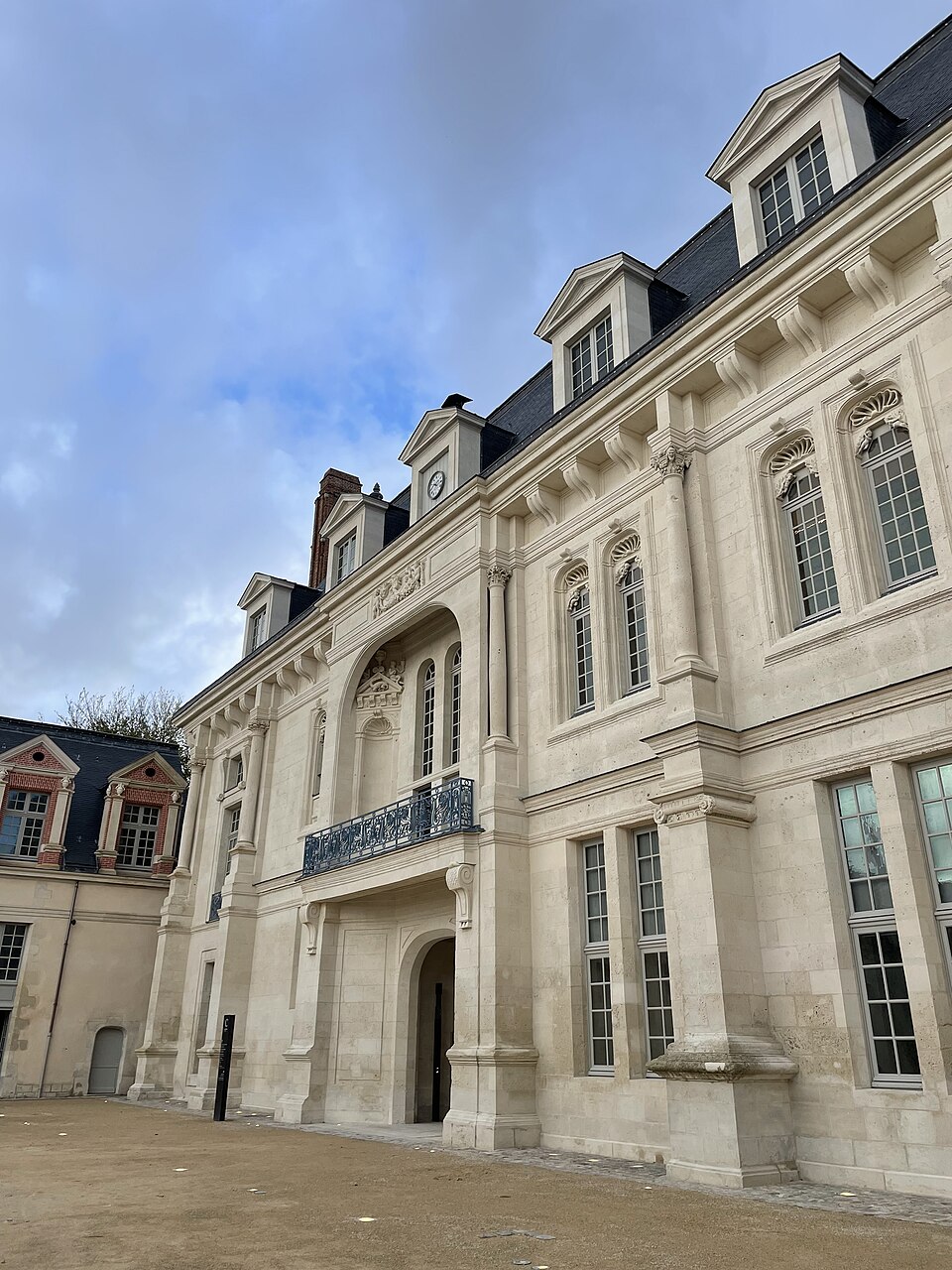
Funded by the sale of timber from the forest, construction spanned the reigns of François Ier and Henri II, with the most intensive phase between 1532 and 1540; the building was completed around 1556. The southern façade, featuring a loggia topped by a portrait of François Ier wearing the collar of the Order of Saint-Michel, is attributed to Philibert de l'Orme, who would later become the first architect of King Henri II. A masterpiece of its era, the château’s chapel was the first in France to break with Gothic tradition: as a symbol of royal power, the king’s emblems — salamanders, fleur-de-lys, crowned initials — replaced the usual Christian symbols in a place of worship. It was at the end of this intense construction period, in August 1539, that François Ier signed the so-called Ordinance of Villers-Cotterêts at the château, mandating the use of French in place of Latin for all administrative and judicial acts in the kingdom. This foundational act, etched into these very walls, would later justify the château’s transformation into a major cultural project dedicated to the French language.
03
A château through the centuries, from Molière to a retirement home
After François Ier, the château enjoyed several lives. In 1661, Louis XIV gifted it to his brother Philippe d’Orléans, known as ‘Monsieur’, on the occasion of his marriage to Henriette of England: the Orléans family hosted lavish festivities here, and Molière premiered Tartuffe at Villers-Cotterêts in 1664. André Le Nôtre, the renowned gardener of Versailles, redesigned the park at Philippe d’Orléans’ request. Louis XV also stayed here in 1722. The Revolution turned the château into national property. Napoleon transformed it in 1804 into a workhouse, serving as both a prison and an almshouse. In 1889, it became a retirement home — a function it retained until 2014. These centuries of successive uses, far removed from its original purpose, left deep scars on the structure: partitions added, floors inserted, decorations covered or destroyed.
04
2014–2018: the slow decline of a forgotten monument
In 2014, the retirement home closed its doors for good. The château was left entirely abandoned. ‘I remembered the building as rather neglected, but when I revisited it 30 years later, I found it in a truly lamentable state,’ recalls Olivier Weets, the chief architect of historic monuments tasked with its restoration, as quoted by France 3 Régions. At the time, the regional heritage authority (Drac) had only carried out minimal safety measures. The rescue began in 2017–2018. During a visit to the château in March 2017 as part of his presidential campaign, Emmanuel Macron announced, following his election, on 20 March 2018, his intention to make the monument a ‘symbolic pillar’ of the Francophonie. The state acquired the château for a symbolic one euro in 2018 from the Aisne Department, which had owned it, and entrusted its restoration to the Centre des monuments nationaux (CMN).
05
An exceptional restoration: three years to save a giant
From 2019 onwards, an ambitious restoration project was launched across the 23,000 m² of buildings, courtyards and parkland that make up the estate. Prior to the works, preventive archaeological excavations were conducted by Inrap and the Aisne archaeological service between May and August 2020, and in subsequent campaigns, particularly in the Jeu de Paume courtyard and the Cour des Offices (3,700 m² explored). These revealed much of the layout of the medieval Château de la Malmaison and showed that the Renaissance building rests on the foundations of this structure, which was demolished in the early 16th century. The restoration work itself, which began in 2020 under the direction of chief architect of historic monuments Olivier Weets, involved rehabilitating around 3,600 m² of roofs, 280 windows and 3,300 m² of floors, according to figures released by AFP in 2021. In total, the project mobilised nearly 600 craftsmen and over 200 companies. The cost, initially estimated at €110 million, ultimately reached €211 million according to France 3 Régions — as the building proved far more degraded than anticipated — with funding almost entirely provided by the state. Three years of work later, the Minister of Culture described the project as one of the most significant restoration efforts ever undertaken in France on a historic monument of this scale.
06
Preserving, restoring, reinstating: the choices behind a heritage rescue
Restoring a monument so heavily altered required difficult decisions. According to the Centre des monuments nationaux, the restoration prioritised surviving Renaissance elements, as well as 17th- and especially 18th-century additions that had earned the monument its listing as a historic landmark in 1997. In the south wing of the royal lodgings, the King’s Staircase — adorned with a coffered ceiling featuring the royal ‘F’, salamanders and floral figures — and the Queen’s Staircase, with its mythological and allegorical decorations, were restored to their original designs. In the chapel, the 18th-century floor added by the Duke of Orléans was removed to restore its original volume and ribbed wooden vault. Conversely, the exterior façades of the royal lodgings were restored to their late 18th-century appearance rather than their original Renaissance state — a deliberate choice by the CMN to remain faithful to the best-documented historical layer. Inside, where little remained of the past after two centuries as a prison, almshouse and then retirement home, the partitions added over time were removed, freeing up space for contemporary features — such as the modern glass canopy designed by Eiffage Métal, which now covers the former Jeu de Paume courtyard with its intricate bespoke geometry, topped by a ‘lexical sky’ of projected words at night. The Jeu de Paume building itself was restored to its original exterior, while its interior was transformed into an auditorium.
07
What visitors can discover today
The Cité internationale de la langue française was inaugurated on 30 October 2023 and opened to the public on 1 November 2023. The permanent exhibition spans around 1,600 m² across fourteen rooms, organised around the global spread of French, its mechanics and its political dimension — featuring around 100 artworks, objects and documents, and some 60 audiovisual and digital installations. The tour continues through the chapel and the Queen’s Staircase with its Renaissance decorations, before leading out into the 53-hectare park. The building also houses a 250-seat auditorium installed in the former Jeu de Paume, as well as artist, researcher and entrepreneur residency workshops on the second floor of the royal lodgings. In its first year of opening, the monument welcomed over 53,000 visitors, according to figures provided by one of the contractors involved in the restoration.
08
Why this restoration remains a heritage benchmark
With its scale — 23,000 m² of estate restored, over €200 million invested, 600 craftsmen mobilised over three years — the restoration of the Château de Villers-Cotterêts has been hailed by the Centre des monuments nationaux as one of France’s greatest heritage projects of its time. ‘It was our duty to save this château of François Ier; it is our honour to have succeeded in less than five years, following a colossal restoration,’ declared the CMN at the inauguration, as quoted by the Ministry of Culture. It is precisely this restoration — its challenges, archaeological discoveries and restoration choices — that the Cité internationale de la langue française will showcase during European Heritage Open Days 2026, under the national theme of ‘Heritage in Peril’: on 19 and 20 September, guided tours will reveal the behind-the-scenes story of the restoration, offering visitors a glimpse of the near-ruinous state from which the monument was rescued.
Sources