
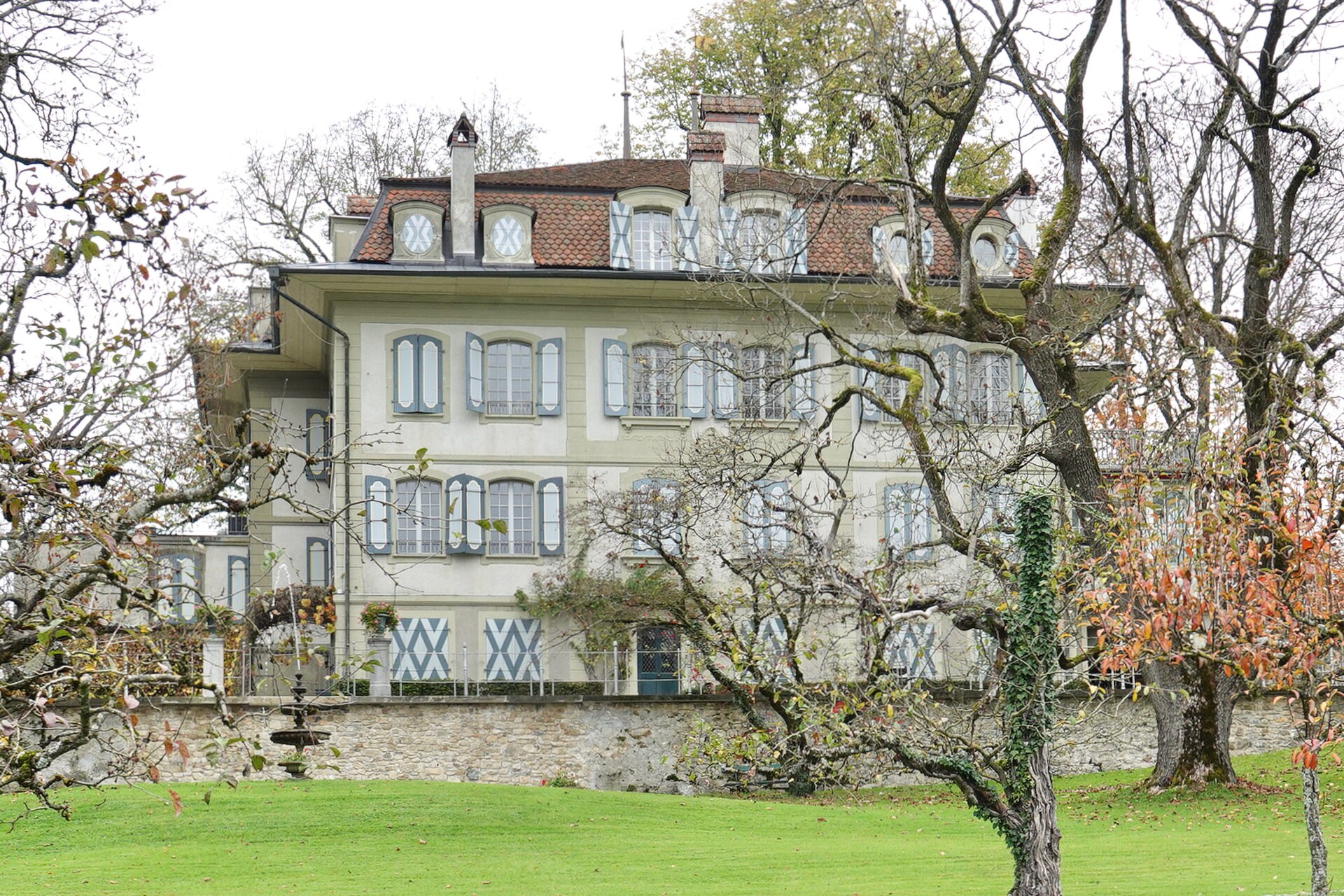
Muri Castle, Muri bei Bern

Muri bei Bern canton de Berne Suisse

Muri Castle

Muri Castle stands on the Muri hill, above the church, in the residential suburbs of Bern.

Époque
vers 1650
Préparer la visite

En un regard

Le château en bref

Muri Castle stands on the Muri hill, above the church, in the residential suburbs of Bern. An older manor house probably occupied the site in the sixteenth century; the present building dates from a reconstruction in the mid-seventeenth century (around 1650–1658 according to sources) for Johann Rudolf von Diesbach, colonel of the Swiss Guards in France and later bailiff of Lenzburg, who began acquiring extensive land in the municipality from 1650. A watercolour by Albrecht Kauw from 1670 preserves its appearance: a compact building flanked by a pointed stair tower. The estate then passed to the Mülinen family (1695), to Abraham Henggi (1758), to the physician Samuel Lehmann (1825), and finally to the banker Ludwig Emanuel von Wagner, who enlarged and remodelled it in 1851–1854. It has remained in the von Ernst family since then, through successive inheritances, down to Catherine Stankiewicz-von Ernst in 1980. As a privately owned property, the castle is not open to visitors.

Époque de construction
vers 1650
Localisation
Muri bei Bern, canton de Berne
Accès au public
Propriété privée

Pourquoi le découvrir

Trois raisons de découvrir Muri Castle

  1. Reconstruit vers 1650 pour Johann Rudolf von Diesbach

    Lire son histoire
  2. Tour principale refaite à partir de 1758

    Parcourir la chronologie
  3. Agrandi en 1851-1854

    Observer l’architecture

Récit

Une histoire à travers les siècles

Le récit

L’histoire de Muri Castle

Un manoir plus ancien occupait probablement le site au XVIe siècle. Vers 1650, le château est reconstruit pour Johann Rudolf von Diesbach, colonel des gardes suisses en France, qui achète des terrains entre 1650 et 1652.

Lire la suiteRéduire

Propriétaires suivants : Albrecht von Mülinen (1695, famille jusqu'en 1758), Abraham Henggi (1758), le médecin Samuel Lehmann (1825), puis Ludwig Emanuel von Wagner (vers 1849), qui agrandit et reconstruit le château en 1851-1854. Il passe en 1892 à sa fille Louise Fanny von Ernst, puis à la famille von Ernst (Alfred Alexander Ludwig Armand von Ernst en 1938, Catherine Stankiewicz-von Ernst en 1980). Pendant la Révolution, le comte d'Artois, futur Charles X, y aurait résidé en exil. Propriété privée.
L’architecture

Ce qu’il faut observer

Une vue de Kauw de 1670 montre un bâtiment compact à tour d'escalier pointue et une dépendance allongée. La tour principale est reconstruite à partir de 1758 par Henggi, puis le château est remanié et agrandi en 1851-1854.

Aujourd’hui

Propriété et usages actuels

Propriété privée, non ouverte au public.

Chronologie

Les étapes de construction

Les campagnes documentées qui ont façonné le monument, période par période.

Grand Siècle & Lumières

  1. vers 1650

    Reconstruction

    Reconstruction pour Johann Rudolf von Diesbach.

Informations pratiques

Préparer sa visite

Propriété privée

Les conditions d’accès ne sont pas documentées : renseignez-vous avant toute visite.

Vous l’avez visité ?

Partagez vos photos

Après relecture, votre photo illustrera cette fiche, créditée à votre nom. Haute définition bienvenue, jusqu’à 40 Mo.

Propriétaires et gestionnaires

Vous gérez Muri Castle ?

Horaires, tarifs et réservation manquent encore sur cette fiche. Transmettez-les et mettez le château en avant auprès des visiteurs qui préparent leur venue.