Wégimont Castle, Soumagne

Soumagne Wallonie Belgique

Wégimont Castle

Wégimont Castle stands in Ayeneux, a district of Soumagne (Province of Liège), in the middle of a 22-hectare wooded park that has become a provincial estate.

Époque
XVe siècle
Préparer la visite

En un regard

Le château en bref

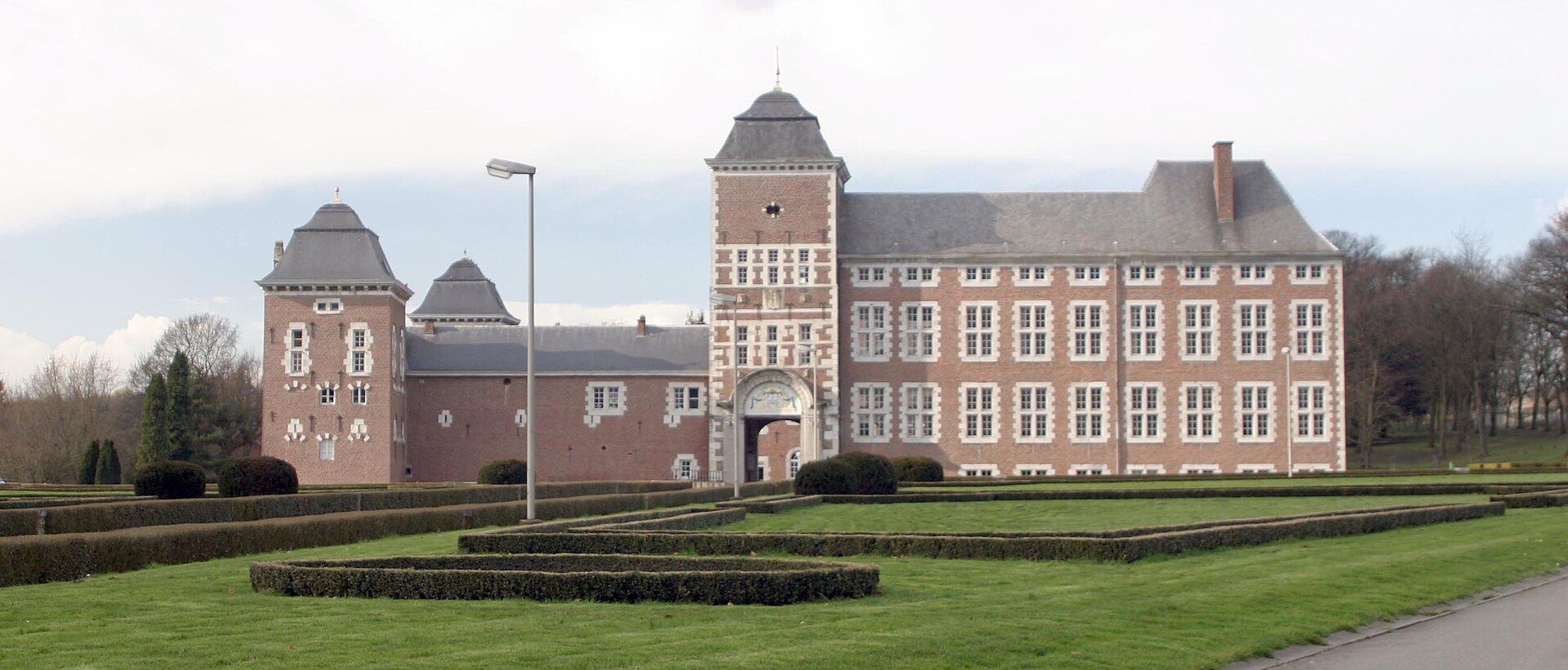
Wégimont Castle stands in Ayeneux, a district of Soumagne (Province of Liège), in the middle of a 22-hectare wooded park that has become a provincial estate. A former seigneurial castle surrounded by a moat and a glacis, it owes its name, according to a tourist brochure, to the first known occupant of the site, a certain Wigger, mentioned in 1190, while its origins seem to date back to the 15th century according to the regional heritage inventory. Of the ensemble that existed before the fire of 1964, the entrance tower of 1614 survives, preceded by a fixed bridge and pierced by an arched porch in the baroque style, along with the ends of the northern and southern side wings and the terrace that once ran along the main residential block to the east, which has since disappeared. The oldest surviving part is a tower with two Gothic windows, to the north. Partially destroyed in 1636 and enlarged in the 17th and 18th centuries, the castle passed from the Aspremont Lynden and then the Oultremont families to the Province of Liège, which opened a provincial estate there in 1938. It is now fitted out as an accommodation centre.

À remarquer

  • Tour d'entrée de 1614
  • Douves et glacis
  • Porche cintré baroque
  • Terrasse
  • Tour à fenêtres gothiques
Tous les éléments architecturaux
Époque de construction
XVe siècle
Localisation
Soumagne, Wallonie
Usage actuel
Domaine provincial de Wégimont (province de Liège) : château aménagé en centre d'hébergement, au cœur d'un parc de 22 ha avec activités de loisirs.

Récit

Une histoire à travers les siècles

Le récit

L’histoire de Wégimont Castle

Les origines du château remontent peut-être au XVe siècle. Une partie en fut détruite en 1636 par les Grignoux, puis il fut agrandi aux XVIIe et XVIIIe siècles. Il appartint aux familles d'Aspremont Lynden puis d'Oultremont avant de devenir propriété de la province de Liège en 1920. Un incendie en 1964 a détruit l'aile principale d'habitation, côté est, et la toiture est perdue.

L’architecture

Ce qu’il faut observer

Le château est ceint de douves et d'un glacis, dans un parc à étangs. La tour d'entrée (1614) est en moellons, tuffeau, brique et calcaire, avec porche en arc, décor de stuc, armoiries sculptées et pigeonnier à l'étage. La chapelle de 1671 et l'ancienne chapelle carmélitaine du Fond des Gottes (caveau d'Oultremont) complètent l'ensemble.

Chronologie

Les étapes de construction

Les campagnes documentées qui ont façonné le monument, période par période.

Moyen Âge

  1. XVe siècle

    ConstructionDatation à confirmer

    Origine du château, qui semble remonter au XVe siècle ; le fief comptait alors une tour et quelques dépendances.

Informations pratiques

Préparer sa visite

Conditions de visite non renseignées

Nous n’avons pas encore d’information vérifiée sur l’ouverture au public. Renseignez-vous auprès du site officiel ou de la mairie avant de vous déplacer.

Vous l’avez visité ?

Partagez vos photos

Après relecture, votre photo illustrera cette fiche, créditée à votre nom. Haute définition bienvenue, jusqu’à 40 Mo.

Propriétaires et gestionnaires

Vous gérez Wégimont Castle ?

Horaires, tarifs et réservation manquent encore sur cette fiche. Transmettez-les et mettez le château en avant auprès des visiteurs qui préparent leur venue.