En un regard
Le château en bref
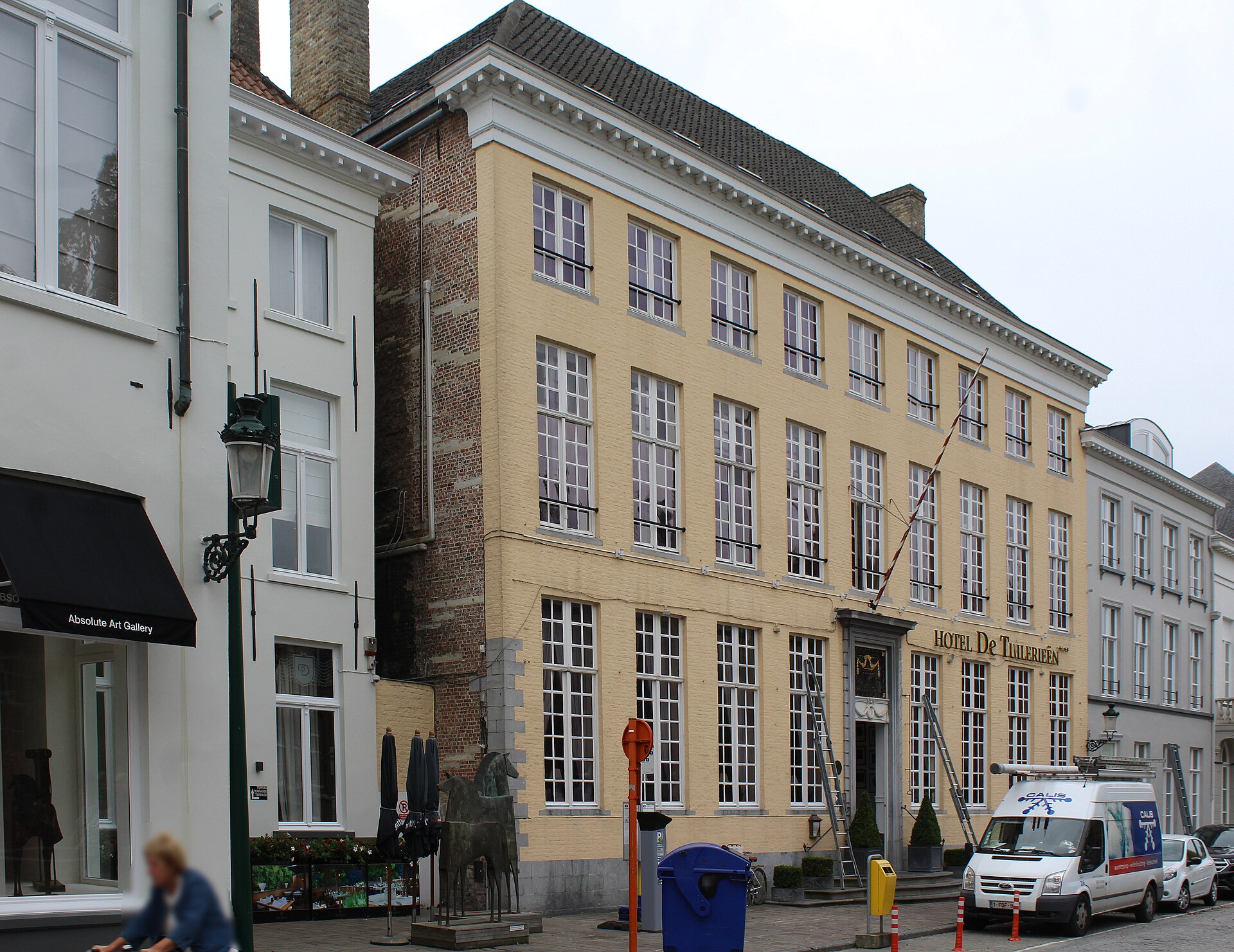
At number 7 Dijver, one of the most famous quays in Bruges, De Tuilerieën is a large patrician house now converted into a hotel. The building is a monumental "dubbelhuis", that is, a double house of nine bays and three storeys, topped by a roof of Flemish tiles whose ridge runs parallel to the street.
Its oldest core dates from 1578–1581. The Flemish inventory links the house to a famous episode in Bruges' religious history: Juan Perez de Malvenda, a member of the town's Spanish merchant community, is said to have sheltered the relic of the Holy Blood here when the Calvinist regime was taking hold in Bruges. From this period survives a 16th- to 17th-century cellar covered by four segmental barrel vaults resting on a central column of natural stone.
The present appearance dates from around 1780, when a gentleman's residence replaced several smaller houses. The street façade, in painted brick, is deliberately plain: only a rendered entablature and a corniche on consoles enliven it. The slightly raised ground floor rests on a plinth of blue stone whose stonemasons' marks suggest reused material. The door, set in a blue stone surround, retains a wooden crossrail with garlands and knots and a fan-shaped wrought-iron fanlight decorated with Louis XVI festoons. Inside, a central corridor serves the reception rooms, and the staircase well contains a Louis XVI-style mahogany staircase with landings. The rear façade, also rendered and painted, has eight bays.
The house was converted into a hotel in 1987–1988, then extended with a veranda in 1999. It has been protected as a monument since 16 December 1991 and has formed part of the protected urban site "Dijver, Arentshuis, Gruuthuse and Church of Our Lady" since 2019. It now houses a 41-room hotel, a member of the Small Luxury Hotels of the World, with the restaurant Mémoire.