En un regard
Le château en bref
Winchester Castle is the former royal fortress that occupied the south-western corner of the city walls, on the high ground overlooking the Itchen valley. Founded shortly after the Norman Conquest, probably around 1067 as a motte-and-bailey castle, it became over the Middle Ages one of the English monarchy's favourite residences and a centre of royal administration, equipped with halls, chambers and chapels.
The castle underwent a notable siege in 1216, when Prince Louis of France took it after about a fortnight with the help of siege engines. Henry III, who was born in Winchester, then undertook very extensive works there, estimated at about £10,000: construction of a new great hall, addition of towers along the curtain wall and rebuilding of the great keep. In 1302 a fire devastated the royal apartments, which were apparently never fully restored. After the Civil War, the fortress was slighted in 1645. In 1683 Charles II began a palace on the site that was never completed, later used as a prison and then as barracks, and destroyed by fire in 1854.
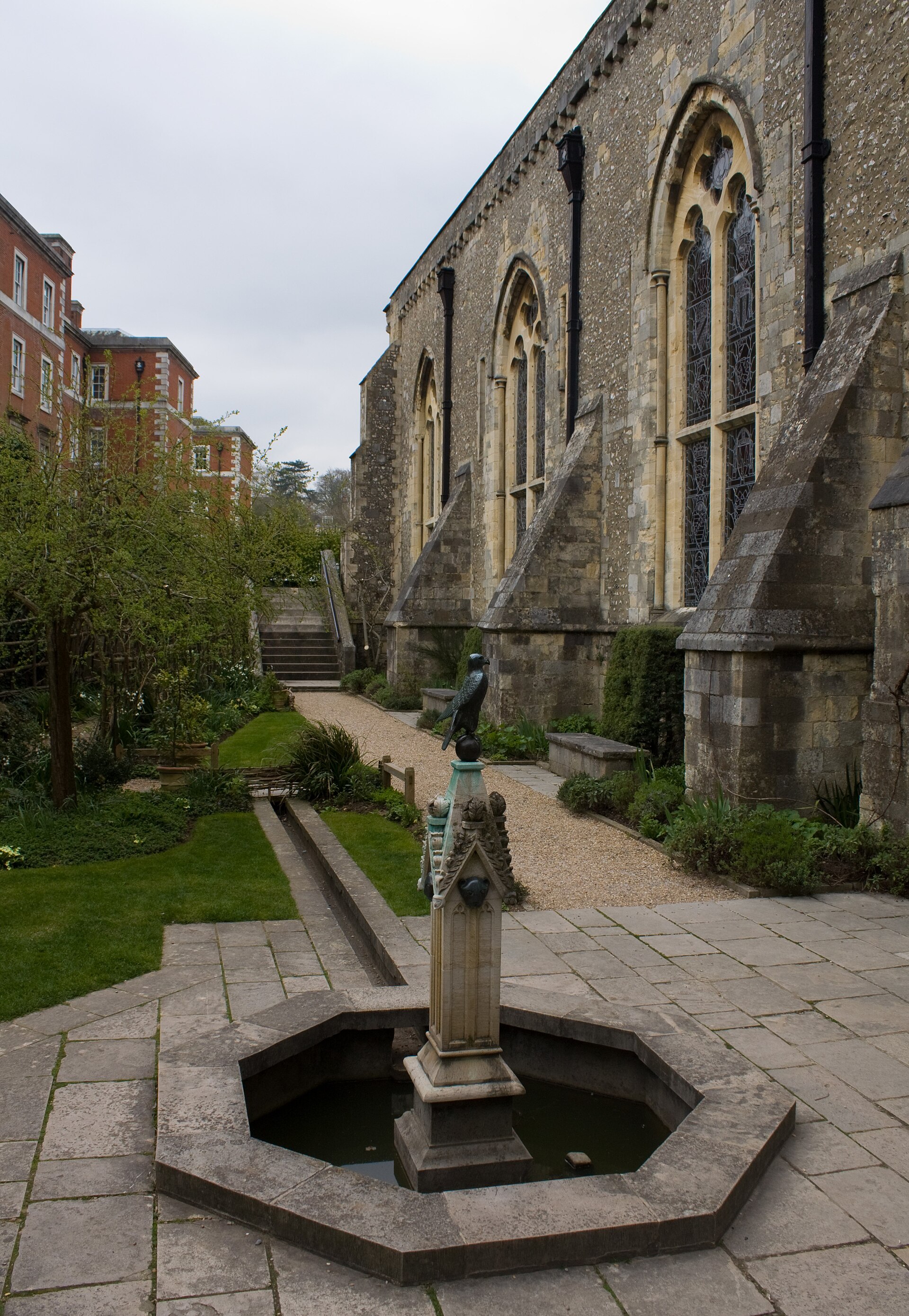
Of the medieval complex, what survives above all is the Great Hall, built for Henry III in the 1220s-1230s: a vast flint building with stone dressings, forming a double cube of about 55 feet, divided into three aisles by a double arcade of five bays on tall Purbeck marble shafts. It houses the famous medieval Round Table, hung on the west wall and associated with the Arthurian legend, as well as a bronze statue of Queen Victoria by Alfred Gilbert (1897). The ditch survives to the south, and excavations have revealed an early Norman chapel. Now part of the county offices complex, the hall is open to the public through the Hampshire Cultural Trust.