En un regard
Le château en bref
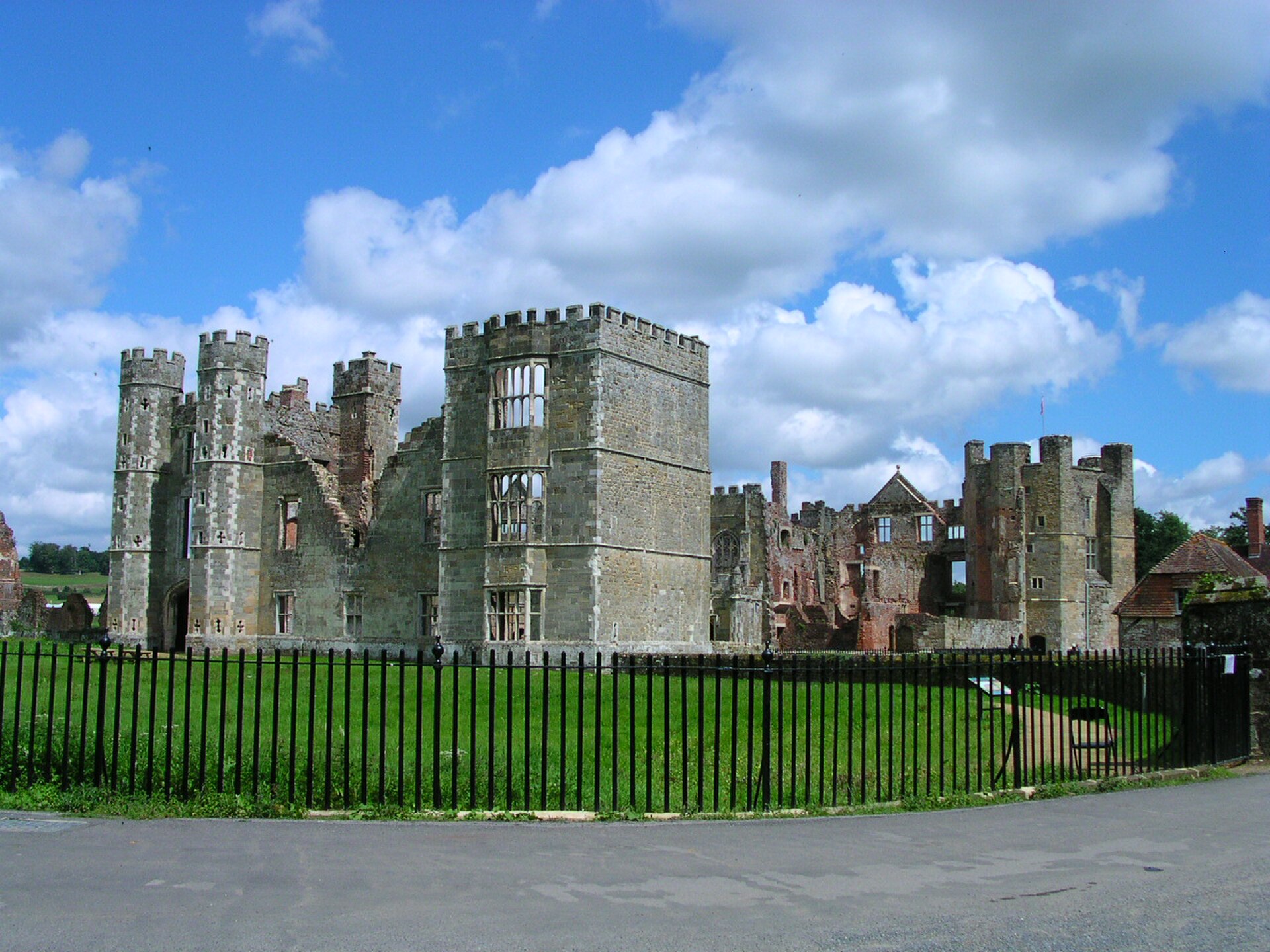
The ruins of Cowdray stand on the banks of the River Rother, just north-east of Midhurst, in the western part of Cowdray Park. Cowdray is one of the great fortified Tudor houses of England. Built around a vast quadrangular courtyard of sandstone ashlar and crowned with crenellated parapets, it was conceived on a scale often compared with that of the royal palace of Hampton Court, its contemporary.
A stronghold of the Bohun family, lords of Midhurst, already occupied the site. They had settled there around 1273, leaving the nearby motte-and-bailey castle on St Ann's Hill. Thirteenth-century floor tiles found on site suggest that an earlier manor house preceded the Tudor house. Around 1492 Sir David Owen, through his marriage to the Bohun heiress, had the old stronghold demolished and began building the east and north ranges. Sir William Fitzwilliam, later Earl of Southampton, bought the estate in 1529, raised the south and west ranges and received a licence to crenellate in 1533. Henry VIII and Elizabeth I both stayed there. In September 1793 a fire broke out during works in preparation for the marriage of the 8th Viscount Montague and devastated the main courtyard. The house was then abandoned.
Between 1909 and 1914 the 1st Viscount Cowdray had the ruins consolidated, saving them from complete collapse. Surviving today are the hexagonal kitchen tower, still at full height, the west range with its gatehouse flanked by octagonal turrets pierced with gunports, the great bay windows of the north range, as well as the outer court, the walled kitchen garden and the conduit house. The site is managed by the Cowdray Heritage Trust, an independent charity.