En un regard
Le château en bref
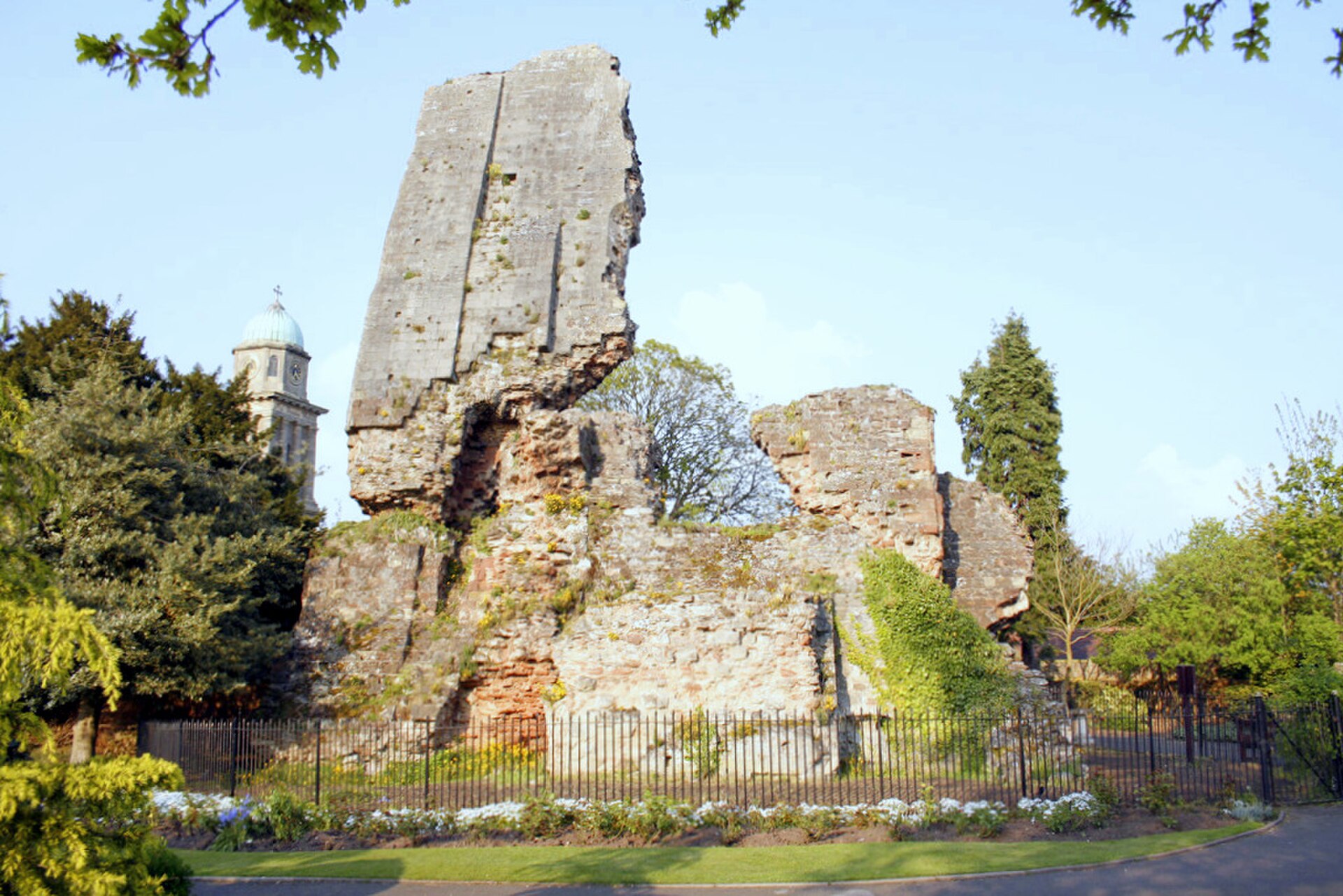
Bridgnorth Castle occupied the southern tip of a sandstone promontory overlooking the River Severn, at the heart of the High Town. Little survives beyond one spectacular fragment: three sides of a square Norman keep some twenty metres high, which leans eastwards by about 17 degrees, a steeper tilt than the Leaning Tower of Pisa. Around it, the former inner bailey has become a public garden.
The foundation is attributed to Robert de Bellême, Earl of Shrewsbury, who around 1101 abandoned his castle and borough at Quatford, a few kilometres to the south. Having rebelled against Henry I, he was forced to surrender as early as 1102 and the fortress became a royal castle. Briefly held by Hugh de Mortimer under Stephen, it returned to Henry II in 1155. In the 12th and 13th centuries, the Exchequer accounts mention a great hall, royal chambers, kitchens and stables within an enclosure nearly 380 m long; the keep probably received a stone staircase and a forebuilding between 1166 and 1174. Decline set in at the end of the 13th century and the site was in ruins by the reign of Henry VIII.
During the Civil War, the Royalist garrison surrendered to Parliament in 1646 after a three-week siege; the walls were then mined and brought down, which explains the tilt of the keep. The present park, laid out in 1897, covers buried remains studied by several excavations (1991, 1995, and Time Team in 2001).