En un regard
Le château en bref
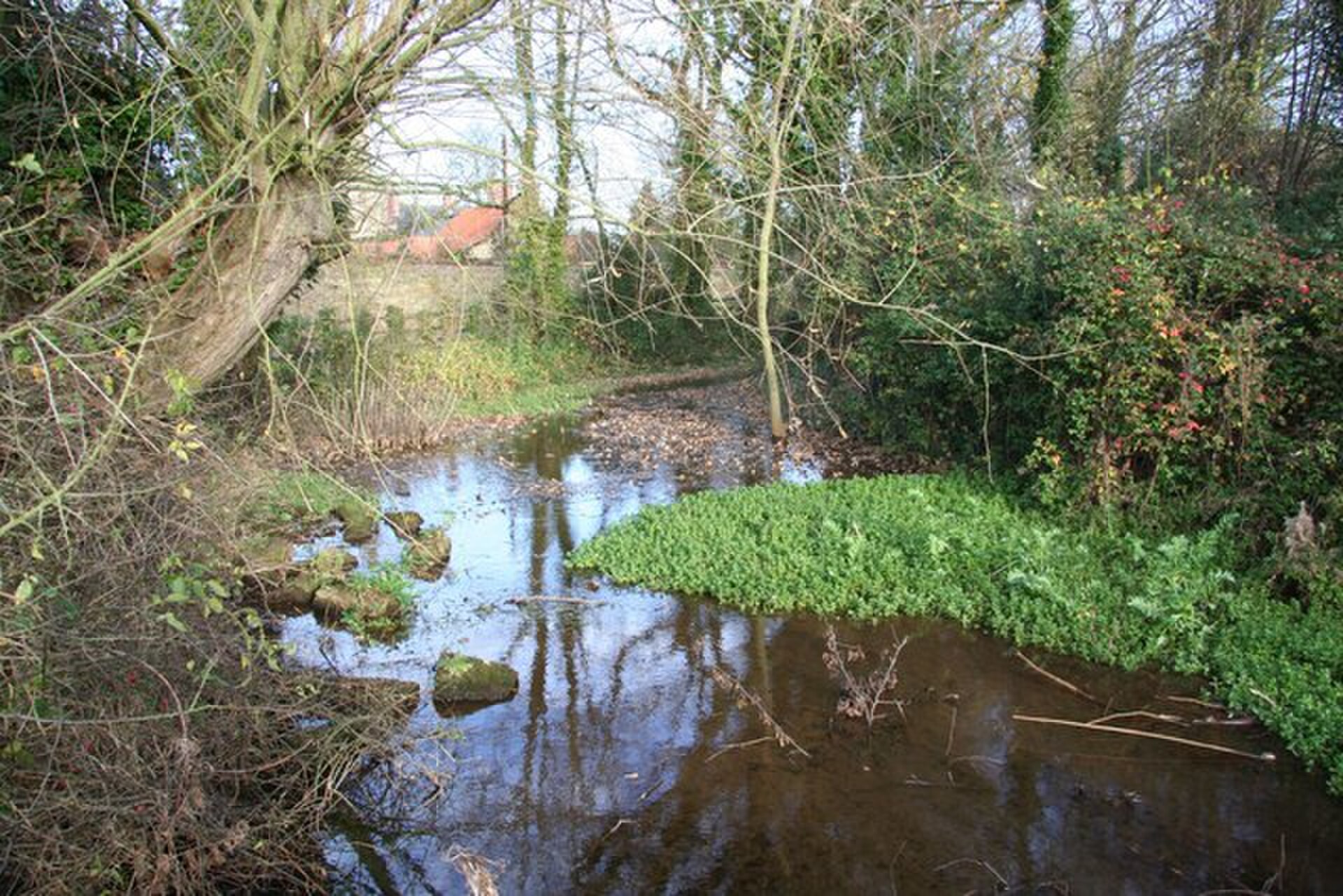
The site known as Castle Hill, at Welbourn in the North Kesteven district, preserves the remains of a medieval ringwork. The earthwork is roughly D-shaped and about 60 m across, its central area lying at the same level as the surrounding ground. An outer bank, standing 2 m above the interior and 4.5 m above the base of the ditch at the north-west, runs along the north, east and west sides, backed by a water-filled ditch up to 15 m wide; to the south, the boundary is marked by three shallow parallel ditches.
After the Conquest, the lands of Welbourn belonged to Robert Malet. In the early 12th century, the portion granted to the lord of Bayeux became the manor of "le Northalle", whose stone enclosure is already mentioned in a document of 1158: this makes Castle Hill a rare example of a ringwork with a masonry curtain wall rather than a palisade. A deed of 1288 describes within the court a hall with two chambers, a kitchen, a brewhouse, cattle sheds and a sheepfold, as well as a wall, a tower and a ditch. The two manors of Welbourn were united in the 14th century in the hands of Isabel de Vescy (1334), and by 1374 the site was described as abandoned and without buildings.
Geophysical survey in 1999 and an archaeological evaluation in 2000 revealed building foundations, an oven, pits and a circular structure about 15 m across interpreted as the tower. The earthworks, protected as a Scheduled Monument, survive well, except for the south-west corner, where the ditch has been filled in and built over.