En un regard
Le château en bref
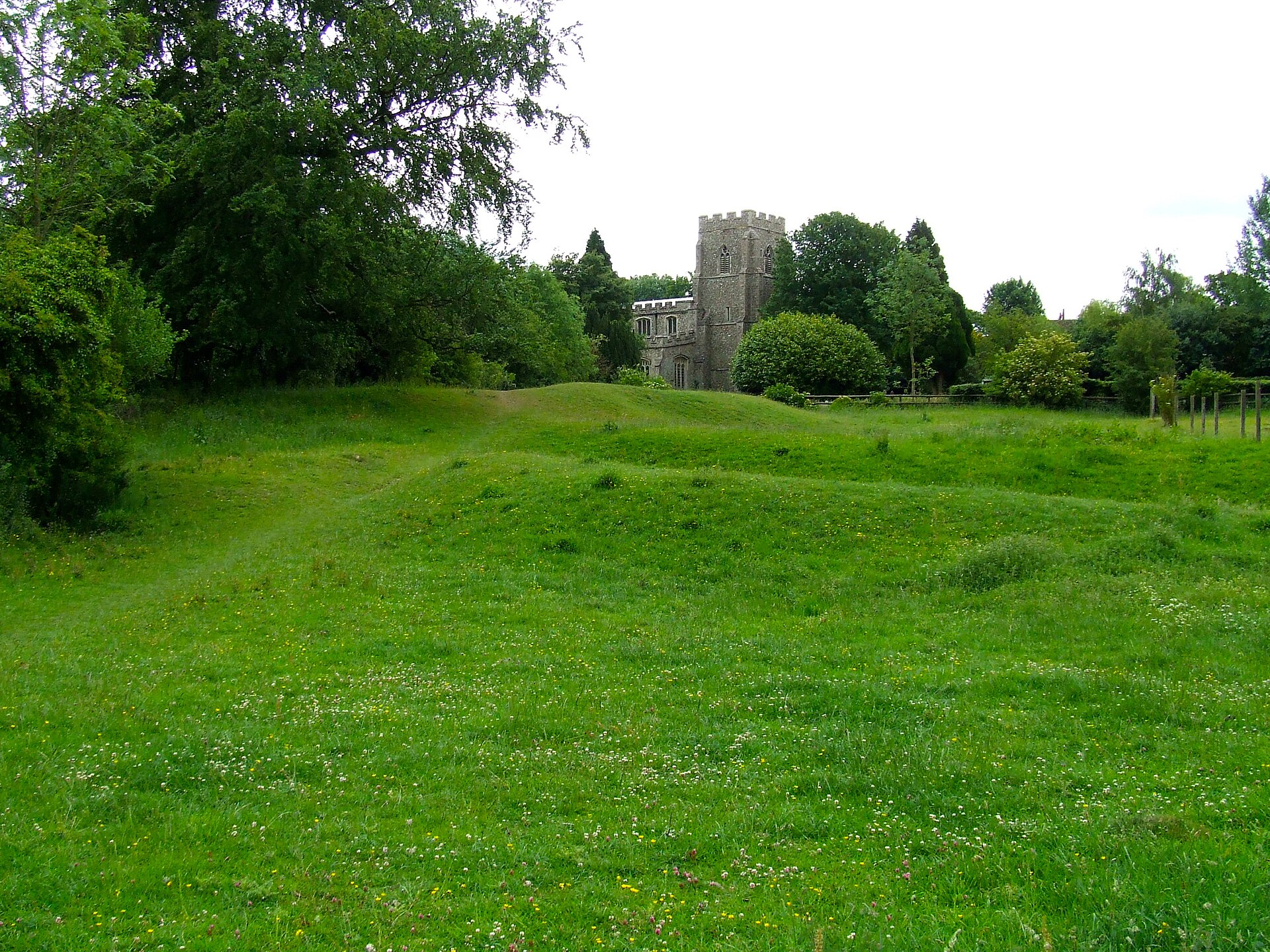
Clavering Castle is a large moated site beside the parish church of Clavering, in north-west Essex, close to the Hertfordshire border. It is not a classic motte-and-bailey castle: the site takes the form of a rectangular enclosure roughly 150 m east to west by 100 m north to south, surrounded by ditches about 26 m wide that still partly hold water.
Its historical interest rests on a disputed identification: many historians see it as "Robert's castle", mentioned in the Anglo-Saxon Chronicle in 1052, where Normans from Edward the Confessor's circle are said to have taken refuge. This Robert would be Robert fitz Wimarc, a close associate of the king and one of the wealthiest laymen in the kingdom, for whom Clavering was the most valuable manor. If the identification were confirmed, Clavering would rank among the rare castles predating the Conquest. Other scholars remain cautious: the term may refer to a simple defended settlement, and the visible earthworks seem rather to date from the mid-12th century or later. The estate remained with Robert's descendants (Swein, Robert of Essex, Henry of Essex) until the latter's disgrace in 1163.
Today the central platform, wooded and on private land, can be partly seen from the churchyard and a public footpath. It retains robbed-out foundation trenches; to the north, channels and ponds suggest a former mill and fishponds. No excavation has taken place, but the local "Project Castle" programme (2005-2008) carried out topographic and geophysical surveys.