Buchenbach Landkreis Breisgau-Hochschwarzwald Allemagne

Bubenstein Ruin

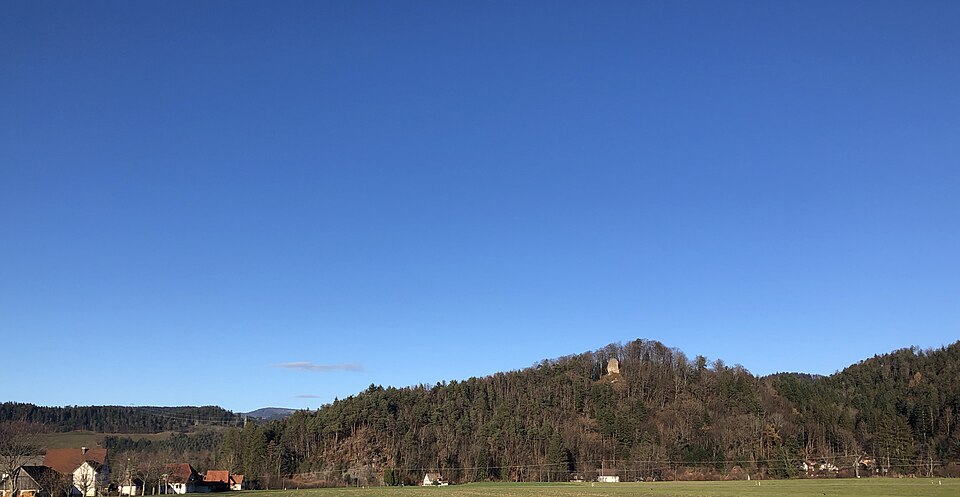
The Bubenstein ruin, also known as Neu-Falkenstein, occupies a rocky spur at an altitude of about 560 m on the northern slope of the Höllental, some 500 m west of Falkenstein Castle, above the village of Falkensteig, in…

Époque
XIIIᵉ siècle (1250)

En un regard

Le château en bref

The Bubenstein ruin, also known as Neu-Falkenstein, occupies a rocky spur at an altitude of about 560 m on the northern slope of the Höllental, some 500 m west of Falkenstein Castle, above the village of Falkensteig, in the municipality of Buchenbach. This small spur castle was probably built in the 13th century by Walter von Falkenstein, a member of the ministerial family that also held the neighbouring fortress and controlled the valley road; he is named as its owner in 1266. The structure, referred to in the documents as a "tower", subsequently passed in shares: in 1328, Werner von Staufen sold three quarters of it to Johann Schnewlin, a member of a powerful patrician family of Freiburg, and in 1407 Kuno von Falkenstein ceded the remaining quarter to Hanmann Schnewlin. In the 19th century, part of the rock was blasted away during the construction of the Höllental railway line, and in the 1960s the highest walls, deemed dangerous to the road below, were demolished. Only masonry remains and the gorge ditch survive today.

Époque de construction
XIIIᵉ siècle (1250)
Localisation
Buchenbach, Landkreis Breisgau-Hochschwarzwald

Récit

Une histoire à travers les siècles

Le récit

L’histoire de Bubenstein Ruin

Construit au XIIIe siècle par les Falkenstein, probablement par Walter von Falkenstein, possesseur en 1266, le Bubenstein formait avec Alt-Falkenstein un dispositif de contrôle de la route du Höllental. En 1328, Werner von Staufen vend ses trois quarts de la tour à Johann Schnewlin ; en 1407, Kuno von Falkenstein cède le dernier quart à Hanmann Schnewlin.

Lire la suiteRéduire
Famille
seigneurs de Falkenstein XIIIe s.-1407Source ↗
Famille
Schnewlin (patriciens de Fribourg) 1328-XVe s.Source ↗

L’architecture

Ce qu’il faut observer

Château d'éperon dominé par une tour d'environ 10 × 10 m à la base, protégé côté montagne par un fossé de gorge large d'environ 8 m et profond d'environ 5 m. Seuls subsistent des restes de murs et le fossé.

Chronologie

Les étapes de construction

Les campagnes documentées qui ont façonné le monument, période par période.

Moyen Âge

  1. 1200–1266

    ConstructionDatation à confirmer

    Construction au XIIIe siècle, probablement par Walter von Falkenstein, cité comme possesseur en 1266.

Informations pratiques

Préparer sa visite

Conditions de visite non renseignées

Nous n’avons pas encore d’information vérifiée sur l’ouverture au public. Renseignez-vous auprès du site officiel ou de la mairie avant de vous déplacer.

Vous l’avez visité ?

Aucune photo pour l’instant : partagez la vôtre

Après relecture, votre photo illustrera cette fiche, créditée à votre nom. Haute définition bienvenue, jusqu’à 40 Mo.

Propriétaires et gestionnaires

Vous gérez Bubenstein Ruin ?

Horaires, tarifs et réservation manquent encore sur cette fiche. Transmettez-les et mettez le château en avant auprès des visiteurs qui préparent leur venue.