Neuhausen (Steinegg) Enzkreis Allemagne

Steinegg Castle

Above the village of Steinegg, part of Neuhausen in the Enzkreis, Steinegg Castle traces its origins to Adalbert von Steinegg, a ministerial of the Counts of Calw mentioned around 1150, who raised a first hilltop castle…

Époque
1150–1695
Style
Renaissance

En un regard

Le château en bref

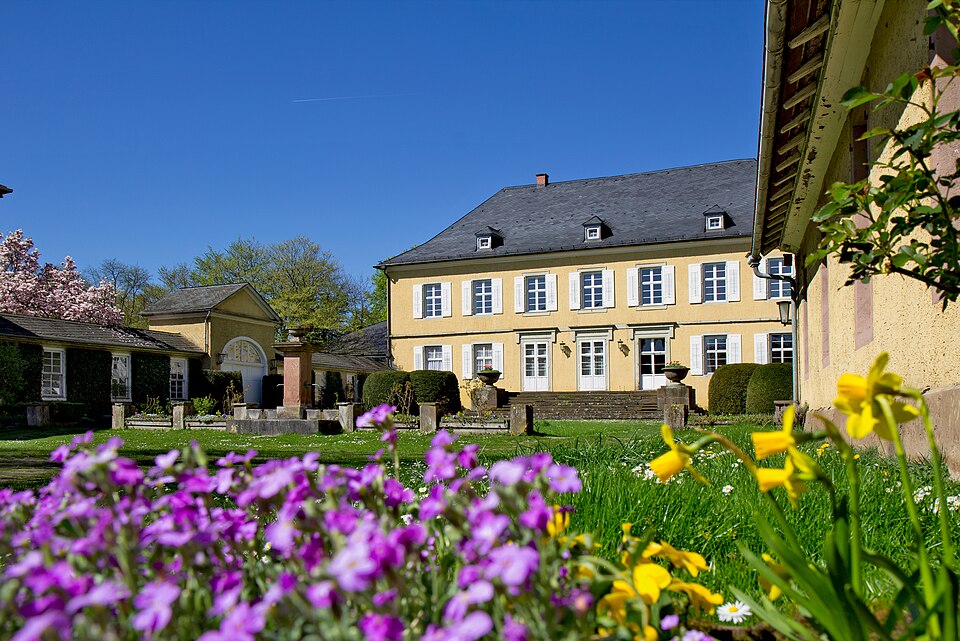
Above the village of Steinegg, part of Neuhausen in the Enzkreis, Steinegg Castle traces its origins to Adalbert von Steinegg, a ministerial of the Counts of Calw mentioned around 1150, who raised a first hilltop castle of which only foundations remain. In 1407 the lordship was sold to Diether V. von Gemmingen; his son built a new castle below the old one, which became the administrative seat of the lordship, a fief of the Margraves of Baden. A chapel was added in 1520 and Hans Pleikard von Gemmingen enlarged the residence in Renaissance style at the end of the 16th century. Spared by the Thirty Years' War, it burned in 1694 and was rebuilt the following year. After 1840 its roofs were removed and it fell into ruin, before St. Clair von Gemmingen-Steinegg campaigned from 1928 for its rescue. Since 1958 the Protestant parish of Pforzheim has run it as a youth and leisure centre.

À remarquer

  • tour de l'Oberburg
  • chapelle castrale (1520)
  • cour intérieure
  • fondations du château supérieur
Tous les éléments architecturaux
Époque de construction
1150–1695
Style architectural
Renaissance
Localisation
Neuhausen (Steinegg), Enzkreis
Accès au public
Visite sous conditions
État
Restauré
Usage actuel
centre de loisirs pour la jeunesse

Pourquoi le découvrir

Trois raisons de découvrir Steinegg Castle

  1. Chapelle castrale de 1520

    Lire son histoire
  2. Siège des Gemmingen-Steinegg pendant plus de quatre siècles

    Parcourir la chronologie
  3. Agrandissement Renaissance par Hans Pleikard von Gemmingen

    Observer l’architecture

Récit

Une histoire à travers les siècles

Le récit

L’histoire de Steinegg Castle

Vers 1150 : Adalbert von Steinegg bâtit le château. 1324 : passe à Wolf I. vom Stain ; 1407 : vendu à Diether V. von Gemmingen, dont le fils construit un nouveau château en contrebas. 1520 : chapelle. Fin XVIe s. : agrandissement Renaissance. 1694 : incendie ; 1695 : reconstruction. Après 1840 : ruine. 1928 : campagne de sauvegarde ; 1958 : reprise par la paroisse protestante de Pforzheim.

L’architecture

Ce qu’il faut observer

Château supérieur réduit aux fondations et à une tour ; château inférieur du XVe siècle agrandi à la Renaissance, avec chapelle castrale (1520) et cour intérieure, en grande partie reconstruit au XXe siècle.

Aujourd’hui

Propriété et usages actuels

Exploité depuis 1958 par la paroisse protestante de Pforzheim comme centre de jeunesse et de loisirs.

Lire la suiteRéduire
Exploitant
Evangelische Kirchengemeinde Pforzheim

Chronologie

Les étapes de construction

Les campagnes documentées qui ont façonné le monument, période par période.

Moyen Âge

  1. Premier château perché

    Construction

  2. Nouveau château des Gemmingen

    Construction

Informations pratiques

Préparer sa visite

Visite sous conditions

L’accès est limité à certaines parties, périodes ou visites encadrées.

Horaires
Abords en accès libre ; le château sert de centre de loisirs pour la jeunesse.

Vous l’avez visité ?

Aucune photo pour l’instant : partagez la vôtre

Après relecture, votre photo illustrera cette fiche, créditée à votre nom. Haute définition bienvenue, jusqu’à 40 Mo.

Propriétaires et gestionnaires

Vous gérez Steinegg Castle ?

Horaires, tarifs et réservation manquent encore sur cette fiche. Transmettez-les et mettez le château en avant auprès des visiteurs qui préparent leur venue.