
Site castral du XIIe siècle sur un éperon du Jura souabe
Hielock Castle
Architecture, patrimoine et histoire · Allemagne entière
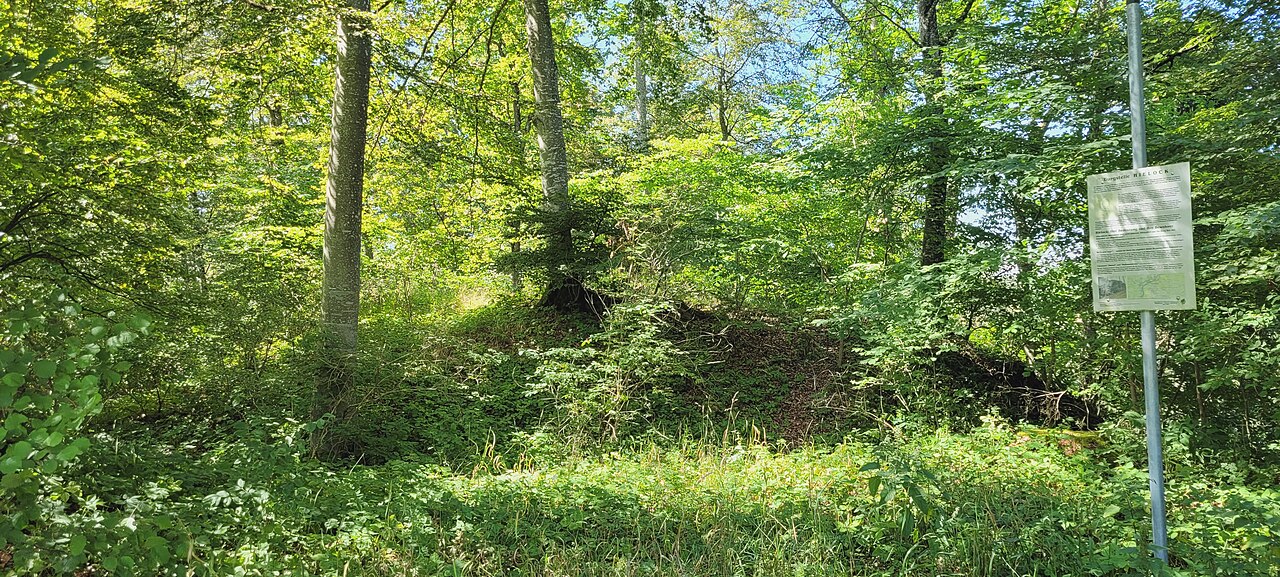
East of the village of Mägerkingen, on a spur about fifty metres above the Seckach valley, lies the site of Hielock Castle, a small fortress of the Swabian Jura. It was probably built in the early 12th century by Milo and Heinrich of Mägerkingen, ministerials of the Counts of Gammertingen who are recorded before 1138. Today only a platform of about 10 by 22 metres remains, surrounded by a curved ditch and an earth rampart. It holds the metre-thick foundations of a rectangular residential tower, uncovered by Professor Votteler in 1890. The castle was probably abandoned around 1362. It was later pledged to the lords of Rechberg, then held by the Counts of Werdenberg, before passing to the town of Trochtelfingen. A legend tells of the proud last lord, Roßmann, and his daughter, who starved in the ruins. Bronze Age and Hallstatt sherds show the spur was occupied long before the Middle Ages.
⌖
Trochtelfingen (Mägerkingen)Allemagne entière
♜
Chronologie documentéePériode de construction
Pourquoi visiter Hielock Castle ?
Fondations d'une tour d'habitation dégagées en 1890
Fossé et rempart de terre lisibles
L’histoire de Hielock Castle
Le château est probablement fondé au début du XIIe siècle par les seigneurs de Mägerkingen, mentionnés avant 1138, puis cité en 1208, 1210, 1212 et 1324. Vers 1362, il est sans doute déjà abandonné. Mis en gage aux Rechberg (1411), il appartient aux comtes de Werdenberg (1437-1441) puis à la ville de Trochtelfingen ; ses fondations sont dégagées en 1890.
Figures historiques
Personnalités liées à Hielock Castle
Découvrez les femmes et les hommes documentés dans l’histoire de ce château et retrouvez, pour chacun, les autres demeures auxquelles ils sont associés.
Ce qu’il faut observer
Petit château de hauteur d'environ 10 x 22 m, isolé par un fossé semi-circulaire et entouré d'un rempart. Les vestiges sont ceux d'une tour d'habitation rectangulaire aux murs d'environ 1 m d'épaisseur.
Les étapes de construction
Les principales campagnes documentées qui ont façonné le monument au fil des siècles.
- Datation probable1100–1138Évolution
- Source solide1890Évolution