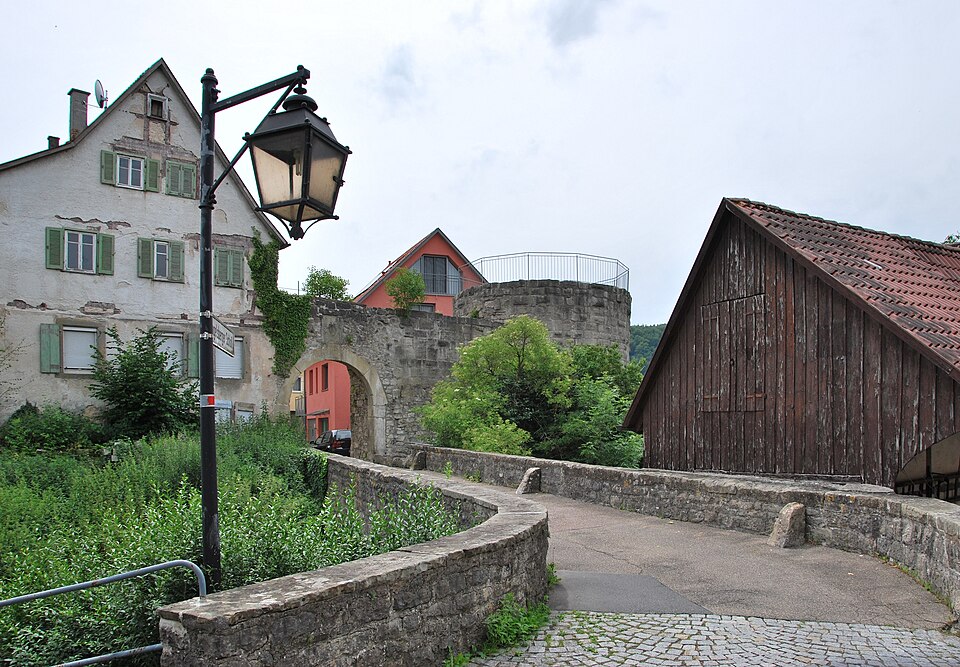
Edelmannshof, Bretzfeld (Rappach)

Bretzfeld (Rappach) Hohenlohekreis Allemagne

Edelmannshof

In the village of Rappach, part of the municipality of Bretzfeld in the heart of the Hohenlohekreis, the Edelmannshof farm estate stands roughly on the site of a former medieval castle that has now almost disappeared.

Époque
Moyen Âge
Préparer la visite
Photo : DALIBRI · CC BY-SA 4.0 Proposer votre photo

En un regard

Le château en bref

In the village of Rappach, part of the municipality of Bretzfeld in the heart of the Hohenlohekreis, the Edelmannshof farm estate stands roughly on the site of a former medieval castle that has now almost disappeared. The stronghold appears in records as early as 1215, linked to the lords of Rappach, a minor local nobility who took their name from the village. It was a fortified residence protected by a water-filled moat, a typical configuration for the lowland or valley-floor castles of the region. Its decline came early: by 1341 the documents speak only of a "Burgstadel", that is, a castle site, a sign that the building had by then lost its function. Of this seigneurial residence only faint traces of masonry and of the moat survive. The very name of the estate, "the nobleman's farm", nevertheless preserves the memory of the noble presence here. The site, occupied by a working farm, is best seen from the edges of the hamlet.

Époque de construction
Moyen Âge
Localisation
Bretzfeld (Rappach), Hohenlohekreis
Usage actuel
emplacement occupé par un domaine agricole (Hofgut Edelmannshof)

Pourquoi le découvrir

Trois raisons de découvrir Edelmannshof

  1. Première mention en 1215 avec les seigneurs de Rappach

    Lire son histoire
  2. Ancien château protégé par un fossé en eau

    Parcourir la chronologie
  3. Déjà réduit à l'état de « Burgstadel » en 1341

    Observer l’architecture

Récit

Une histoire à travers les siècles

Le récit

L’histoire de Edelmannshof

Le château est mentionné pour la première fois en 1215 avec les seigneurs de Rappach. Entouré d'un fossé en eau, il est déjà qualifié de « Burgstadel » (simple emplacement de château) en 1341, ce qui indique un abandon ou une ruine dès la première moitié du XIVe siècle. Le Hofgut Edelmannshof s'est ensuite établi approximativement sur l'ancien site castral.

L’architecture

Ce qu’il faut observer

Ancien château entouré d'un fossé rempli d'eau. Il n'en reste que de modestes vestiges de murs et du fossé ; les bâtiments du domaine agricole de l'Edelmannshof recouvrent à peu près l'emprise de la place forte.

Chronologie

Les étapes de construction

Les campagnes documentées qui ont façonné le monument, période par période.

Moyen Âge

  1. XIIIe siècle

    Évolution

    Première mention du château avec les seigneurs de Rappach.

  2. XIVe siècle

    Évolution

    Le site n'est plus désigné que comme « Burgstadel » (emplacement de château).

Informations pratiques

Préparer sa visite

Conditions de visite non renseignées

Nous n’avons pas encore d’information vérifiée sur l’ouverture au public. Renseignez-vous auprès du site officiel ou de la mairie avant de vous déplacer.

Vous l’avez visité ?

Partagez vos photos

Après relecture, votre photo illustrera cette fiche, créditée à votre nom. Haute définition bienvenue, jusqu’à 40 Mo.

Propriétaires et gestionnaires

Vous gérez Edelmannshof ?

Horaires, tarifs et réservation manquent encore sur cette fiche. Transmettez-les et mettez le château en avant auprès des visiteurs qui préparent leur venue.