
Forchtenberg (Sindringen) Hohenlohekreis Allemagne

Sindringer Schloss

Overlooking the upper part of Sindringen, a village now belonging to Forchtenberg in the Kocher valley, Sindringen Castle keeps a powerful medieval keep as its centrepiece.

Époque
Moyen Âge

En un regard

Le château en bref

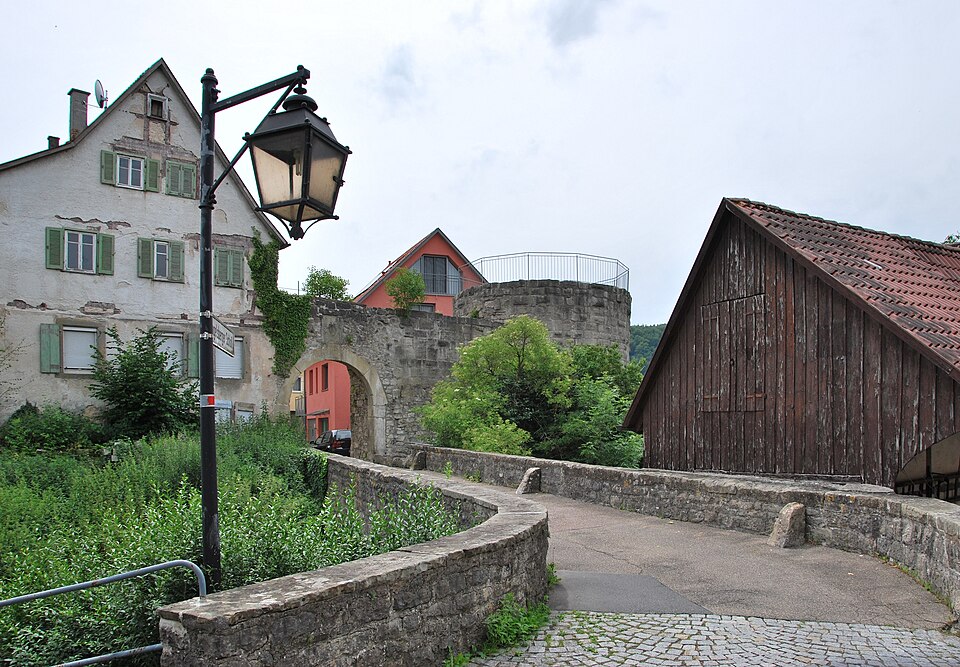
Overlooking the upper part of Sindringen, a village now belonging to Forchtenberg in the Kocher valley, Sindringen Castle keeps a powerful medieval keep as its centrepiece. This massive tower, since pierced with large windows, has been adapted for residential use, while fragments of the former curtain wall recall the defensive purpose of the site; the other buildings are more recent. The locality, mentioned as early as 1037 in the foundation charter of Öhringen, passed from the Counts of Calw to the Lords of Weinsberg, and then in the early 14th century to the House of Hohenlohe, which made it the seat of an administrative district. In 1363 Emperor Charles IV granted it town and market rights, although the settlement never truly developed into a town. After the Hohenlohe partitions, the castle belonged in turn to the Waldenburg and Pfedelbach branches and, from 1728, to the Catholic Bartenstein line. A privately owned and inhabited property, it can only be viewed from the outside.

Époque de construction
Moyen Âge
Localisation
Forchtenberg (Sindringen), Hohenlohekreis
Accès au public
Non ouvert au public
Usage actuel
Résidence privée

Pourquoi le découvrir

Trois raisons de découvrir Sindringer Schloss

  1. Donjon médiéval massif transformé en habitation

    Lire son histoire
  2. Vestiges de l'enceinte fortifiée

    Observer l’architecture
  3. Ancien siège de bailliage des Hohenlohe

    Préparer la visite

Récit

Une histoire à travers les siècles

Le récit

L’histoire de Sindringer Schloss

1037 : première mention de Sindringen dans la charte de fondation d'Öhringen. XIIIe siècle : passage des comtes de Calw aux seigneurs de Weinsberg.

Lire la suiteRéduire

Début XIVe siècle : acquisition par les Hohenlohe, qui en font un siège administratif (Amt). 1363 : Charles IV accorde les droits de ville et de marché. 1551/1555 : attribué à Hohenlohe-Waldenburg lors du partage, puis centre administratif de Hohenlohe-Pfedelbach. 1728 : passe à la branche catholique Hohenlohe-Bartenstein. Aujourd'hui propriété privée.
L’architecture

Ce qu’il faut observer

Le noyau conservé est un donjon (Bergfried) massif, aménagé en logement avec de grandes baies. Subsistent aussi des parties des anciennes fortifications ; les autres bâtiments du site sont d'époque plus récente.

Aujourd’hui

Propriété et usages actuels

Château en mains privées servant d'habitation ; seul l'extérieur peut être vu.

Figures historiques

Ils ont marqué Sindringer Schloss

Les femmes et les hommes documentés dans l’histoire du lieu. Ouvrez une ligne pour en savoir plus et retrouver les autres demeures qui leur sont associées.

Informations pratiques

Préparer sa visite

Non ouvert au public

Le château ne se visite pas. Merci de respecter la propriété et la vie privée des occupants.

Horaires
Propriété privée habitée : vue extérieure uniquement, sans horaires ni droit d'entrée.

Vous l’avez visité ?

Aucune photo pour l’instant : partagez la vôtre

Après relecture, votre photo illustrera cette fiche, créditée à votre nom. Haute définition bienvenue, jusqu’à 40 Mo.

Propriétaires et gestionnaires

Vous gérez Sindringer Schloss ?

Horaires, tarifs et réservation manquent encore sur cette fiche. Transmettez-les et mettez le château en avant auprès des visiteurs qui préparent leur venue.