En un regard
Le château en bref
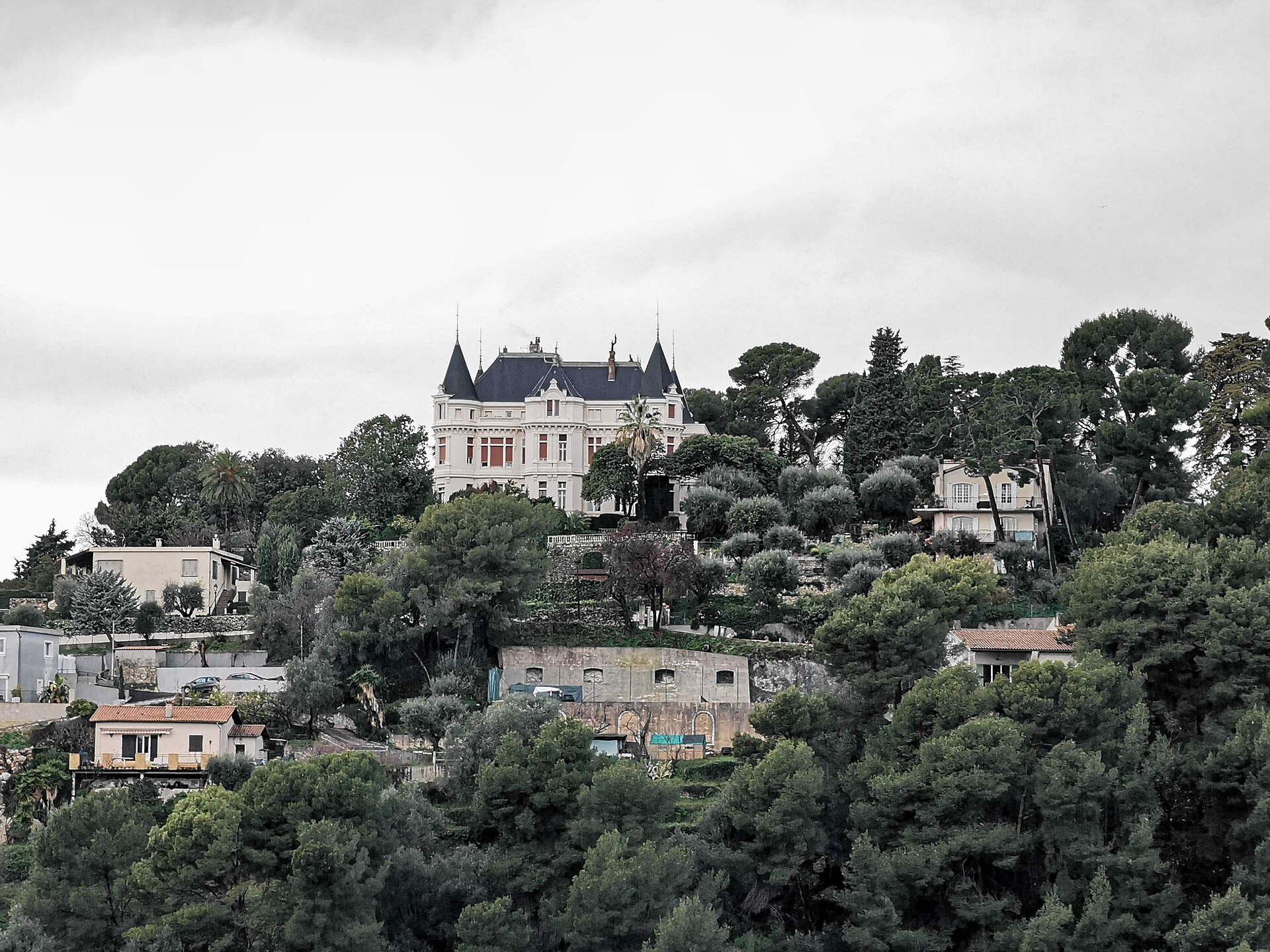
The Château de Gairaut is a villa-château located in the Gairaut district on the heights of Nice.
It was built between 1900 and 1904 by the Niçois millionaire Joseph Giordan, who had inherited a plot of several hectares on which stood a more modest building erected in 1744.
He instructed the finest craftsmen of the region: "Wherever my wife sets her eyes, she must encounter happiness." The château, with its Belle Époque architecture, is influenced by the French Renaissance style, with Baroque decoration and an octagonal tower at the rear. It has some thirty rooms, and its terraces offer a panoramic view over the city of Nice and the Mediterranean. The dining room is lined with mahogany panelling, the whole of which had been exhibited at the 1900 Universal Exhibition. The plan of the château is organised around a vast atrium covered by a glass dome. Upstairs, a gallery runs around it and leads to the rooms. All the ceilings and walls are painted with natural pigments. In the billiard room, frescoes are attributed to Jules Chéret, and one of them to Alfons Mucha. An interior staircase, also decorated with frescoes, leads up to a small glass dome, the remains of an observatory used by J. Giordan, who was passionate about astronomy.
After J. Giordan's death, the château was occupied by the Germans, who installed an anti-aircraft battery on its roof. His son Henri Giordan, also owner of the Hôtel Carlton in Lyon and the Hôtel de l'Ermitage in Évian, ruined himself maintaining the château, which had been damaged during the war years. After an attempt with Jean Médecin to create a Belle Époque museum there, the grandson Joseph Jean Giordan resigned himself to selling it to a property dealer who divided the estate into plots.
After nearly 40 years of abandonment, in 1987 Éric Poisson, an advertising executive, bought the château, which was destined for demolition. The Giordan grandson said: "My great-grandfather ruined himself building it. My grandfather ruined himself maintaining it. My father ruined himself trying to make it work. I congratulate you, dear sir, on having been able to acquire it!"
Éric Poisson developed a passion for the house, which reminded him of his grandmother's in Angers. To pay tribute to it, he undertook a complete renovation respecting the architecture, the decoration and the interior ornamentation. Although the glass roofs were damaged and pigeons were flying in the atrium, miraculously the frescoes were all intact, except those of the left wing, which had collapsed. He surrounded himself with the decorators Jacques Grange and Christian Benais. Jacques Grange rethought the layout of the rooms and modernised the premises while respecting their authenticity. The bedrooms were thus all given bathrooms and treated like hotel suites. With Christian Benais, they hunted for antiques and created a setting that recaptured the atmosphere of the turn of the century. The furniture thus comes from the former Hôtel d'Orsay, from Sarah Bernhardt's house and from the Marché Serpette, where among other things they found pieces created for the Universal Exhibitions. Éric Poisson thus refurnished the house with taste, gathering works of art worthy of such a residence.
The part of the park that remained attached to the château regained its charm thanks to works carried out between 1991 and 1993. The owner called on the landscape architect Alain Goudot to recreate gardens, terraces, pools and cascades as well as a rose garden. A grotto and its pool in artificial rockwork dating from the time of construction were set back in place at the end of the vista, and an exotic garden was also laid out. In 1993, the sculptor Bernard Pagès, inspired by the place, designed and produced, along the swimming pool on the château's terrace, a 2.65 m high sculpture called the Grande Gloriette, a thicket of iron branches that echoes another sculpture evoking branches, located on the column of the staircase leading to the terrace.
After restoring the château and its gardens to their former splendour, Éric Poisson sold it in 2000, together with all its interior collections, to the Russian businessman Sergei Pugachev. In early 2012, the courts decided to seize the château. After several years of legal proceedings, the Nice Tribunal de grande instance declared the Russian proceedings against Sergei Pugachev null and void, and he kept the château and his other assets in France. Mr Pugachev has continued Éric Poisson's renovation work to preserve the splendour of the place. For example, he called on a ceramist-potter holding the title of Meilleur Ouvrier de France to reproduce identical copies of the château's ceramics.