En un regard
Le château en bref
Le château de Kermenguy is a château located in Cléder, in the French department of Finistère.
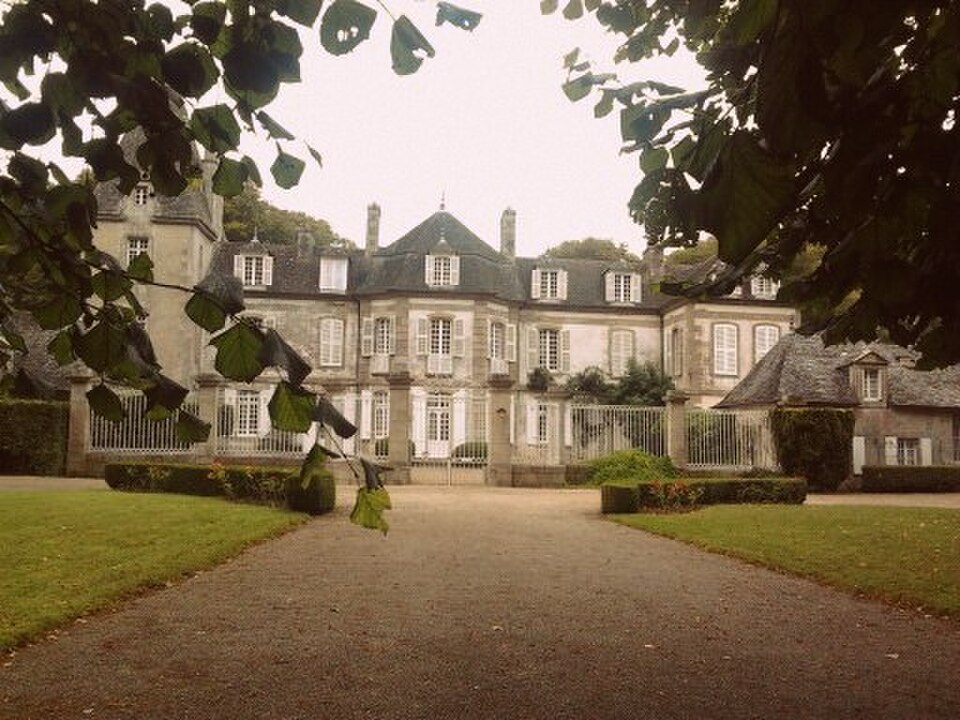
The château of Kermenguy was originally a former keep dating from the 13th century. It was replaced by a handsome Breton manor house completed in 1632, flanked by two turrets and extended by another wing before the Revolution, at which time these parts were destroyed. The present manor is enclosed by a fine Louis XIII-style gallery, characterised by its very closely spaced small pillars, which are the hallmark of the period. The manor house, the balustrades, the pillars of the avenues and the dovecote are listed in the supplementary inventory of historic monuments.
During the Revolution, the north wing was burned, along with one of the turrets. During this troubled period, the manor served as a hiding place for non-juring priests. It was at this time that Nicolas de Kermenguy helped Monseigneur de la Marche, Bishop of Saint-Pol-de-Léon, go into exile on the island of Jersey. The woods of Kermenguy served as the headquarters for counter-revolutionary troops during the Battle of Kerguidu in March 1793, near the Kerguidu mill, which is today located in the commune of Tréflaouénan.
In 1810, the chapel situated in the park was destroyed, as it was deemed too distant from the parish church and was to be made accessible to the entire neighbourhood; it was replaced by an oratory inside the house.
The lands and the château of Kermenguy have been owned by the same family (cf. Kermenguy family) for more than six centuries. In 1400, Yvon Derian (or Derrien), son of the lord of Pratalan, married Basile de Coëtaudon, lady of Kermenguy and Kerabret. It was around this time that the name Kermenguy began to be adopted as a family name. The Derrien family, from which Yvon Derrien descended, distinguished itself by producing a bishop (1227 to 1238), a crusader (Guillaume Derrien in 1248) and a seneschal of Brittany (Hervé Derrien in 1378). The Kermenguys distinguished themselves by producing a Knight of the Order of Saint Michael (Jacques de Kermenguy in 1647), a Knight of Saint Lazarus in 1721, two pages to the king in 1710 and 1750, a page to the queen in 1755, an independent royalist deputy (Émile de Kermenguy, deputy from 1871 to 1893), and numerous mayors and priests more recently.