En un regard
Le château en bref
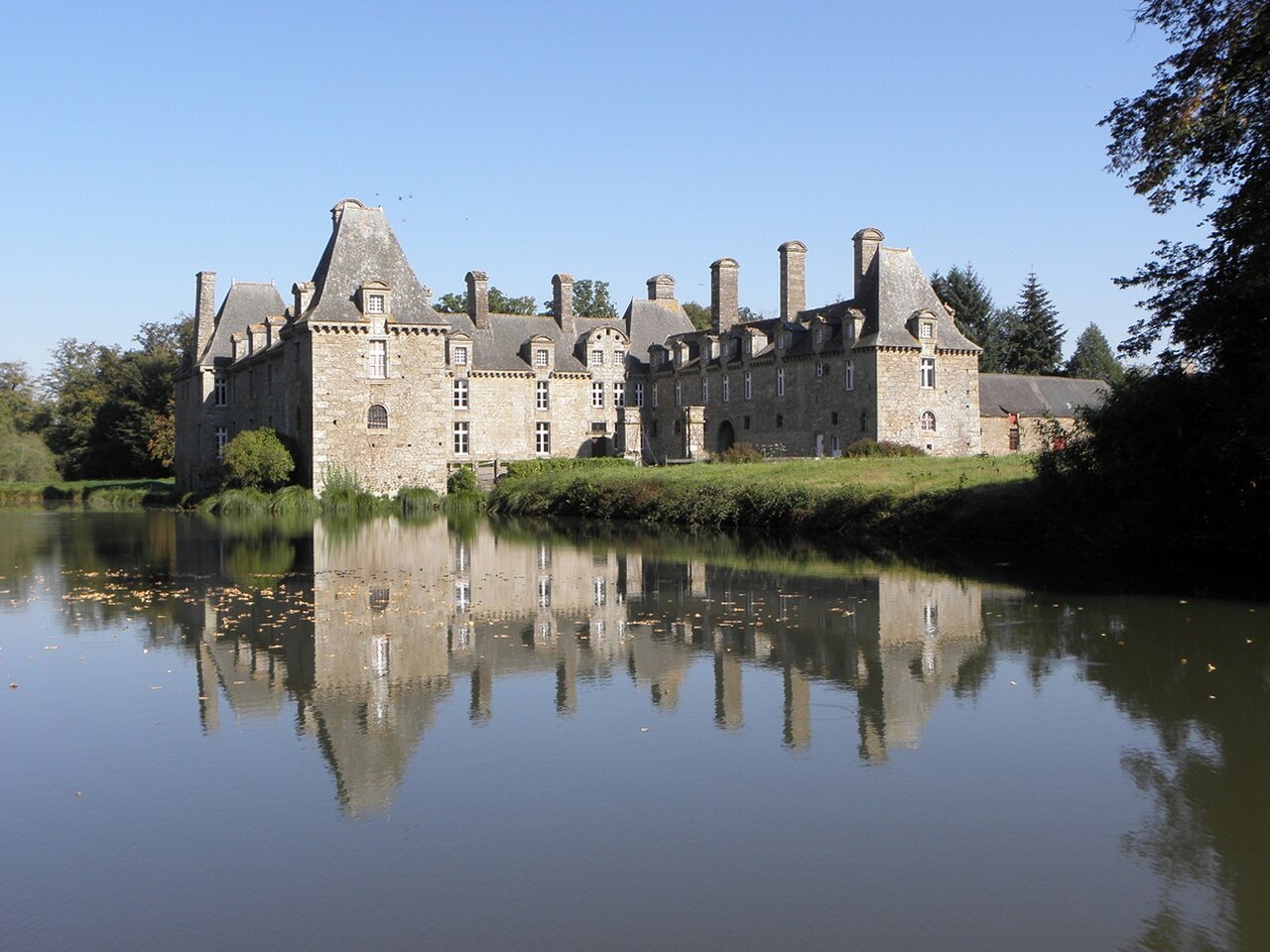
Boutavent Castle is located in the commune of Iffendic, France.
The ruins of the medieval fortified castle stand on a natural rocky spur at the locality of Boutavent. The estate, surrounded by the Paimpont forest massif and the Boutavent pond, covers more than two hectares.
In the 13th and 14th centuries, the castle is documented as belonging to the lords of Montfort. It thus formed part of the Montfort family's possessions, alongside the castles of Comper, Montfort, Montauban and Gaël.
The history of the site is accompanied by legends. It is said that in the 7th century the castle was the residence of Judicael, King of Domnonée, and that it was the meeting place between the king and Saint Éloi, who had been sent to settle a border dispute between the Bretons and the Franks.
The castle is structured in two elements typical of this type of site: an upper bailey and a lower bailey, separated by a deep ditch. Several buildings, identifiable by micro-topography, are mainly located against the curtain walls. The rampart and the elements of the lower bailey's enclosure are still clearly visible.
In the 16th century, the castle is known to have been in ruins. The circumstances of the destruction of the fortified site of Boutavent remain mysterious. It may have been dismantled during the War of Succession (second half of the 14th century), or in 1373, during Bertrand Du Guesclin's campaign in Brittany, but nothing proves that the castle was no longer inhabited afterwards.
Many local authors of the 19th century wrote about Boutavent, including Poignand, Vigoland and Oresve. Although these writings are rare testimonies about the site, the entire history of the castle remains without reliable sources.
Various campaigns to consolidate the remains have taken place since 2006, during which archaeological material was found (slates, pottery, floor tiles and glazed roof tiles). The site, managed by Montfort Communauté, has been open to the public since 2005. Maintenance work, consolidation of the remains and enhancement of Boutavent are carried out in collaboration with the regional archaeology service and the Eureka Emplois Services work-integration project.
Prior to the 2016 restoration, a first archaeological trial excavation was carried out in September and October 2015 by CERAPAR (Centre de Recherches Archéologiques du Pays de Rennes), under the supervision of the regional archaeology service and Montfort Communauté. During this operation, the gatehouse tower at the castle's entrance and a flanking tower were discovered. In the north-east curtain wall, three splayed openings and a possible postern came to light. The finds from the excavated area suggest occupation at the end of the 12th century.