En un regard
Le château en bref
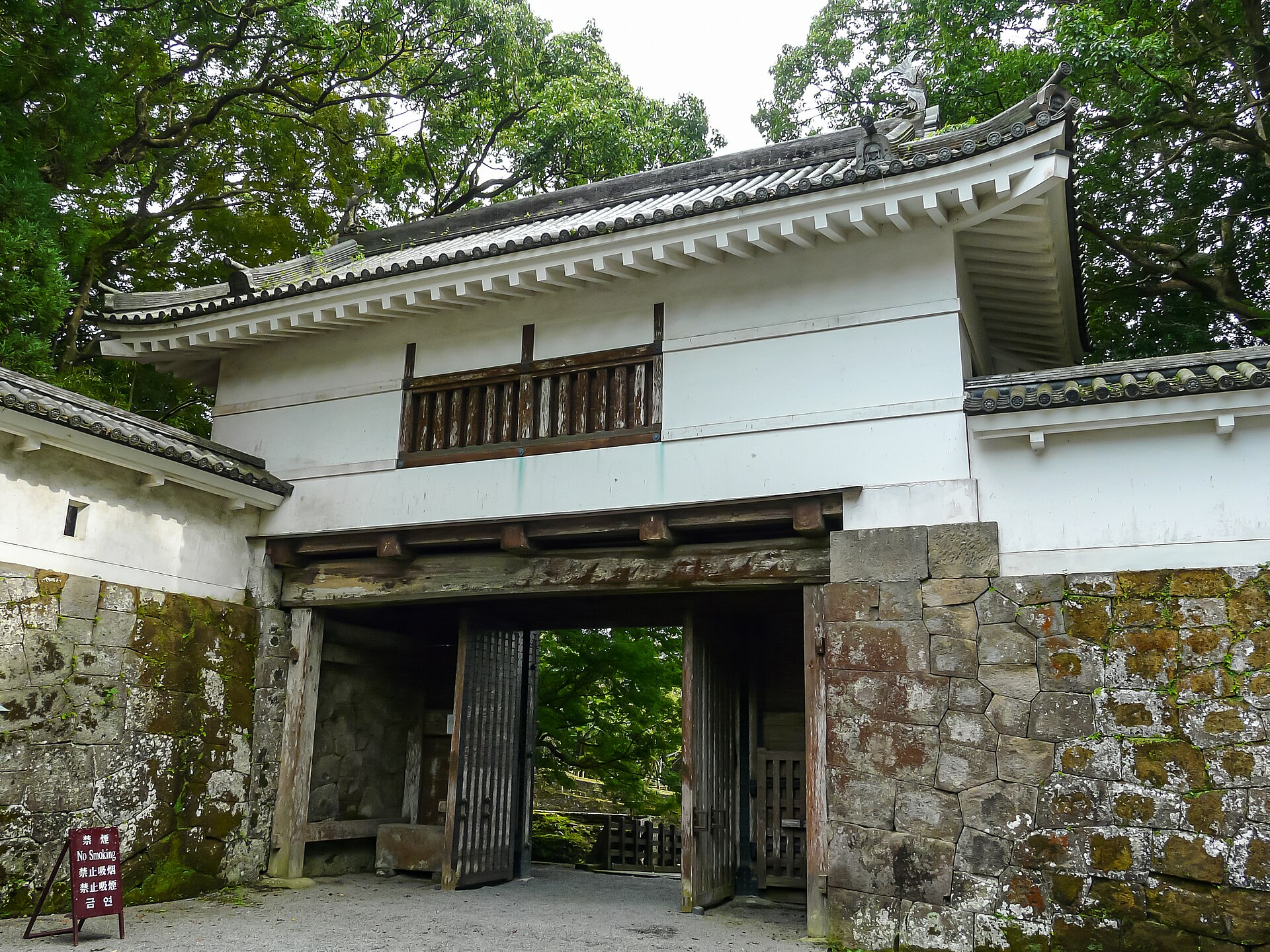
Obi Castle spreads over a group of hills of shirasu, the soft volcanic deposit of southern Kyushu, in a small basin formed by a wide bend of the Sakatani River. Its strength never depended on a keep: the core of the site, about 750 metres from east to west and 500 from north to south, is cut by deep dry moats into highly independent enclosures, among them Honmaru, Matsuo, Naka-no-jo, Imajo, Naka-no-maru, Nishi-no-maru, Matsu-no-maru and Kita-no-maru; at the beginning of the Edo period the stronghold had thirteen enclosures. In the Middle Ages, Obi was the prize in a long struggle between the Shimazu of Satsuma, who placed Niiro Tadatsugu there in 1458, and the Ito of Hyuga, whose leader Ito Yoshisuke seized it in 1567. Victory became final only under Hideyoshi: after the Kyushu campaign of 1587, Ito Suketaka obtained the castle and his descendants kept it until 1871, at the head of a domain of 51,000 koku. Most of the visible walls result from the major works of 1686 to 1693, undertaken after damage from an earthquake in the 1660s according to a secondary source. Visitors also find a recent reconstruction: the Otemon, a gate of 1978 in century-old Obi cedar on old foundations, and the Matsuo-no-maru palace, restored in 1979. The most striking feature remains the continuity between castle and town: part of the site and the former samurai quarter, still lined with low walls and gateways, have formed since 1977 the first protected ensemble of this kind in Kyushu. The former Honmaru, planted with cedars, now looks like woodland.
- Époque de construction
- 1686–1693
- Localisation
- Nichinan, Préfecture de Miyazaki
- Protection
- Ensemble protégé de bâtiments traditionnels (重要伝統的建造物群保存地区), quartier de samouraïs, 19,8 ha (1977)
- Accès au public
- Ouvert au public
- État
- Vestiges
- Usage actuel
- musée, parc historique