En un regard
Le château en bref
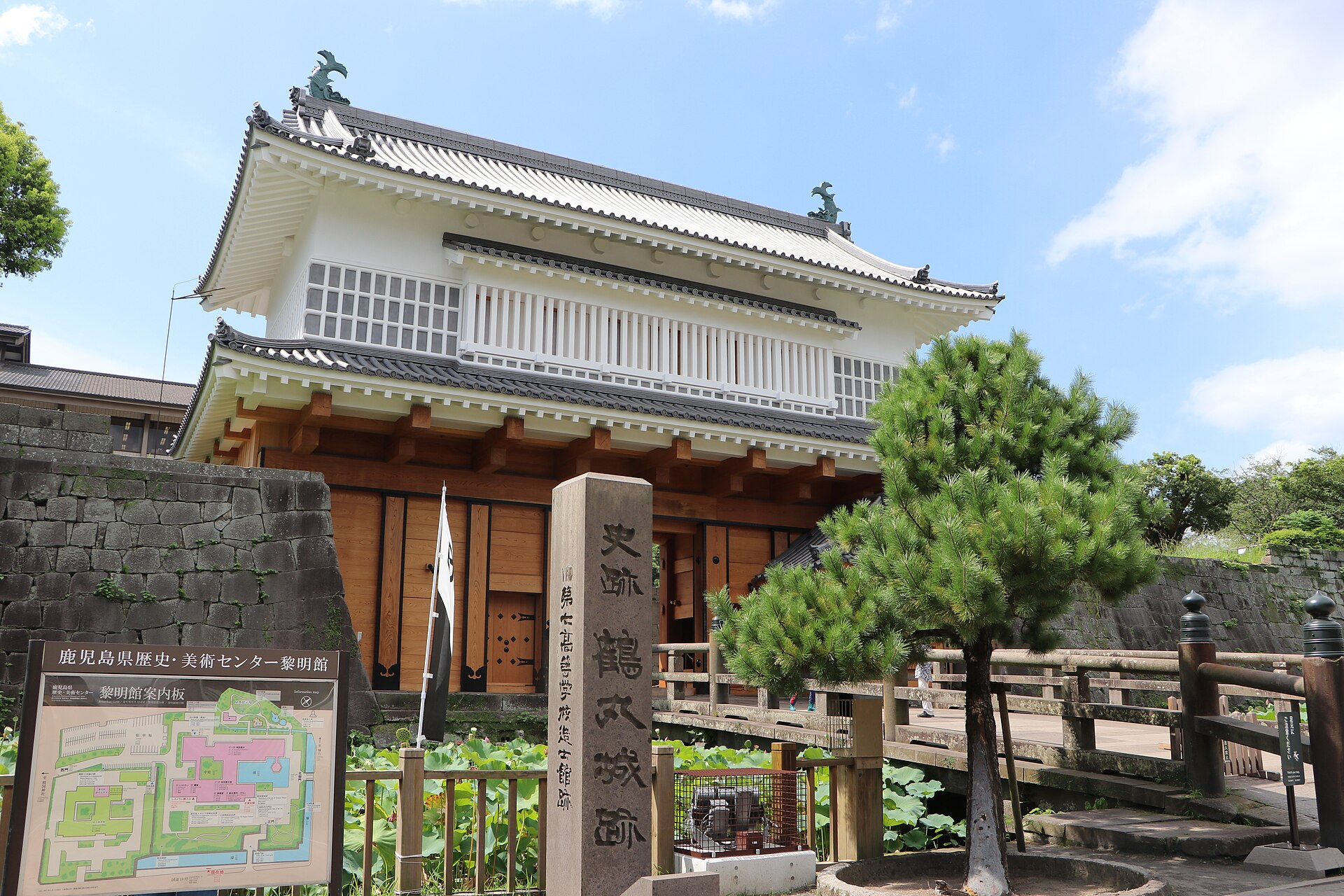
Kagoshima Castle, also known as Tsurumaru, was not given a keep. A specialist guide cites the saying that men serve as ramparts and adds caution toward the shogunate and the domain's finances; these explanations should be read as hypotheses. Its distinctiveness lies in its plan, in which the lord's residence and offices spread across the plain at the foot of Mount Shiroyama, whose relief provides the defence, following a medieval principle that pairs a lower residence with a hilltop fort. Shimazu Iehisa, first lord of the Satsuma domain, began it around 1601, just after Sekigahara, and the Shimazu resided there until the end of the feudal regime. The heights had already carried the Kamiyama fort, held from the late Kamakura period and passing to the Shimazu during the period of the Northern and Southern Courts. The site's history continued long after its abandonment in 1871: the main enclosure and the gate burned in 1873, the Satsuma Rebellion of 1877 turned the place into a battlefield, and the walls still bear the marks of bullets and shells. The former grounds later housed the Seventh Higher School, Kagoshima University, the Reimeikan museum and the prefectural library. The most visible feature today is the Goroumon gate, restored in 2020, a timber structure 20 metres high and wide, rebuilt on 18 original stone footings and financed more than half by donations. The national designation was extended and renamed in 2023 in light of the excavations linked to this project.
- Époque de construction
- 1601–1615
- Localisation
- Kagoshima, Préfecture de Kagoshima
- Protection
- Site historique national (国指定史跡), « Kagoshima-jō ato », extension et renommage de « Shiroyama » (2023)
- Accès au public
- Ouvert au public
- État
- Vestiges
- Usage actuel
- musée, bibliothèque, site historique