En un regard
Le château en bref
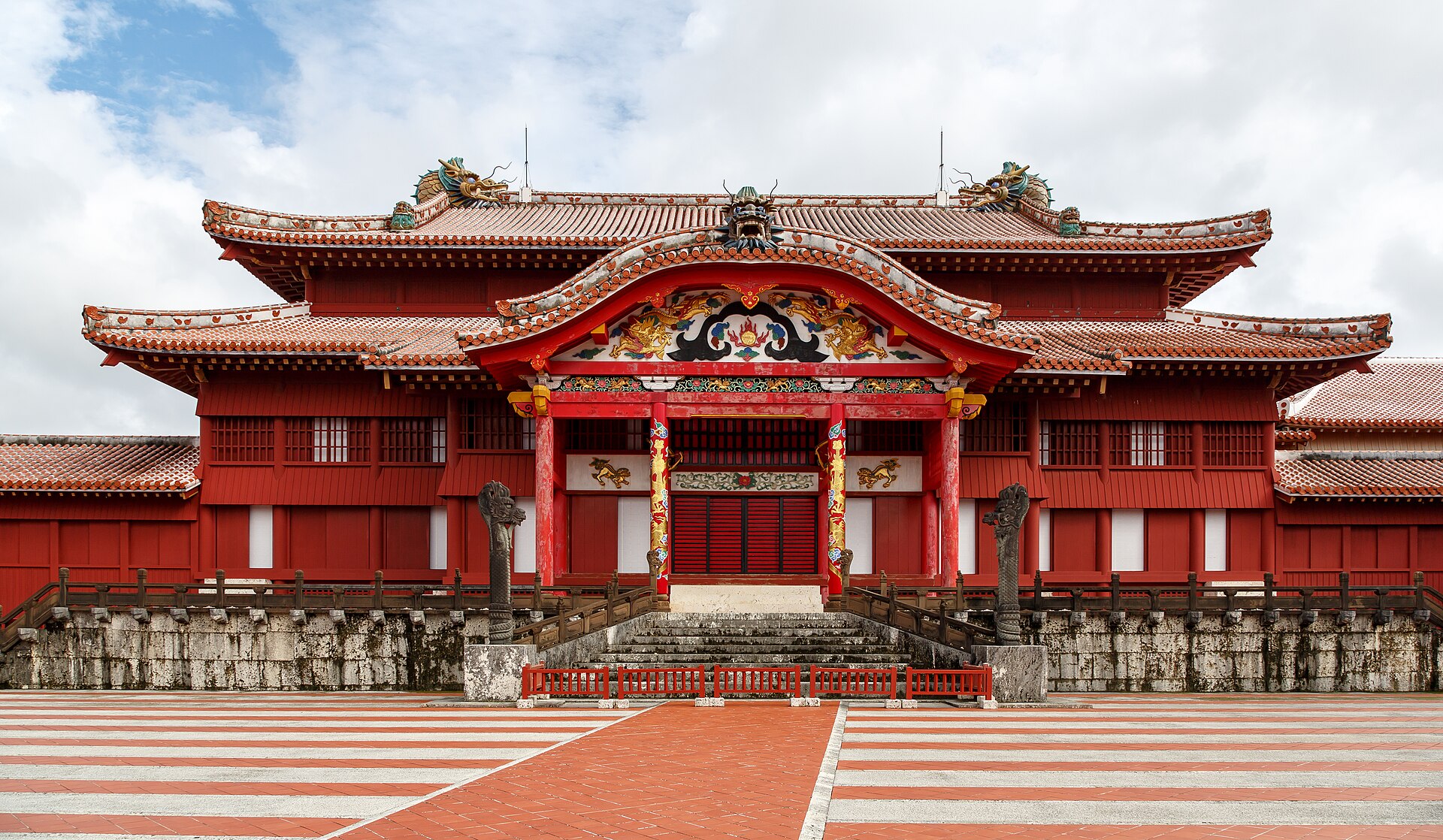
Palace and fortress of the kings of Ryukyu, Shuri crowns a hill overlooking Naha and its port at an altitude of about 130 metres. It differs from a classic Japanese castle: its coralline limestone wall, some 1,080 metres long, follows the terrain in curves and rises 6 to 15 metres with a thickness of about 3 metres, while the interior combines royal residence, administrative centre and places of worship, including some ten sacred spaces in the area known as Kyo no Uchi. The date of its foundation has not been established: institutions cite the middle or second half of the 14th century, others the early 15th, while the national record describes it as unknown. After Sho Hashi's unification of 1429, the site became the political centre of a maritime kingdom in contact with China and Japan, with a double enclosure completed in the 16th century. Its red-painted buildings, ordered along an east-west axis, and the Seiden with its carved dragons bear witness to these exchanges. Destroyed several times by fire, in 1453, 1660 and 1709, the palace had to be handed over to Japan in 1879, served for a time as a shrine, was listed as a national treasure in 1925 and was annihilated in 1945; the Japanese general staff had dug its tunnels beneath the hill. Rebuilt from 1989 using pre-war plans, it burned again on 31 October 2019. At the time of verification, the opening of the new Seiden was announced for 23 November 2026: this new building will be distinct from the archaeological remains that constitute the World Heritage component inscribed in 2000.