En un regard
Le château en bref
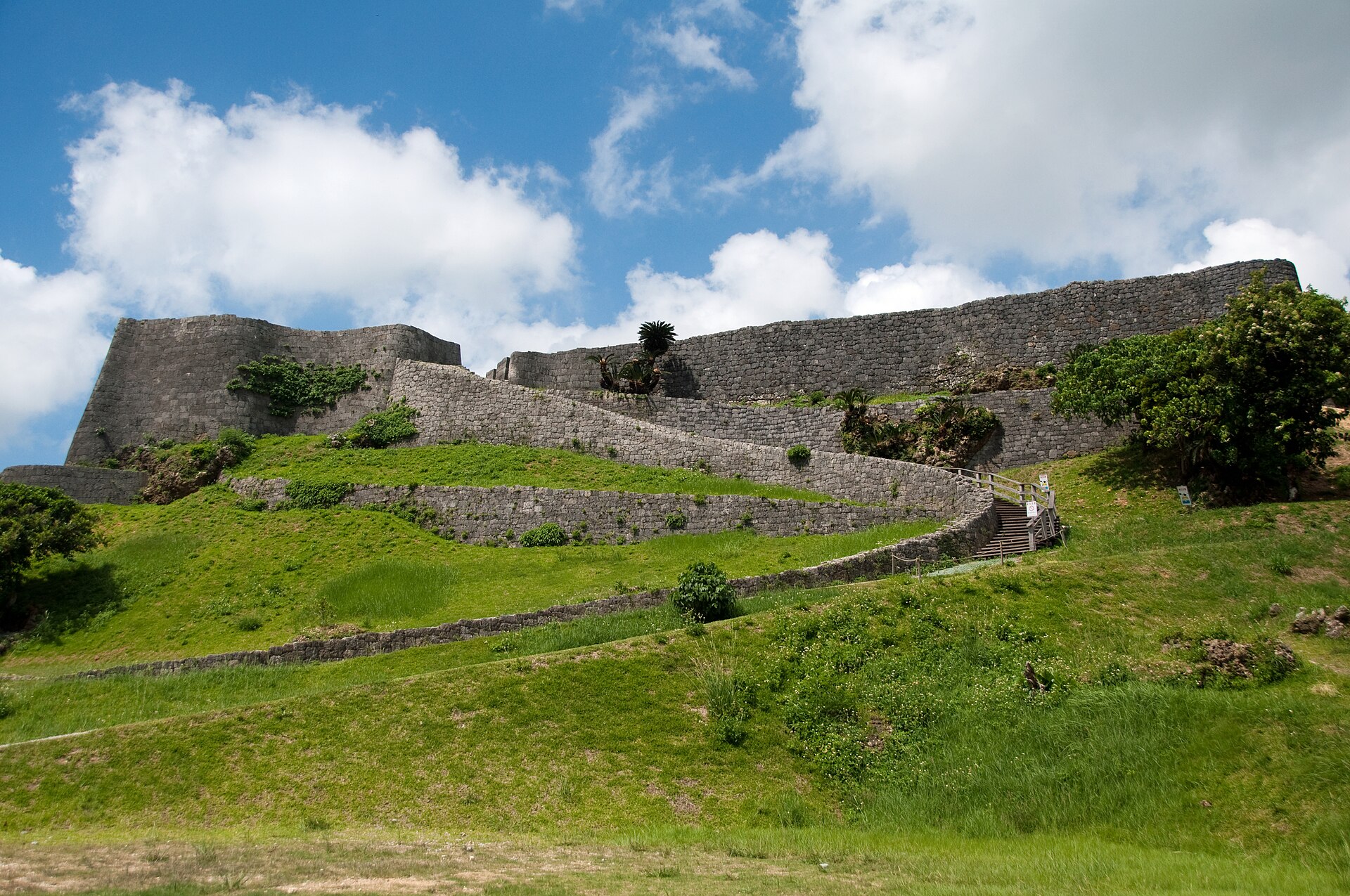
On a central height of the Katsuren Peninsula, in Uruma, the enclosures of this gusuku descend in terraces from a summit close to 98 m, before an eastern enclosure climbs again to the south-east. The site's management body describes four numbered enclosures and this eastern section, covering 11,897 m². The limestone walls follow the cliffs and natural relief, so that the defences owe as much to topography as to masonry. From the highest point the view extends over the bays of Nakagusuku and Kin. Sources date the emergence of the fortress to the 12th-13th centuries without allowing greater precision, and early human occupation is attested by shells found at the foot of the cliff. The 15th century belongs to Amawari, a lord whose rise rested on maritime trade and whose territory the Omorosaushi celebrate by likening it to Kamakura. King Shō Taikyū gave him his daughter in marriage, but the forces of Shuri took the castle in 1458; the management body acknowledges that the circumstances remain unclear. Excavations, begun as early as 1960, have yielded large quantities of Chinese ceramics, pieces from South-East Asia and Korea, Japanese-style tiles, parrot bones and coins. In 2016 the city announced that it had identified ten copper coins, including four Roman and one Ottoman, in the fourth enclosure; when and how they arrived has yet to be established. Conservation of the walls began in 1977.
- Époque de construction
- XIIe-XIIIe siècles
- Localisation
- Uruma, Préfecture d'Okinawa
- Protection
- Site historique national (国指定史跡) (1972)
- Accès au public
- Ouvert au public
- État
- Vestiges
- Usage actuel
- site archéologique visitable, musée d'histoire