En un regard
Le château en bref
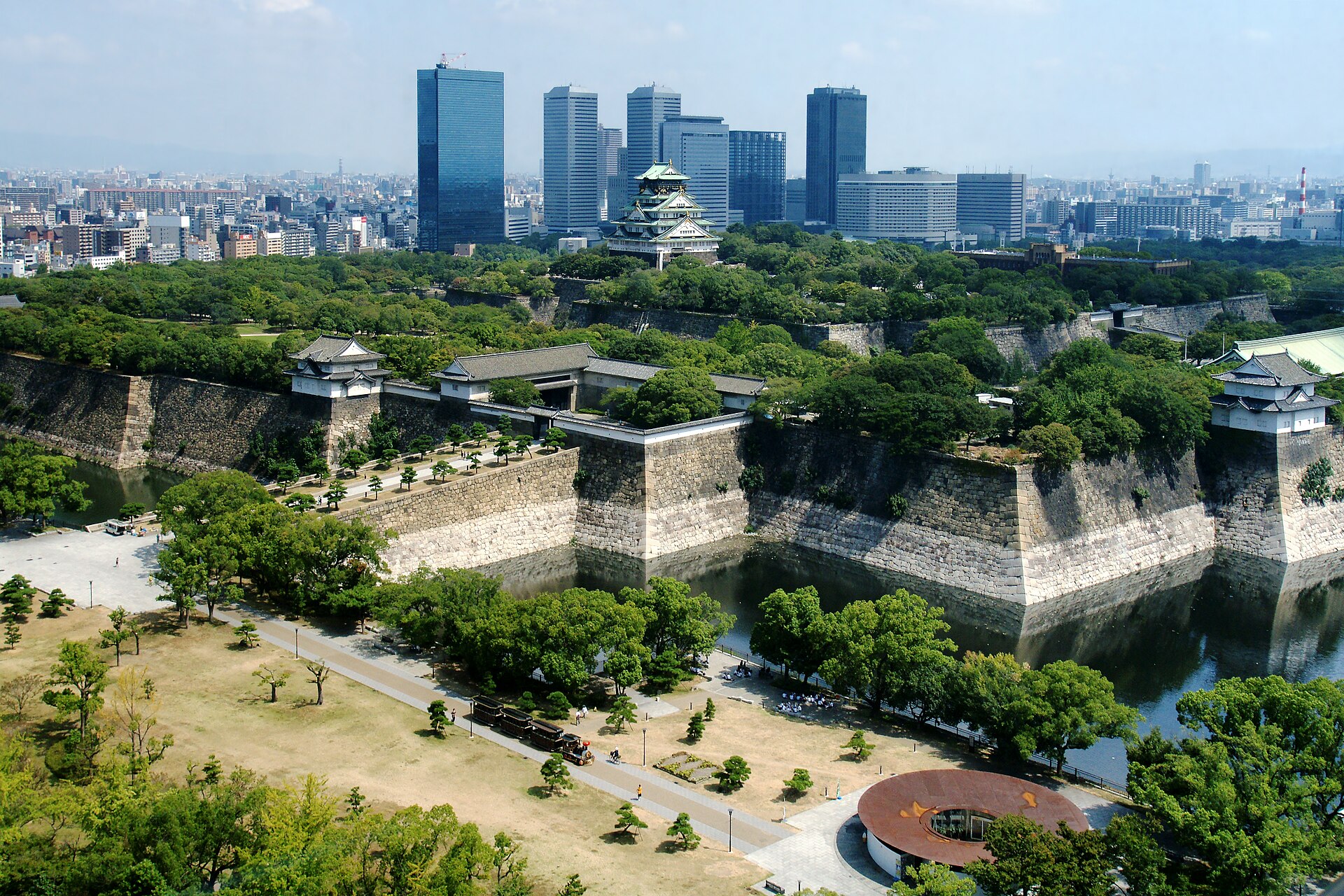
The Uemachi plateau carries several superimposed layers of history. The Hongan-ji settled here as early as 1496, became the seat of its movement in 1532, and was destroyed by fire at the end of the war against Oda Nobunaga. In September 1583 Toyotomi Hideyoshi began a vast castle here, whose honmaru was finished in 1585. That castle was wiped out in the summer siege of 1615, and the Toyotomi remains lie buried beneath later works. The shogunate, which placed the city under direct administration in 1619, had an entirely new fortress built between 1620 and 1629 in three phases, with 64 daimyō families mobilised for the stonework and moats. Some 12 km of walls and nearly 430 sections survive, bearing about 2,000 types of masons' marks on 50,000 to 60,000 blocks; the Tako-ishi stone at the Sakuramon gate reaches about 59 m². The Tokugawa tenshu, completed in 1626, was struck by lightning in 1665 and never rebuilt. Many buildings were lost in 1868, and the site became a military base with an arsenal. The present tenshu, opened in November 1931, was born of a public subscription: built in steel-framed reinforced concrete, it takes on the appearance of the Toyotomi keep without being a copy of a surviving building. With its base it rises to 52.7 m. Thirteen Edo-period buildings are Important Cultural Properties. On 16 October 2026 the Council for Cultural Affairs recommended that the tenshu be listed; this recommendation does not yet amount to a designation.
- Époque de construction
- 1620–1629
- Localisation
- Osaka, Préfecture d'Osaka
- Protection
- Site historique spécial (特別史跡) (1955)
- Accès au public
- Ouvert au public
- État
- Restauré
- Usage actuel
- parc public, musée d'histoire