En un regard
Le château en bref
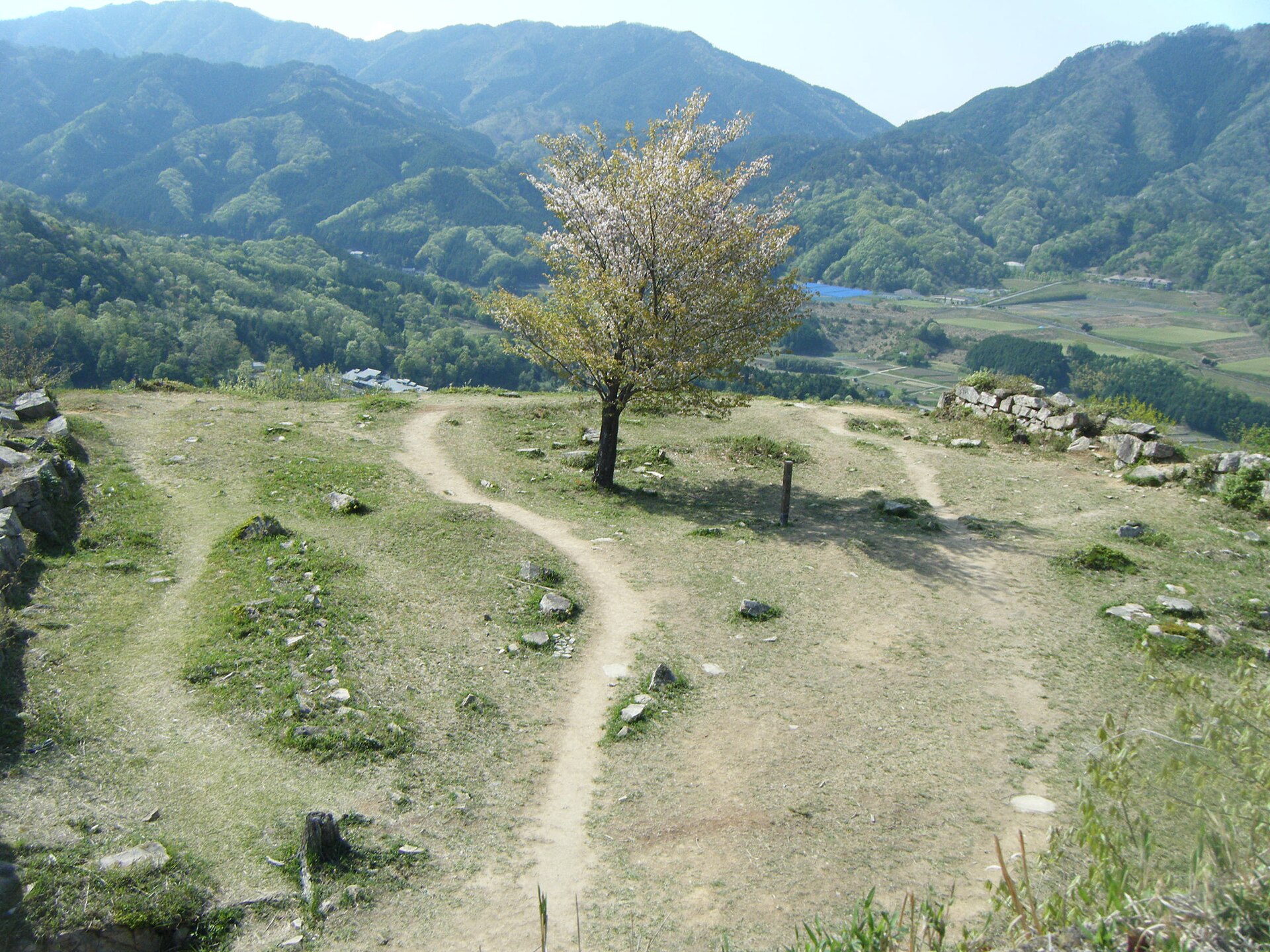
Rising above the Maruyama valley, the 353-metre peak bears a rare example of a Japanese mountain castle that has retained its stone walls. The history of the site begins in the fifteenth century: tradition holds that Yamana Mochitoyo began the works around 1431, and that the Ōtagaki, his vassals, held the stronghold over several generations. The campaigns waged for Oda Nobunaga in Tajima, between 1569 and 1580, overturned this balance. Kuwayama Shigeharu was subsequently granted the castle, and then Akamatsu Hirohide in 1585.
The present appearance is attributed to this final phase: a honmaru at the centre, a tenshudai, and stone terraces descending towards the Kita-Senjō and Minami-Senjō esplanades, whose layout evokes a bird with outstretched wings. The scale of the masonry suggests backing from the Toyotomi regime. Hirohide, who had switched from the Western camp to the Eastern camp in 1600, was forced to commit suicide after the fire at Tottori, and the castle was abandoned. Though not dismantled in depth, the site came under the authority of Ikuno after 1615. Designated in 1943, it retains its walls but no buildings.
- Époque de construction
- 1431–1600
- Localisation
- Asago, Préfecture de Hyōgo
- Protection
- Site historique national (国史跡) (1943)
- Accès au public
- Ouvert au public
- État
- En ruine
- Usage actuel
- Site archéologique, Site touristique