
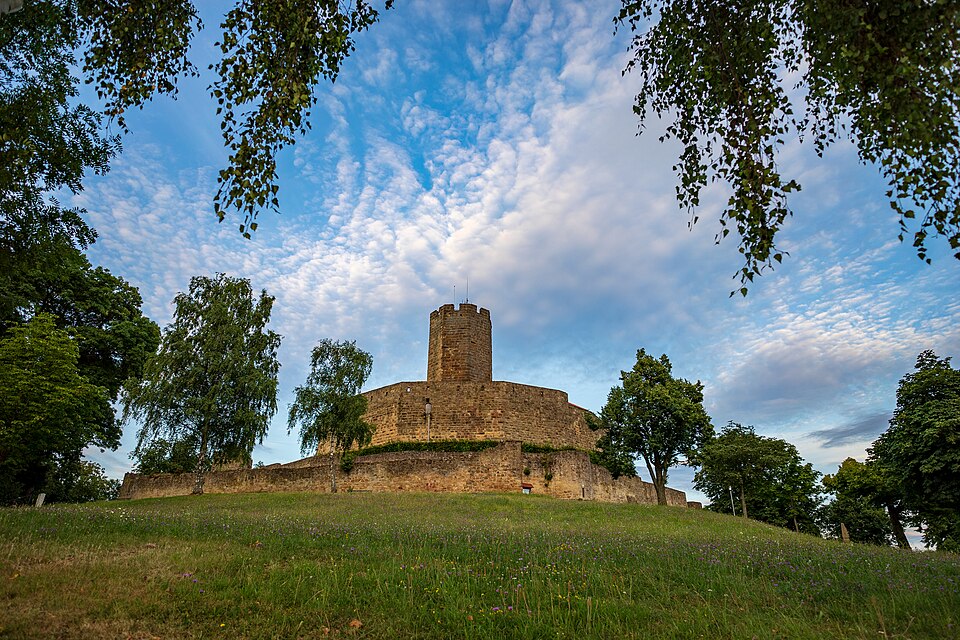
Rottenburg am Neckar (Weiler)
Weiler Burg
enfance et jeunesse présumées (tradition) · XIIIe siècle
→Countess of Hohenberg (by birth) · Countess of Habsburg · Queen of the Romans (1273–1281)
Gertrude of Hohenberg, who became Queen Anne in 1273, was the wife of Rodolphe de Habsburg and the mother of Albert Ier: through her descended the line that made the Habsburgs one of the great dynasties of Europe. Daughter of the Swabian Count Burkhard III of Hohenberg and of Mechthild, of the Counts Palatine of Tübingen, she was born around 1225–1235; the NDB places her birth at Deilingen. Married to Rodolphe before March 1254, she was crowned at Aachen on 24 October 1273, after her husband's election as King of the Romans, and shortly afterwards adopted the name Anne. The couple held their court in Vienna from 1277. She died there in January 1281 and was buried, at her wish, in Basel Cathedral, before her remains moved to Saint-Blaise and then to Sankt Paul im Lavanttal. A local tradition, which no contemporary document confirms, places her childhood and youth at the Weilerburg, the former Rotenburg of the Counts of Hohenberg overlooking Rottenburg am Neckar.
Born into the comital nobility of the Upper Neckar, Gertrude married a count who was then still only regional, Rodolphe of Habsburg. His election as king in 1273 transformed the countess into a queen: crowned at Aachen, she adopted the name Anne, perhaps under the influence of the growing cult of the Virgin's mother. Their many children produced the alliances that anchored the dynasty in Austria.
Weiler BurgBirth of Gertrude, daughter of Count Burkhard III of Hohenberg and Mechthild of Tübingen.
Marriage to Count Rodolphe of Habsburg.
Crowned at Aachen; she still signed “Gertrude” that day and shortly afterwards took the name Anne.
The royal couple establish their court in Vienna.
Dies in Vienna; buried at her request in Basel Cathedral.
A gilded crown removed from her tomb joins the treasury of Basel Cathedral.
Historicist statue of the queen after the engravings in Francesco Terzio's Imagines Domus Austriae (Kunsthistorisches Museum, Vienna).
Translation of her remains to Saint-Blaise, then to Sankt Paul im Lavanttal (Carinthia).
The Weilerburg, formerly called Rotenburg, belonged to the Counts of Hohenberg at the latest by the 13th century. Local tradition holds that Gertrude grew up there; this claim is not supported by any document from the period and should be read as a memory attached to the place. The NDB, for its part, places her birth at Deilingen. The castle passed to the Habsburgs only in 1381, a century after her death.
Dying in Vienna, the queen wished to rest in Basel, where her tomb survives in the cathedral. Her remains were nevertheless transferred in 1770 to the abbey of Saint-Blaise in the Black Forest, then in 1807, after secularisation, to Sankt Paul im Lavanttal in Carinthia, where they still lie.
The Renaissance Habsburgs kept the memory of their ancestor alive: a statue from the second half of the 16th century, held at the Kunsthistorisches Museum in Vienna, depicts her after the engravings in Francesco Terzio's Imagines Domus Austriae. It is a reconstructed effigy, not a portrait.
Cette synthèse croise plusieurs sources pour documenter les lieux, événements et relations historiques.