
Fukui
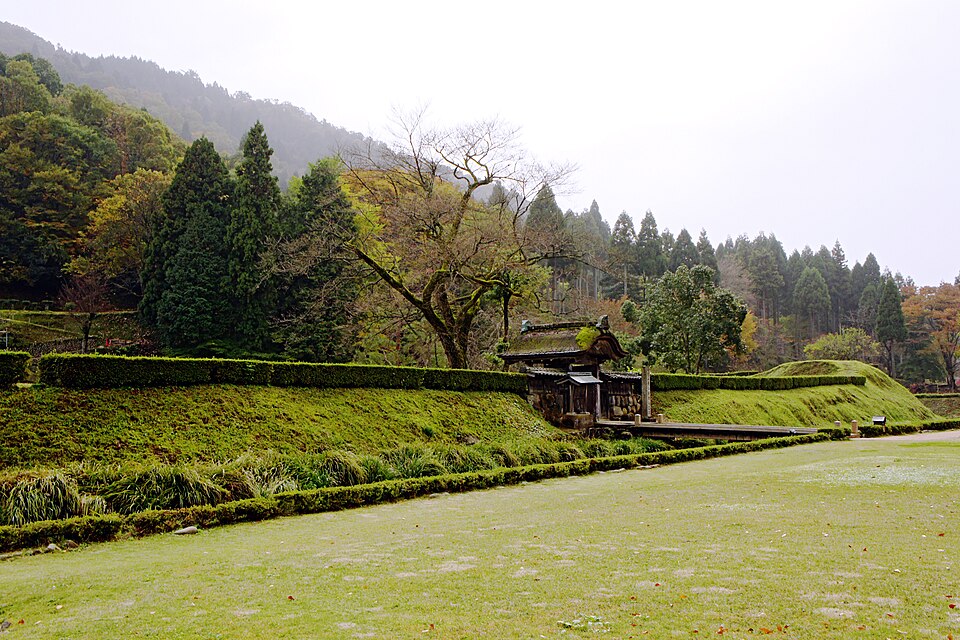
Château d'Ichijōdani
Dernier seigneur (1548-1573)
→Lord of Ichijōdani Castle · Saemon no kami
Asakura Yoshikage (1533-1573) is the eleventh and last head of the Asakura clan, master of Echizen Province from the fortified valley of Ichijōdani. Lord of Ichijōdani Castle from 1548, he turned his capital into a cultural hub modelled on Kyoto, hosting poets, scholars and the future shōgun Ashikaga Yoshiaki. Allied with Azai Nagamasa against Oda Nobunaga, he was defeated at Anegawa in 1570, then at Tonezaka in 1573. Betrayed by his cousin Asakura Kageakira, he took his own life at Kenshō-ji temple in Ōno while Nobunaga set fire to Ichijōdani. The ruins of his city, excavated since 1967, now form a Special Historic Site of Japan.
Under Yoshikage, the Ichijōdani valley, closed off by two gates and overlooked by a mountain castle, became one of the most refined cities in sixteenth-century Japan. The lord, trained in waka poetry, painting and Zen, hosted poetry gatherings there and a kyokusui banquet in 1562. His portrait, preserved at Shingetsu-ji temple in Fukui, is designated an Important Cultural Property.
Château d'IchijōdaniBorn at Ichijōdani Castle, son of Asakura Takakage; childhood name Nobukage.
Succeeds his father as head of the clan and lord of Ichijōdani.
Receives a character from the name of shōgun Ashikaga Yoshiteru and takes the name Yoshikage.
Organises a kyokusui poetry banquet in his castle town.
Hosts Ashikaga Yoshiaki in exile at Ichijōdani, without escorting him to Kyoto; Yoshiaki then turns to Nobunaga.
Siege of Kanegasaki, followed by defeat at the Battle of Anegawa alongside Azai Nagamasa against Oda Nobunaga and Tokugawa Ieyasu.
Defeat at Tonezaka; Nobunaga sets fire to Ichijōdani. Betrayed by Asakura Kageakira, Yoshikage takes his own life at Kenshō-ji in Ōno. End of the Asakura clan.
Refusing to escort Ashikaga Yoshiaki to Kyoto, Yoshikage left Nobunaga to assume the role of the shōgun's protector. The rivalry degenerated into open war: Kanegasaki and Anegawa in 1570, then the campaign of 1573 that ended in the burning of Ichijōdani and the lord's suicide. The city, buried, was not rediscovered until the twentieth century.
Cette synthèse croise plusieurs sources pour documenter les lieux, événements et relations historiques.