
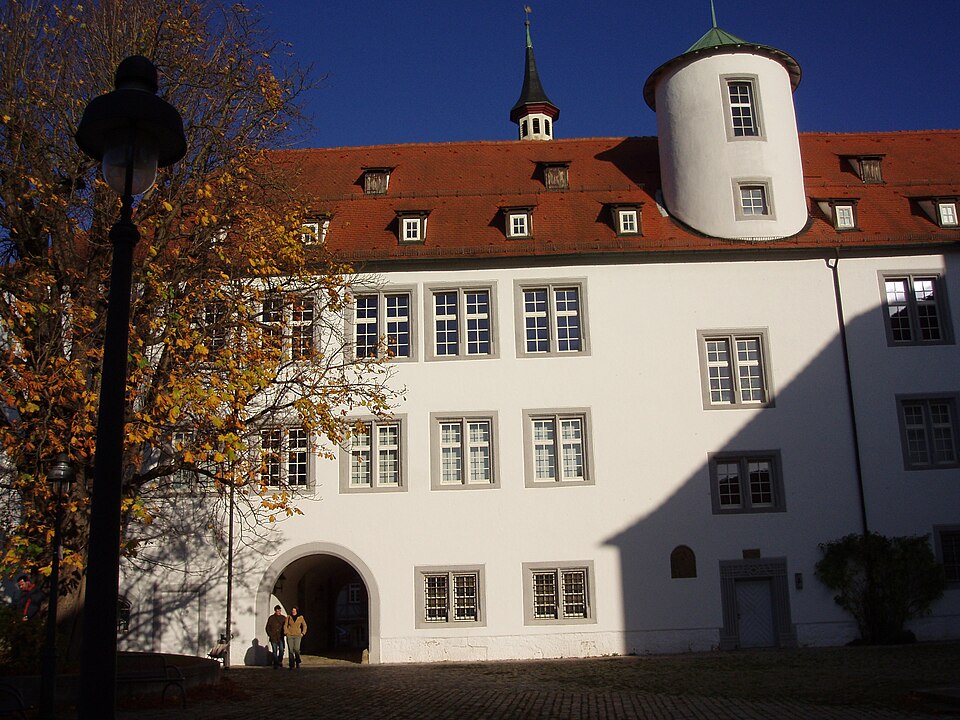
Waldenbuch
Schloss Waldenbuch
architecte de l'aile sud · 1717
→architect and director of buildings to the Duke of Württemberg (1715) · Landbaumeister (1717) · lieutenant colonel (1726)
Donato Giuseppe Frisoni (1683-1735) was the architect who gave Duke Eberhard Ludwig's Württemberg its Baroque face. Born in Laino, near Lake Como, into a family of artists from northern Italy, he first worked as a stuccoer in Vienna, Passau and Prague before being called in 1709 to the building site of Ludwigsburg Palace. With no formal training as an architect, he succeeded Johann Friedrich Nette as head of the works in 1715, despite the reservations of the building commission. He completed his predecessor's tripartite wing, designed the new central block, the galleries and pavilions, the Favorite and the regular plan of the town of Ludwigsburg, and supplied designs for Weingarten Abbey. At Schloss Waldenbuch, former hunting lodge of the dukes, he drew up in 1717 a three-storey south wing that fits with restraint between the Renaissance buildings. Accused of embezzlement after the duke's death in 1733, he was acquitted shortly before dying in Ludwigsburg.
Frisoni belonged to those families of artisans from the Lombard lakes who spread across Baroque Central Europe. Trained in stucco and active in Prague, Vienna and Passau, he arrived at Ludwigsburg as a decorator; it was the sudden death of Nette in 1714 that opened to him, against the advice of the building commission, the direction of the duchy's largest building site.
Schloss WaldenbuchBorn in Laino, in the Como region.
Stuccoer in Prague, notably at the Sternberg Palace (1706); also worked in Vienna and Passau.
Called to the Ludwigsburg site as associate of Tommaso Soldati; directs his own team from 1712.
Succeeds Johann Friedrich Nette as palace architect; beginning of the Baroque town of Ludwigsburg.
Appointed Landbaumeister; draws the south wing of Waldenbuch Castle, begins the Favorite and supplies plans for Weingarten.
New central block, galleries and pavilions of Ludwigsburg Palace.
After the death of Eberhard Ludwig, arrested with Paolo Retti for alleged embezzlement.
Acquitted, he dies a few months later in Ludwigsburg (29 November); buried in Öffingen.
In 1717, just as he became Landbaumeister, Frisoni received from the duke the commission for a new wing for the Waldenbuch hunting lodge. He inserted it between the east wing and the kitchen building, respecting the sobriety of the neighbouring Renaissance constructions and reserving the Baroque taste for the interior fittings. The main entrance, with a double-flight staircase, is located in this wing, at the corner of the kitchen building.
Beyond the palace, whose tripartite wing he completed before designing the new central block, the galleries and the pavilions, Frisoni fixed the regular plan of the new town of Ludwigsburg, with its symmetrical streets and its arcaded market square. His drawings are still preserved and his stucco decorations adorn several rooms of the palace.
The death of Eberhard Ludwig in 1733 deprived Frisoni of his protector. Accused with Paolo Retti of misappropriating funds, he was arrested, then cleared in 1735, only a few months before his death in Ludwigsburg.
Cette synthèse croise plusieurs sources pour documenter les lieux, événements et relations historiques.