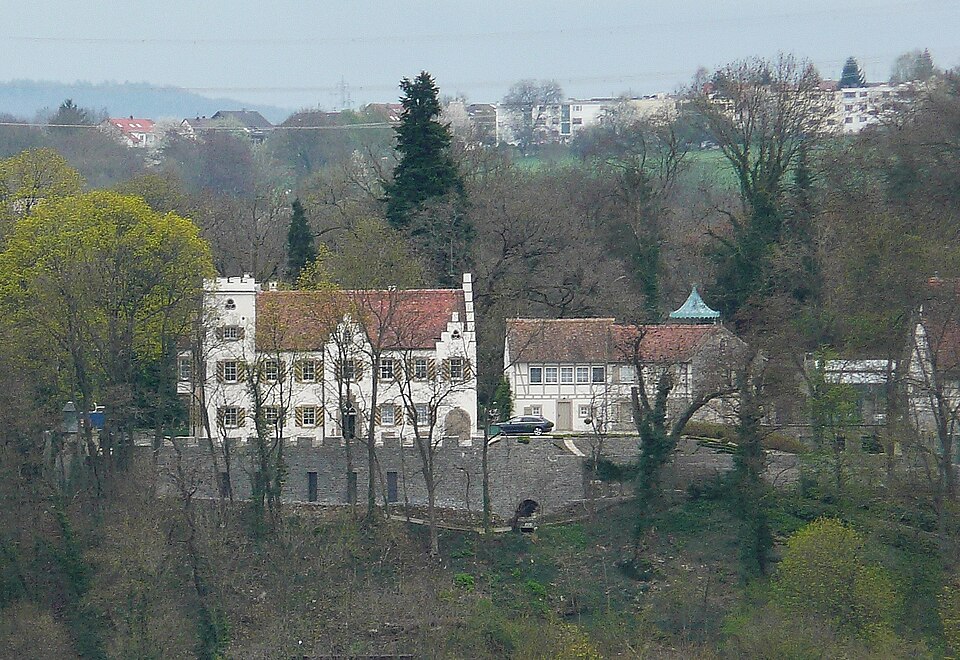
Lichtenstein (Honau)
Ruine Alt-Lichtenstein
comte visé par la guerre impériale de 1311
→Count of Württemberg · imperial advocate of Lower Swabia (under Albert I)
Eberhard I of Württemberg, known as ‘the Illustrious’ (der Erlauchte), born posthumously in Stuttgart on 13 March 1265 and died in the same city on 5 June 1325, governed the County of Württemberg from 1279–1280. A dogged opponent of the policy of recovering imperial property pursued by Rudolf of Habsburg, then by Henry VII, he was placed under the imperial ban in 1310. The imperial war of 1310–1312 saw the occupation of most of his lands, the destruction of the family necropolis at Beutelsbach, and the destruction of Württemberg castles, including Burg Rems, at the confluence of the Rems and the Neckar, and Vieux-Lichtenstein, ravaged by Reutlingen in 1311. The death of Henry VII in 1313 and the double election of 1314 allowed him to recover everything and enlarge his county, of which he made Stuttgart the capital.
The conflict of 1310–1312 constitutes the most serious crisis of the young county: the Swabian imperial cities and the troops of the imperial advocate occupy most of Württemberg. Several Württemberg castles then disappear, such as Burg Rems, above the confluence of the Rems and the Neckar, or Vieux-Lichtenstein, set on fire by Reutlingen in 1311. The disappearance of Henry VII in 1313 reverses the situation in favour of the count.
Ruine Alt-LichtensteinPosthumous birth in Stuttgart, son of Count Ulrich I and Agnes of Silesia-Liegnitz.
Becomes count on the death of his half-brother Ulrich II (1279), then governs alone after the death of his guardian Hartmann I of Grüningen (1280).
Rudolf of Habsburg besieges Stuttgart, has its walls pulled down, then destroys the fortifications in the surrounding area.
Supports Albert I after the deposition of Adolf of Nassau and receives the advocacy of Lower Swabia.
Placed under the imperial ban by Henry VII following complaints from the Swabian imperial cities; the imperial war leads to the occupation of most of his county and the destruction of the Beutelsbach necropolis; he has to flee.
Troops from Reutlingen destroy the castle of Vieux-Lichtenstein as part of the imperial war against Eberhard.
Burg Rems, a Württemberg border post at the confluence of the Rems and the Neckar, is destroyed during the conflict between Eberhard and Henry VII; it will be rebuilt by the Nothaft, vassals of Württemberg.
Death of Henry VII, which spares Württemberg a definitive defeat.
A supporter of Frederick the Fair during the double election, he recovers his lands and concludes peace with Esslingen in 1316.
Dies in Stuttgart, leaving a county enlarged by roughly half; buried in the Stiftskirche.
1310-1312 · Placed under the imperial ban, Eberhard loses most of his lands; the Beutelsbach necropolis and several castles are destroyed. He recovers them after the death of Henry VII (1313).
Comté de WurtembergCette synthèse croise plusieurs sources pour documenter les lieux, événements et relations historiques.