
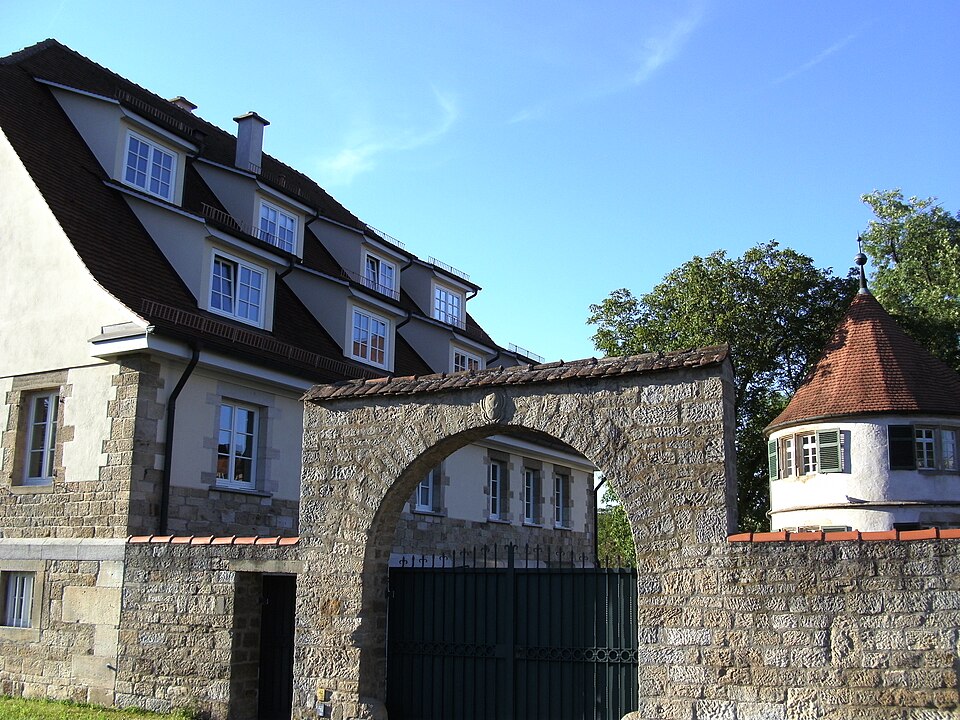
Tübingen (Kilchberg)
Schloss Kilchberg
seigneur et bâtisseur du logis gothique tardif · fin du XVe siècle - 1508
→knight (dubbed at Prague in 1453) · chamberlain at the Austrian court · governor of Montbéliard · chief bailiff (Obervogt) of Tübingen · lord of Kilchberg
Georg von Ehingen (1428-1508) embodies the Swabian knight of the late Middle Ages, torn between distant adventure and service to a territorial prince. Born at Hohenentringen Castle, son of the Württemberg councillor Rudolf von Ehingen, he first built his career at the Austrian court before undertaking two great journeys: to Rhodes and the Holy Land, then, from 1456 to 1459, to the Iberian Peninsula, where he fought at Ceuta for the King of Portugal and before Granada alongside the Castilians, passing through the courts of France, England and Scotland. The account he produced from these travels counts among the first noble autobiographies in the German language. Back in Swabia, he became one of the most influential advisers of Count Eberhard le Barbu: diplomat, governor of Montbéliard and chief bailiff of Tübingen, he took part in preparing the foundation of the university. Lord of Kilchberg, he had the late Gothic residential building that forms the heart of the present castle erected there at the end of the fifteenth century, and he died there in 1508.
Georg von Ehingen's travels followed a chivalric ideal rather than a political mission: seeking glory at the courts and on the frontiers of Christendom. After a first eastern journey, marked by captivity and ransom, he reached the Atlantic and the western Mediterranean, fighting the Moors at Ceuta and before Granada before returning through England and Scotland.
Schloss KilchbergBorn at Hohenentringen Castle, son of Rudolf von Ehingen.
The von Ehingen family succeeds the Lescher family at Kilchberg.
Dubbed knight at Prague; in the service of the Austrian court, where he becomes chamberlain.
Journey to Rhodes and the Holy Land, where he is captured and then ransomed.
Second journey: fighting at Ceuta for Portugal and before Granada with Castile; visits to the courts of France, England and Scotland.
Adviser to Count Eberhard le Barbu: diplomat, arbitrator, governor of Montbéliard, chief bailiff of Tübingen; helps prepare the foundation of the university (1477).
Has a late Gothic stone house built at Kilchberg on the foundations of the Staufen-era castle, retaining the octagonal moat.
Portrait of the knight on a wing of the altarpiece of the Kilchberg chapel, now in the Staatsgalerie Stuttgart.
Dies at Kilchberg.
First printed edition of his travel account at Augsburg (reissued in 1843 under the title Reisen nach der Ritterschaft).
His travel account, probably intended for his descendants, is considered one of the first noble autobiographies in German. The manuscript preserved in Stuttgart is accompanied by nine portraits of the sovereigns he met; the text was printed at Augsburg in 1600 and reissued in 1843.
Back in Swabia, Ehingen put his experience at the service of Württemberg: regent, negotiator and arbitrator, governor of Montbéliard, chief bailiff of Tübingen, he was associated with the preparations for the foundation of the University of Tübingen and was active within the Swabian League.
His family had held Kilchberg since 1438. At the end of the fifteenth century, Georg had a late Gothic stone house built there on the foundations of the Staufen-era castle, retaining the rare octagonal moat; the annexes added at the beginning of the sixteenth century then gave the castle its present silhouette. The chapel altarpiece, painted around 1490-1495 in the circle of Bartholomäus Zeitblom, showed him as a donor; it is now in the Staatsgalerie Stuttgart.
Cette synthèse croise plusieurs sources pour documenter les lieux, événements et relations historiques.