
Gomaringen
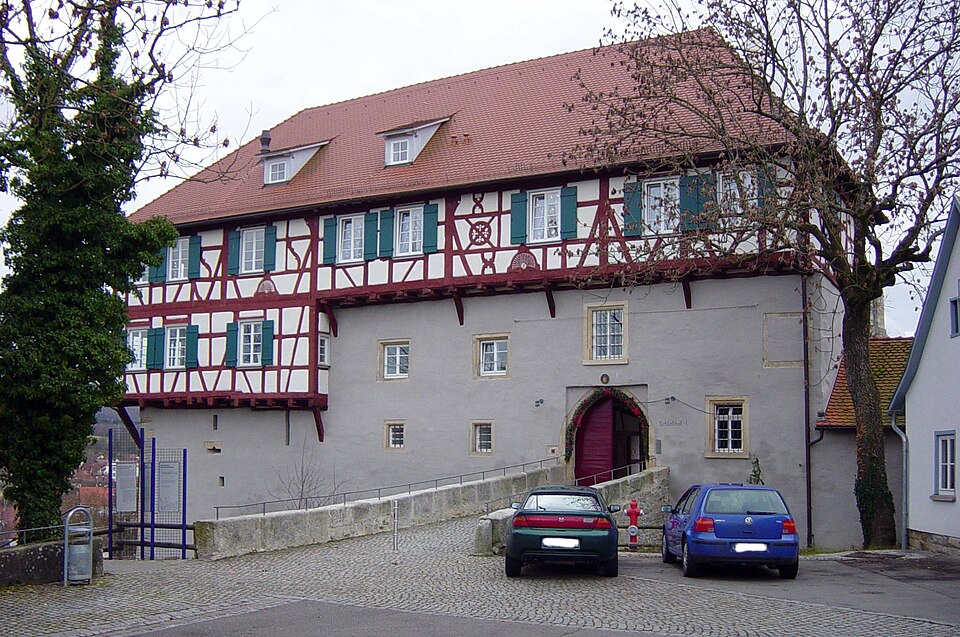
Gomaringer Schloss
pasteur de Gomaringen résidant au château-presbytère · 1837-1841
→pastor of Gomaringen (1837-1841) · dean (1842) · Oberkonsistorialrat (1845)
Gustav Schwab (1792-1850) was one of the central figures of the Swabian poets' circle, alongside Ludwig Uhland and Justinus Kerner. Born and died in Stuttgart, trained at the Tübingen Stift, he taught classical languages at the upper school (gymnase supérieur) in Stuttgart, directed the poetry section of Cotta's Morgenblatt, and co-edited the Deutscher Musenalmanach with Adelbert von Chamisso, supporting young authors such as Lenau and Freiligrath. His lasting reputation rests above all on his Die schönsten Sagen des klassischen Altertums, written largely between 1838 and 1840 while he was pastor at Gomaringen. From 1837 to 1841 he lived and carried out his duties at Gomaringen Castle, then a Protestant parsonage; there he received Uhland, Kerner and Lenau. Back in Stuttgart, he ended his career as dean and then as councillor of the Upper Consistory. The castle today houses a museum dedicated to him, installed in his former apartment.
More than through his own poetry, Schwab counted as a conduit: responsible for the poetry column of Cotta's Morgenblatt and jointly in charge of the Deutscher Musenalmanach, he opened its pages to a generation of young authors, including Lenau and Freiligrath, and maintained the network of friendships born at the Tübingen Stift with Uhland and Kerner.
Gomaringer SchlossBorn in Stuttgart on 19 juin.
Studies at the Tübingen Stift; friendship with Uhland, Kerner and Karl Mayer.
Professor of classical languages at the upper school (gymnase supérieur) in Stuttgart.
Marries Sophie Karoline Gmelin.
Publishes Der Bodensee, a literary and landscape guide.
Directs the poetry section of the Morgenblatt für gebildete Stände (the ADB gives 1827-1837).
Appointed pastor at Gomaringen; he settles in the castle, which serves as the parsonage.
Publication of Schönsten Sagen des klassischen Altertums, largely written at Gomaringen.
Publishes a life of Schiller, also written at Gomaringen.
Returns to Stuttgart.
Councillor of the Upper Consistory (Oberkonsistorialrat).
Dies in Stuttgart on 4 novembre; buried in the Hoppenlau cemetery.
Opening of the castle museum dedicated to Gustav Schwab, in his former apartment.
Appointed in 1837 to Gomaringen, a village at the foot of the Swabian Jura, Schwab lodged in the castle, then the parish parsonage. These four years were among the most productive of his life: he wrote numerous poems there, his biography of Schiller, and most of his legends of antiquity. Uhland and Kerner came to visit him there, and Lenau, passing through, amused himself with his Swabian accent. He returned to Stuttgart in 1841.
Published from 1838 to 1840, Die schönsten Sagen des klassischen Altertums offers a continuous version of Greek and Roman myths aimed at a broad readership. The work, reprinted again and again, shaped knowledge of mythology in the German-speaking world for generations.
Since 1998, two rooms on the upper floor of the castle, corresponding to the pastor's apartment, have presented images, documents and first editions connected with his stay, with an emphasis on his works devoted to the Swabian Jura. The circuit was designed in collaboration with the Arbeitsstelle für literarische Museen in Marbach.
Cette synthèse croise plusieurs sources pour documenter les lieux, événements et relations historiques.