
Tokushima
Château de Tokushima
Fondateur (1585-1586)
→Lord of Awa · Lord of Tokushima
Son of Hachisuka Masakatsu, a companion of Toyotomi Hideyoshi, Hachisuka Iemasa (1558–1639) founded Tokushima Castle and became the ancestor of the line that governed Awa Province until the Meiji period. Rewarded in 1585 after the Shikoku campaign with Awa Province, estimated at about 175,000 koku, he briefly settled at Ichinomiya Castle before building Tokushima Castle on Mount Shiroyama between 1585 and 1586, surrounded by rivers and moats. He took part in the Korean campaigns. In 1600 he withdrew, citing illness, while his son Yoshishige joined the Eastern Army, which ensured the domain was preserved. Having become a monk under the name Hōan, he continued to advise his house until his death in Tokushima.
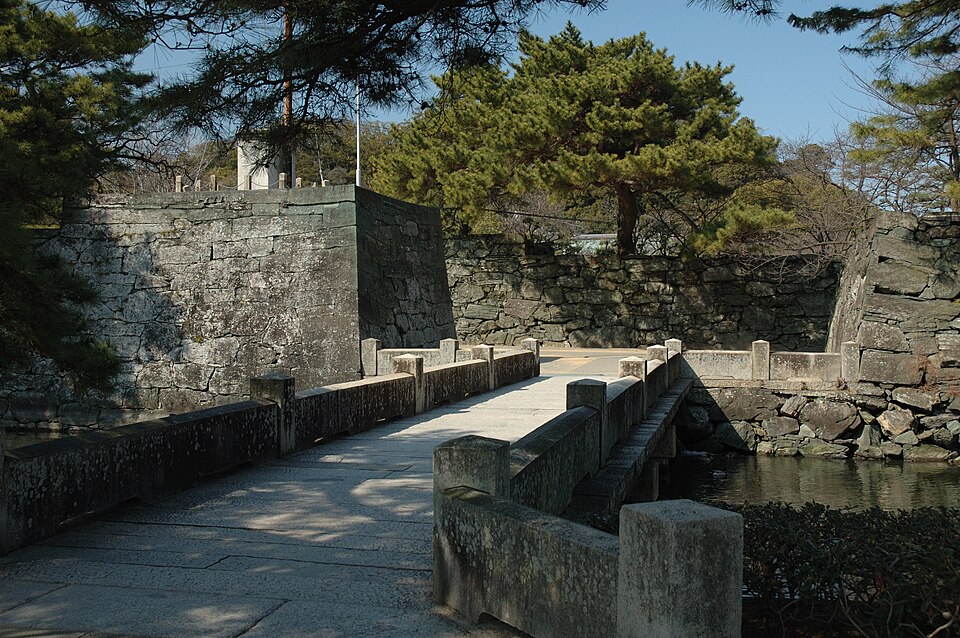
Lord of Awa in 1585, Iemasa chose Mount Shiroyama, a hill already fortified in the 14th century, as the site of his capital. The castle, completed in 1586, aligns its enclosures along the ridge and places the palace at the foot of the hill, protected by rivers and moats; its walls of local green schist remain its signature. Around 1600, the garden of the Omote-goten was laid out, today a place of picturesque beauty.
Château de TokushimaBorn in Owari Province, son of Hachisuka Masakatsu.
Fights at the Battle of Yamazaki alongside Hideyoshi.
Receives Awa Province after the Shikoku campaign and begins construction of Tokushima Castle.
Completion of Tokushima Castle.
Takes part in the Korean campaigns (Bunroku and Keichō).
Does not take part in Sekigahara; his son Yoshishige serves in the Eastern Army, which preserves the domain. Iemasa becomes a monk under the name Hōan.
Dies in Tokushima.
In 1600, Iemasa, attached to the Western Army, withdrew on the pretext of illness while his son Yoshishige fought for Tokugawa Ieyasu. This double stance allowed the Hachisuka to retain Awa; Iemasa, having become a monk under the name Hōan, remained a tutelary figure of the domain.
Cette synthèse croise plusieurs sources pour documenter les lieux, événements et relations historiques.