
Köngen
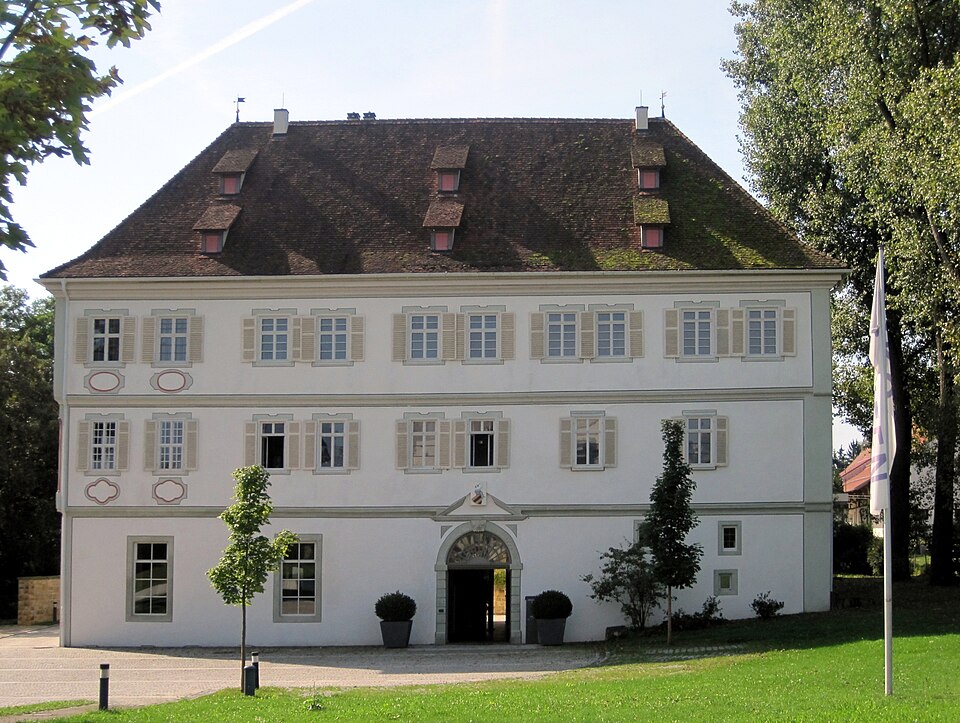
Schloss Köngen
architecte ducal · 1614-1620
→Landbaumeister of the Duchy of Württemberg (1608)
Heinrich Schickhardt (Herrenberg, 1558 – Stuttgart, 1635) was the leading architect and engineer at the court of Württemberg at the turn of the 16th and 17th centuries. Trained as a joiner and then assistant to master builder Georg Beer from 1578, he became the trusted adviser of Duke Frédéric Ier, accompanied him to Italy in 1599–1600 and was appointed Landbaumeister in 1608. He is credited with the plan of Freudenstadt, the Neuer Bau in Stuttgart, numerous buildings in Montbéliard (including the Saint-Martin temple) and the bridge over the Neckar at Köngen. At Köngen Castle, owned by the Thumb von Neuburg family, he directed alterations in 1614 and 1620. He died in January 1635, mortally wounded by soldiers during the Thirty Years' War.
In the service of Duke Frédéric Ier, who ruled both Württemberg and the County of Montbéliard, Schickhardt divided his life between the two territories after 1600. There he delivered court buildings, a college, a temple and a large map of the county (1616), destroyed in 1944.
Schloss KöngenBorn in Herrenberg.
Becomes assistant to court architect Georg Beer; works with him on Stammheim Castle (1579–1581).
Former town hall of Esslingen, his first major independent commission.
Rebuilding of Schiltach after a fire, together with Georg Beer.
Travels to Italy alongside Duke Frédéric Ier, recorded in a detailed journal; start of work on Freudenstadt (1599).
Construction of the Ulrich Bridge (Ulrichsbrücke) over the Neckar at Köngen, still standing (1600–1603 according to the NDB).
Saint-Martin Temple in Montbéliard, an early model of a Protestant church.
Appointed Landbaumeister of the duchy under Jean-Frédéric and returns permanently to Württemberg.
First campaign of alterations at Köngen Castle.
Second intervention at Köngen Castle.
Dies in Stuttgart from the effects of violence by soldiers during the Thirty Years' War (the ADB gives a different date and place).
Schickhardt's name is doubly linked to Köngen: at the beginning of the 17th century he built a stone bridge over the Neckar, still in use, and then intervened in 1614 and 1620 at the Thumb von Neuburg castle, which had been remodelled in Renaissance style from 1538–1539 onwards.
1600-1602 · Ulrichsbrücke, still standing; the NDB gives 1600–1603.
KöngenCette synthèse croise plusieurs sources pour documenter les lieux, événements et relations historiques.