
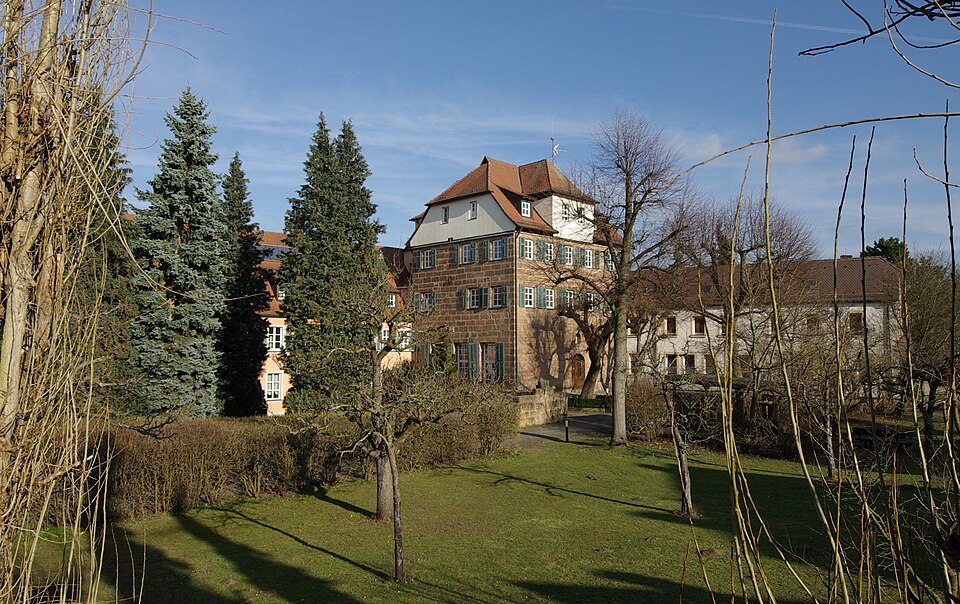
Buckenhof
Schloss Puckenhof
Vicaire luthérien, fondateur du Rettungshaus installé au château en 1850 · 1850
→Julius Schunck (1822–1857), Lutheran vicar in Erlangen, was among the promoters of the Inner Mission in Bavaria. Founder of the Rettungshaus Schallershof, he moved it in autumn 1850 to the former Puckenhof castle in Buckenhof, near Erlangen, merging it with the existing ‘Armentöchteranstalt’. The castle became one of the first institutions of its kind in Bavaria and still houses a youth welfare organisation today. Invited in 1849 by Johann Hinrich Wichern to the Congress for Inner Mission in Wittenberg, he set out his principles on assistance to the poor there; his text, assessed by the Faculty of Philosophy at Erlangen, was accepted as a doctoral thesis. From 1851 onwards, he directed the publication of the ‘Puckenhofer Blätter für das Volk’, which later became the ‘Blätter für Innere Mission’.
The work of Julius Schunck illustrates the social re-purposing of a seigneurial castle in the mid-19th century. In 1850, the former Hallerschloss in Buckenhof, which its Nuremberg owners had left two years earlier, housed a Rettungshaus for poor children, one of the first institutions of this type in Bavaria, joined by the Armentöchteranstalt. Since then, the site has never ceased to serve as a place of youth welfare, which largely explains the conservation and present-day reading of the castle.
Schloss PuckenhofInvited by Johann Hinrich Wichern to the Congress for Inner Mission in Wittenberg, where he presented his principles on assistance to the poor.
The Rettungshaus he founded was moved to the former Puckenhof castle, east of Erlangen, and merged with the Armentöchteranstalt.
He took over the direction of the ‘Puckenhofer Blätter für das Volk’, later renamed ‘Blätter für Innere Mission’, the organ of the Diakonisches Werk in Bavaria.
In Erlangen, from 1851, Schunck directed the ‘Puckenhofer Blätter für das Volk’, a publication that later took the title ‘Blätter für Innere Mission’ and became the organ of the Diakonisches Werk of Bavaria. His text presented at Wittenberg in 1849, which argued that the Church rather than the State should take charge of assistance to the poor, was accepted as a doctoral thesis by the Faculty of Philosophy at Erlangen.
This summary cross-references several sources to document the places, events and historical relationships.