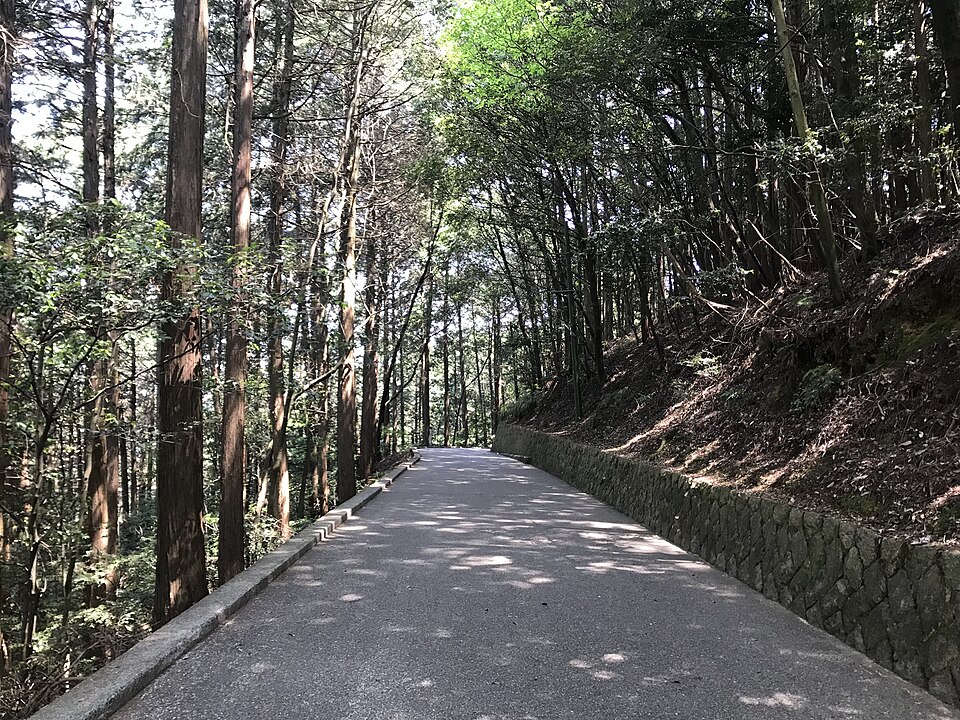
Kitahiroshima
Château de Hinoyama
dernier occupant avant le départ pour Izumo · jusqu'en 1591
→Lord of Iwakuni
Son of Kikkawa Motoharu and nephew of Mōri Motonari, Kikkawa Hiroie (1561–1625) was the founder of Iwakuni Castle. After 1591 he was first based at Toda Castle (Gassan-Toda) in Izumo. He fought in Korea during the campaigns of 1592–1598, where he distinguished himself at the siege of Ulsan. In 1600 he secretly negotiated with Tokugawa Ieyasu, through the intermediary of Kuroda Nagamasa, for the neutrality of the Mōri forces at Sekigahara in order to preserve the clan. Rewarded with a fief of roughly 30,000 koku at Iwakuni within the Mōri domain, he built a lowland residence and a hilltop castle above the Nishiki River between 1601 and 1608; the castle was dismantled as early as 1615. His descendants governed Iwakuni until the Meiji period.
At Iwakuni, Hiroie organised his capital around the Nishiki River: a seigneurial residence at the foot of the mountain and, at the summit of Mount Yokoyama, a fortress with a four-storey keep whose upper storey overhangs. Completed in 1608, the structure was demolished as early as 1615 on the orders of the shogunate, and the Kikkawa subsequently governed from the lowland residence, the present-day Kikkō Park. The keep, rebuilt in 1962, now recalls this work.
Château de HinoyamaBirth, son of Kikkawa Motoharu.
Receives territories from Toyotomi Hideyoshi and resides at Toda Castle in Izumo.
Takes part in the Korean campaigns; distinguishes himself at the siege of Ulsan.
Secretly negotiates with Tokugawa Ieyasu for the neutrality of the Mōri at Sekigahara.
Settles at Iwakuni (roughly 30,000 koku) and begins construction of the castle.
Completion of the hilltop castle at Iwakuni.
The castle is dismantled in accordance with the edict of ‘one province, one castle’.
Death.
Officially enrolled in the Western Army, Hiroie concluded a secret agreement with Tokugawa Ieyasu in 1600 through Kuroda Nagamasa and, with his vanguard, blocked the engagement of the Mōri forces. Ieyasu, however, did not fully honour the arrangement and reduced the Mōri domain to two provinces, and Hiroie received Iwakuni within it.
Cette synthèse croise plusieurs sources pour documenter les lieux, événements et relations historiques.