
Regensburg
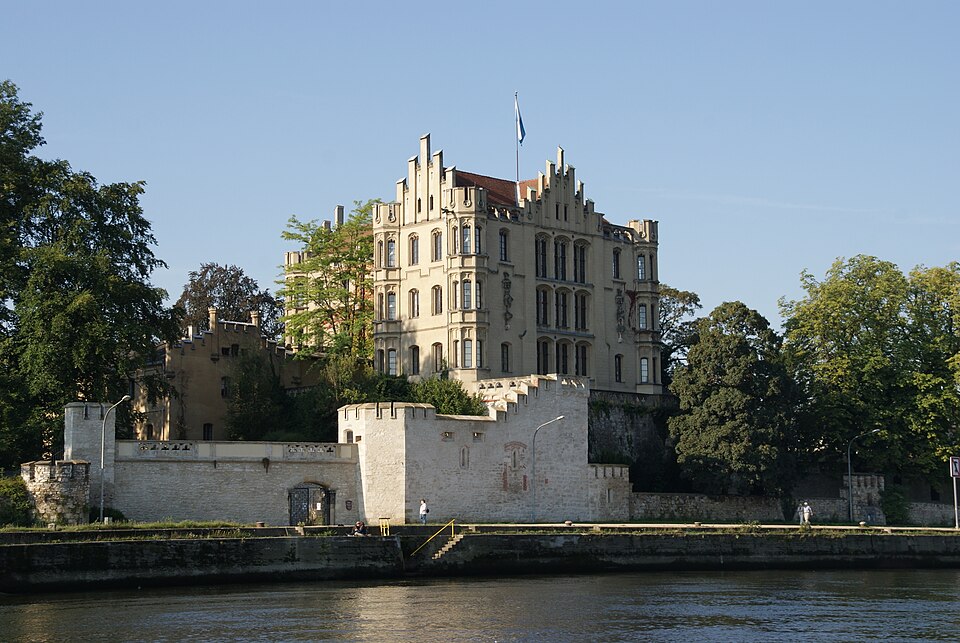
Königliche Villa
Architecte
→Ludwig Foltz (1809-1867), born in Bingen am Rhein, was an architect, sculptor and decorative artist who worked in Ratisbonne and then in Munich. Trained in Strasbourg and Mayence, he settled in Munich in 1830, where he attended classes at the Academy. He then taught in Ratisbonne and later became a professor at the Polytechnikum de Munich. In the field of castle heritage he is best known for the Königliche Villa in Ratisbonne, the neo-Gothic summer residence of King Maximilien II of Bavaria, built from 1854 to 1856 on the bank of the Danube. His architectural and decorative work has been the subject of a thesis on the history of the so-called Maximilian style (Maximilianstil).
According to the Allgemeine Deutsche Biographie, Ludwig Foltz, born in Bingen in 1809, trained in Strasbourg under Arnold, then in Mayence under Scholl and Lasaulx, before moving to Munich in 1830, where he attended the Academy. He taught in Ratisbonne at a trade school, then became professor at the Polytechnikum de Munich, a post he held until his death in 1867.
Königliche VillaBirth of Ludwig Foltz in Bingen am Rhein (23 March according to the article by Fritz-von Preuschen).
After training in Strasbourg and Mayence, he settled in Munich and attended classes at the Academy.
Taught at a trade school in Ratisbonne before being appointed professor at the Polytechnikum de Munich.
Construction of the Königliche Villa in Ratisbonne for King Maximilien II de Bavière; the works were carried out by master mason Wilhelm Madler under his direction.
Died in Munich, while still a professor at the Polytechnikum.
From 1854 to 1856, Foltz designed Maximilien II's neo-Gothic summer residence on the former East Bastion of Ratisbonne, on the bank of the Danube. The BLfD study describes it as a major work of early historicism; the construction was carried out by master mason Wilhelm Madler under Foltz's direction. The exact extent of Carl von Effner's role remains uncertain, as the plans are signed by Foltz alone.
Foltz was not only an architect: the thesis by Rosa Micus (1986) examines his architectural and applied-arts work as a contribution to the history of the Maximilian style. A specialist website also records him as a pattern designer for the Villeroy & Boch manufactory in Mettlach.
This summary cross-references several sources to document the places, events and historical relationships.