Kani
Château de Mino-Kaneyama
Seigneur (1584-1600)
→Daimyō of the Tsuyama domain (1603-1634)
Mori Tadamasa (1570-1634) is the founder of Tsuyama Castle, one of the largest fortresses in western Japan. Sixth son of Mori Yoshinari and younger brother of Mori Nagayoshi, whom he succeeded in 1584, he served Toyotomi Hideyoshi and later aligned himself with the Tokugawa. In 1603 he received the Tsuyama domain in Mimasaka Province, with an income of 185,000 koku. From 1604 he had a large hilltop castle built on Kakuzan hill, on the ruins of an earlier Yamana castle, featuring a five-storey keep and dozens of turrets. It was completed in 1616 after twelve years of construction. Its terraced stone walls still form the backdrop of Kakuzan Park today. He died in 1634.
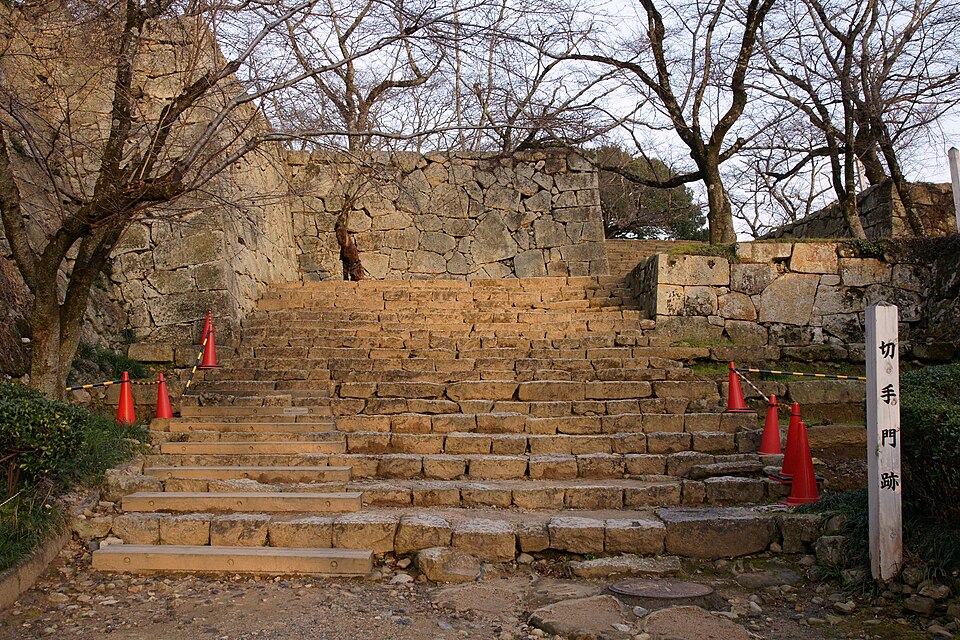
Having arrived in Tsuyama in 1603, Mori Tadamasa chose Kakuzan hill, already occupied in the 15th century by a castle of the Yamana clan, as the seat of his new domain. Construction, begun in 1604, lasted twelve years. The result is a large hilltop castle of the teikaku type, with a five-storey keep and some 77 turrets, counted among Japan's three great hirayamajiro, alongside Himeji and Matsuyama. Its terraced stone walls, reaching some ten metres in height in places, survived the demolition of the buildings after 1873.
Château de Mino-KaneyamaBirth, sixth son of Mori Yoshinari.
Succeeds his elder brother Mori Nagayoshi, who died in battle.
Transferred to Mimasaka Province, he receives the Tsuyama domain (185,000 koku).
Construction of Tsuyama Castle begins on Kakuzan hill.
Completion of the castle after twelve years of construction.
Death of Mori Tadamasa.
Born into a family of vassals of Oda Nobunaga, Tadamasa is the youngest of Mori Yoshinari's sons; he succeeded his brother Nagayoshi in 1584. Favoured by Toyotomi Hideyoshi, he was later granted the Tsuyama domain by the Tokugawa in 1603. His line would hold it until 1697, before it passed to the Matsudaira clan.
Cette synthèse croise plusieurs sources pour documenter les lieux, événements et relations historiques.