
Okayama
Château de Bitchū Takamatsu
Seigneur et défenseur du château (mort en 1582)
→Lord of Bitchū Takamatsu Castle · Lord of Shimizu Castle
Shimizu Muneharu (1537-1582), commander of Bitchū Province in the service of the Mōri clan and Kobayakawa Takakage, is inseparable from Bitchū Takamatsu Castle, of which he became lord. In 1582, besieged by Hashiba Hideyoshi, he refused the offer of Bitchū Province in exchange for surrender. Hideyoshi then had the marsh fortress flooded by raising an embankment and diverting the Ashimori River. When the death of Oda Nobunaga at Honnō-ji prompted Hideyoshi to negotiate, Muneharu agreed to take his own life to save his garrison: he killed himself in a boat, before both armies, on 23 June 1582. His loyalty has made him a celebrated figure, honoured by the head tomb on the castle site.
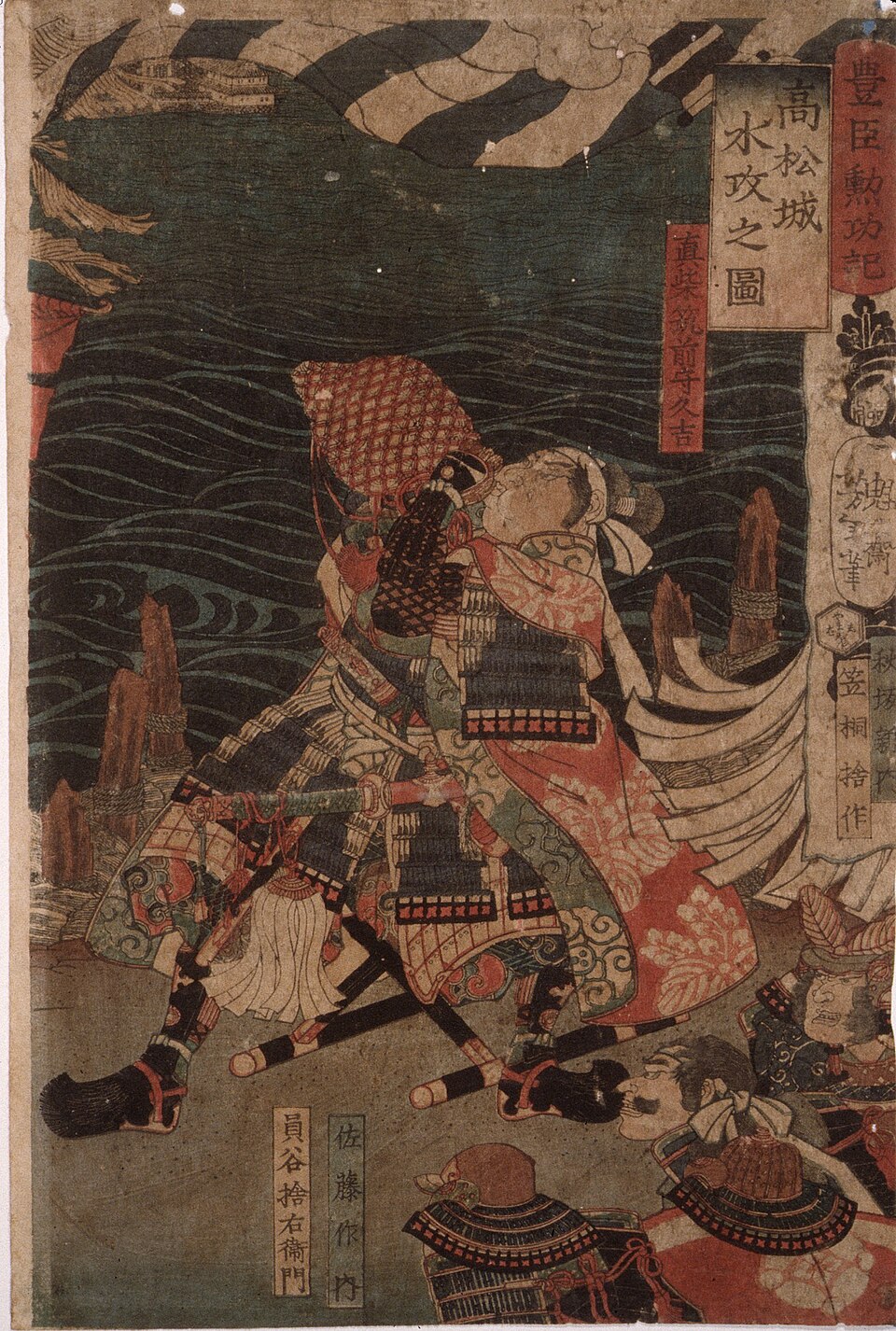
Bitchū Takamatsu Castle was a plain fortress surrounded by marshes, difficult to take by assault. In 1582, Hashiba Hideyoshi, on the advice of Kuroda Kanbei, had a long embankment built in about twelve days and diverted the Ashimori River into it; swollen by the seasonal rains, the water formed a lake that isolated the stronghold and cut off the Mōri reinforcements. Muneharu refused Hideyoshi's offer to cede him Bitchū Province in exchange for his surrender.
Château de Bitchū TakamatsuBorn, son of Shimizu Munenori.
In the service of the Mōri and Kobayakawa Takakage, he becomes lord of Bitchū Takamatsu Castle.
Defends the castle against Hashiba Hideyoshi, who floods it using an embankment blocking the Ashimori River.
After the Honnō-ji incident, takes his own life in a boat, a condition of peace between Hideyoshi and the Mōri.
On learning of Oda Nobunaga's death at Honnō-ji, Hideyoshi wished to conclude peace with the Mōri quickly; he demanded the death of the garrison's commander. Muneharu complied in a boat, in the middle of the artificial lake and before the eyes of both armies, thereby allowing his men to be spared. The castle site, protected since 1929, preserves the head tomb, and a small museum is dedicated to him.
Cette synthèse croise plusieurs sources pour documenter les lieux, événements et relations historiques.