
Nakatsugawa
Château de Naegi
Reprend le château en 1600, premier daimyō du domaine de Naegi
→First daimyō of the Naegi domain
Tōyama Tomomasa (born 1556), son of Tōyama Tomotada and, through his mother, a great-nephew of Oda Nobunaga, is the restorer of Naegi Castle and the first daimyō of the Naegi domain. Driven out of eastern Mino with his father by Mori Nagayoshi in 1583, he took refuge with Tokugawa Ieyasu and served the Tokugawa for nearly twenty years. In 1600, on Ieyasu's orders and with the support of Kiso forces, he retook Naegi shortly before the Battle of Sekigahara and contributed to the surrender of Iwamura Castle. His domain of about 10,500 koku remained in the hands of his descendants for twelve generations, until the Meiji Restoration, making Naegi one of the rare castles held almost continuously by a single family.
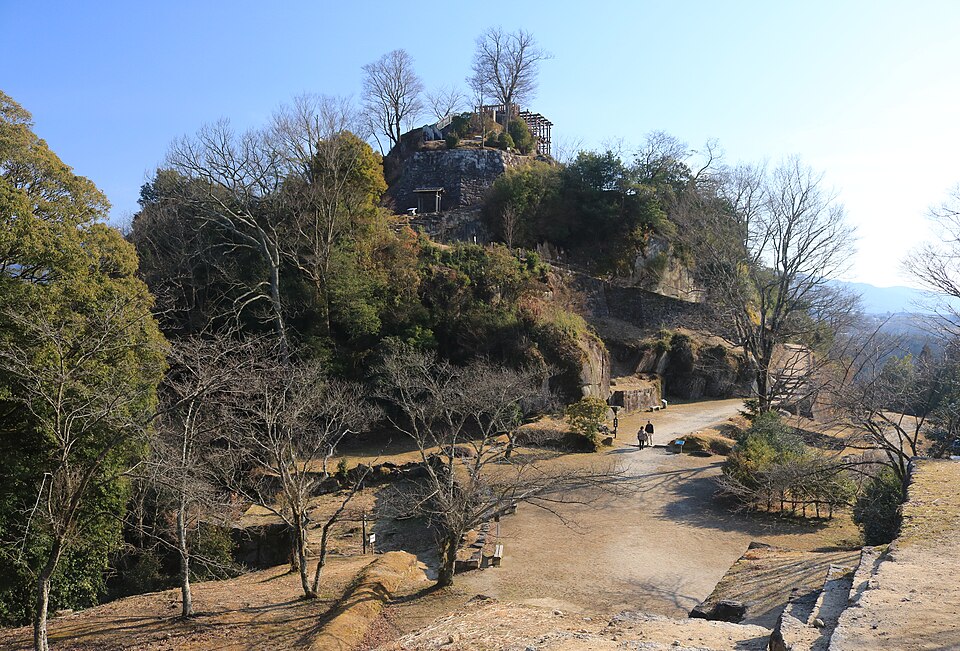
Eighteen years after leaving Naegi, Tomomasa returned there in 1600 during the Sekigahara campaign: on Ieyasu's orders, he entered the castle after its commander withdrew, shortly before the decisive battle. The Agency for Cultural Affairs notes that Naegi is a rare small-domain castle held almost entirely by a single family; the outer walls, remodelled in the early Edo period, bear witness to the reorganisation carried out by the Tōyama after their return.
Château de NaegiBorn at Iihazama Castle, son of Tōyama Tomotada; his mother is a niece of Oda Nobunaga.
Settles at Ateraji Castle; his brother Tomoshige died there in 1574 while defending it.
Refusing to serve under Mori Nagayoshi, he is driven out of Naegi with his father and takes refuge at Hamamatsu with Tokugawa Ieyasu; he then serves under Suganuma Sadatoshi.
After the Odawara campaign, he follows the Tokugawa vassals to Tatebayashi.
On Ieyasu's orders and with the help of Kiso forces, he retakes Naegi Castle before Sekigahara and secures the surrender of Iwamura Castle; he receives a domain of about 10,500 koku.
Takes part as a commissioner in the reconstruction of Sunpu Castle.
Ōsaka sieges: defends Kuwana Castle (winter 1614), then distinguishes himself under Matsudaira Tadaaki (summer 1615).
Having taken refuge at Hamamatsu in 1583, Tomomasa served under several Tokugawa vassals, accompanied the move to Kantō after 1590, and then took part in the major construction projects and campaigns of the new shogunate: the reconstruction of Sunpu in 1610, the defence of Kuwana in 1614 and the summer campaign of Ōsaka in 1615. He also developed new farmland within his domain from 1605 onwards.
Cette synthèse croise plusieurs sources pour documenter les lieux, événements et relations historiques.