
Okayama
Château d'Okayama
Bâtisseur du donjon (achevé en 1597)
→Daimyō of Bizen · Member of the council of five regents (Go-tairō)
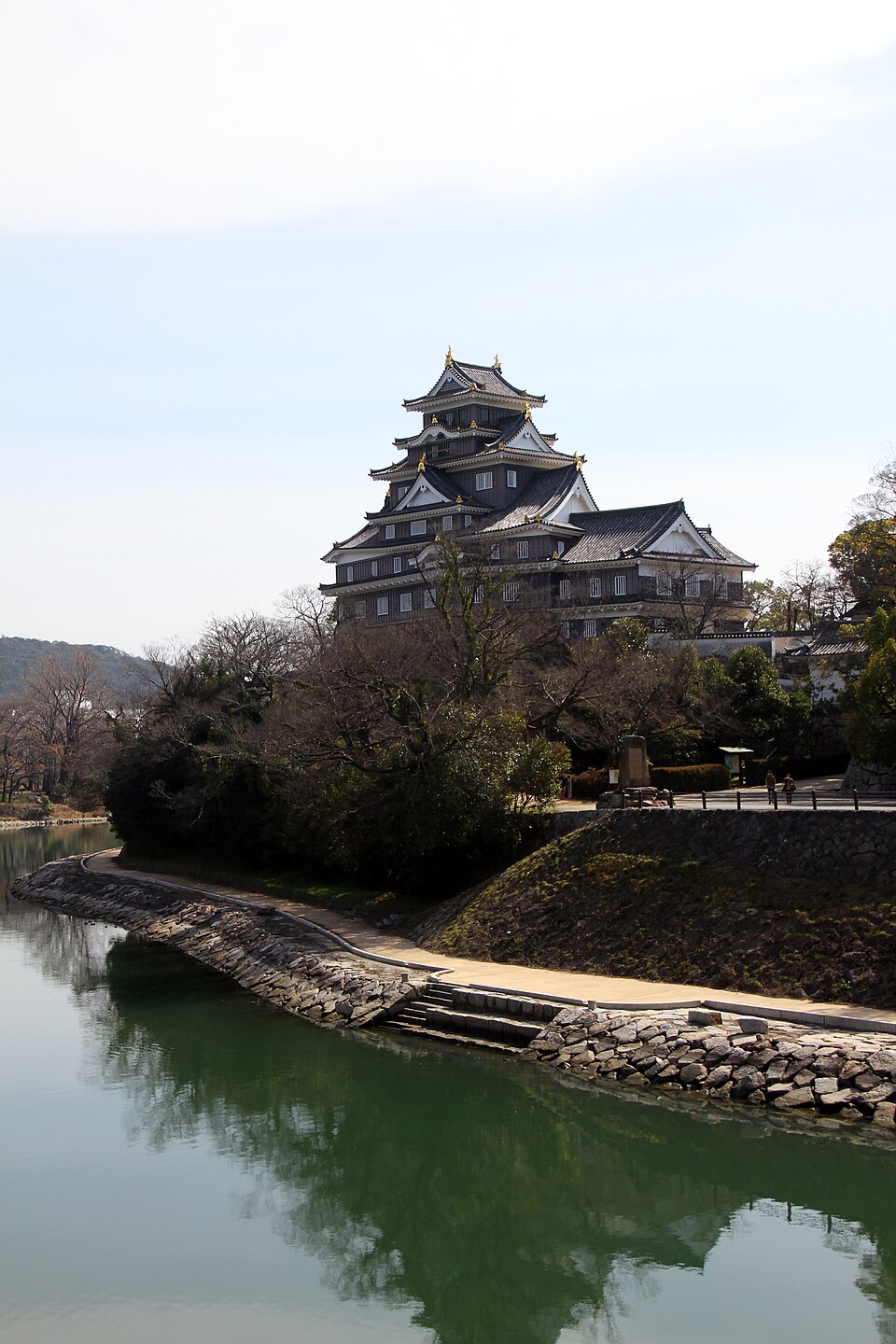
Ukita Hideie (1572–1655), daimyō of Bizen Province, is the man who gave Okayama Castle its silhouette as the ‘Crow Castle’. Son of Ukita Naoie, who had made Okayama his base from 1570, he completed in 1597 the black keep with a pentagonal base on Okayama Hill and organised the castle town around it. A protégé of Toyotomi Hideyoshi, he became Hideyoshi's adoptive son-in-law through his marriage to Gōhime, daughter of Maeda Toshiie, and was one of the five great regents (Go-tairō). He commanded troops during the Korean campaigns. Fighting for the Western Army at Sekigahara in 1600, he lost his domains, which passed to Kobayakawa Hideaki, and he spent the rest of his life in exile on the island of Hachijō-jima, where he died in 1655.
When Hideie inherited the Bizen domain, his father Ukita Naoie had already made Okayama the centre of his power. The son transformed the site into a true castle of the Momoyama period: he set the keep on Okayama Hill, on the edge of the Asahi River, on a stone base with an irregular pentagonal plan. Completed in 1597, the structure was clad in black boards and, according to tradition, decorated with gold tiles, hence the nicknames Crow Castle and Golden Crow Castle. The present castle, rebuilt in 1966 after its destruction in 1945, follows this silhouette.
Château d'OkayamaBorn in Bizen Province, son of Ukita Naoie.
Death of his father; he inherits the domain under the protection of Hideyoshi.
Marriage to Gōhime, daughter of Maeda Toshiie, adopted by Hideyoshi.
Commander during the first Korean campaign; wounded at the siege of Haengju.
Completion of the keep of Okayama Castle.
Member of the council of five regents alongside Tokugawa Ieyasu, Maeda Toshiie, Uesugi Kagekatsu and Mōri Terumoto.
Fights for the Western Army at Sekigahara; his lands and Okayama pass to Kobayakawa Hideaki.
Dies in exile on the island of Hachijō-jima.
Close to Toyotomi Hideyoshi, and married to Gōhime, daughter of Maeda Toshiie adopted by Hideyoshi, Hideie sat in 1598 on the council of five regents charged with governing during the minority of Toyotomi Hideyori. He commanded troops in Korea (1592–1598). In 1600, he fought for the Western Army at Sekigahara; weakened by defections within his own clan, he was defeated, lost his domains and was exiled to the island of Hachijō-jima with his sons. He died there in 1655, at an advanced age, long outliving most of the figures of his time.
Cette synthèse croise plusieurs sources pour documenter les lieux, événements et relations historiques.