
L’architecture
Ce qu’il faut observer
Édifice de plan quadrangulaire cantonné de tours ; intérieur conservant des plafonds à la française et une pièce décorée à la fin du XVIIIe siècle.
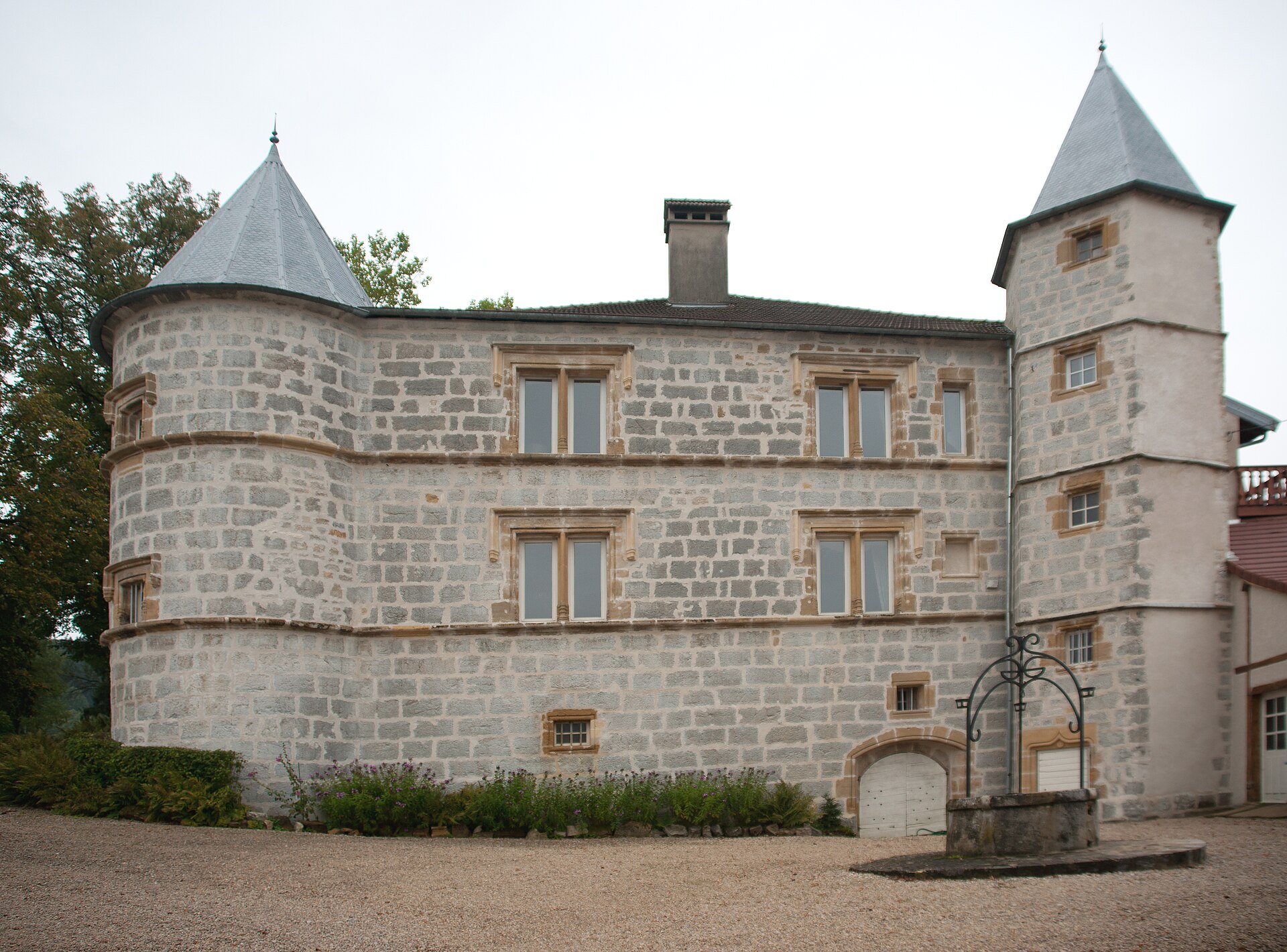
Sirod Jura
The Château de Sirod, also known as the Château de Montrichard, is a château located in Sirod in the Jura department of France.
En un regard
The Château de Sirod, also known as the Château de Montrichard, is a château located in Sirod in the Jura department of France. It has been partially listed as a monument historique since 1997. The oldest parts are the base stones of the building, which appear to date from the 14th century. The south-west hexagonal tower dates from the 15th century according to analyses by archaeologists. The Sirod fief, which depended on the barony of Chateauvilain, was held in feudal tenure by the Sirod (or Seroz) family from at least the 12th century. It was bought in the 16th century by the Montrichard family, six generations of whom served as captains of the Nozeroy garrison and gruyers of the Châlon-Arlay forests between 1529 and 1741. Under the master mason Richard Maire, builder of the palace of Cardinal Granvelle in Besançon, the façade was entirely renovated: the former Romanesque façade of the Sirod family was doubled with a Renaissance-style facing of grey Bajocian limestone, with banding, mullions and window surrounds in Hauterivian stone (yellow stone from Molpré and Mièges). After the conquest of the Franche-Comté, the losing branch of the Montrichard family settled at the Château de Frontenay through their marriage to Suzanne de Visemal in 1679, and at the Château de Saint-Martin (near Voiteur), at a lower altitude. They sold the lordship and the château to the Watteville family, their overlords at Chateauvilain, who thus reconsolidated their fiefs. The Watteville family remained for a century, as the Montrichard had at Sirod.
Récit
L’architecture
Édifice de plan quadrangulaire cantonné de tours ; intérieur conservant des plafonds à la française et une pièce décorée à la fin du XVIIIe siècle.
Chronologie
Les campagnes documentées qui ont façonné le monument, période par période.
Campagne principale par la famille de Montrichard vers 1550 (la description existante mentionne des parties plus anciennes, XIVe-XVe siècle).
Campagne secondaire ; pièce décorée à la fin du XVIIIe siècle.
Informations pratiques
Nous n’avons pas encore d’information vérifiée sur l’ouverture au public. Renseignez-vous auprès du site officiel ou de la mairie avant de vous déplacer.
Vous l’avez visité ?
Après relecture, votre photo illustrera cette fiche, créditée à votre nom. Haute définition bienvenue, jusqu’à 40 Mo.
Propriétaires et gestionnaires
Horaires, tarifs et réservation manquent encore sur cette fiche. Transmettez-les et mettez le château en avant auprès des visiteurs qui préparent leur venue.
Nearby