
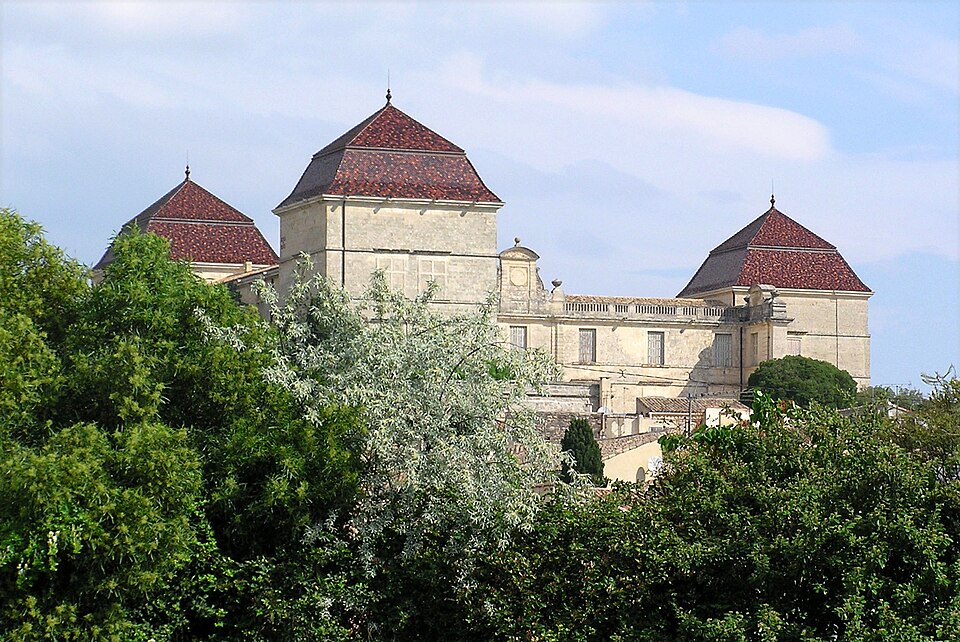
Castries
Château de Castries
Maître d'œuvre du château (1663-1664)
→Jean Bonnassier (sometimes spelled Bonnasier or Bonassier) is an architect active in Montpellier in the second half of the 17th century. His dates of birth and death are not known. The Monuments historiques entry names him as the principal master builder of the Château de Castries, rebuilt for the marquis René-Gaspard de La Croix de Castries: he is mentioned on the site in 1663 and 1664. He is therefore credited, at least in part, with the classical residence with Montpellier-style façades that dominates the plain, with its two wings set at right angles and its corner pavilions. Montpellier archives also show him working on religious architecture: on 22 July 1668, he signed with the churchwardens of Notre-Dame-des-Tables the prix-fait (fixed-price contract) for the high altarpiece, for 3,000 livres. His drawings served as the model for the work, a restrained, architectural decoration, carried out with the master masons Antoine Armand and Pierre Moynier and received in 1673. This altarpiece, destroyed during the Revolution, inspired that of the Récollets in Sommières.
After the destruction of the medieval château in 1622, reconstruction began in 1645. The Mérimée entry names Jean Bonnassier as the principal master builder of the present building, active in 1663–1664. The plan provided for three U-shaped wings; only two were built, with façades following the common Montpellier model.
Château de CastriesMentioned as master builder on the construction site of the Château de Castries.
Signs the prix-fait (fixed-price contract) for the high altarpiece of Notre-Dame-des-Tables in Montpellier (3,000 livres).
Reception of the altarpiece, with a supplement of 250 livres for alterations.
Recommended by Henry de Mariotte, president of the Chamber of Accounts, Aids and Finances, Bonnassier supplied the drawings for the high altarpiece of the church of Notre-Dame-des-Tables. The choice of an architect rather than a sculptor explains its decoration, dominated by architecture. For its execution he partnered with Antoine Armand, master of the royal works, and Pierre Moynier. An Antoine Arman also appears among the builders of the Castries aqueduct in 1670, according to the Mérimée entry, which suggests the same circle of Montpellier builders without allowing us to state that it is the same person.
Cette synthèse croise plusieurs sources pour documenter les lieux, événements et relations historiques.