
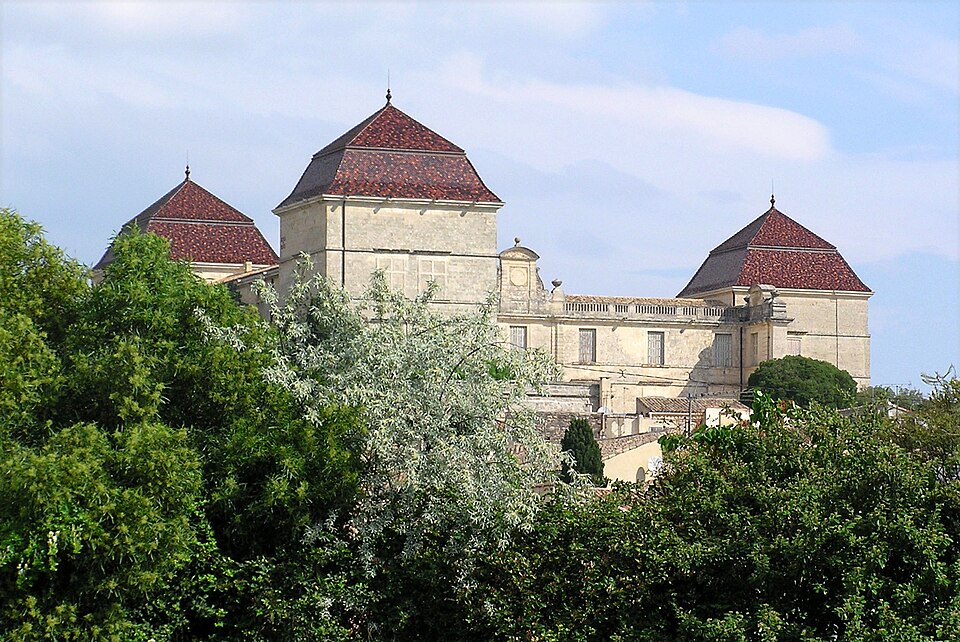
Castries
Château de Castries
Ingénieur du canal du Midi, aqueduc traditionnellement attribué
→Baron de Bonrepos
Pierre-Paul Riquet (Béziers, around 1609 – Toulouse, 1er octobre 1680), Baron de Bonrepos, is the creator of the Canal du Midi, the waterway linking the Garonne to the Mediterranean. Born into a family of Béziers notables, he received no training as an engineer. He made his fortune as a tax farmer of the gabelles (the salt tax), notably in Languedoc and Roussillon, and taught himself hydraulics. His key insight was to supply the summit of the canal, the Naurouze threshold, by capturing waters from the Montagne Noire. Backed by Colbert, he obtained the royal edict launching the works in 1666. He committed his fortune to the project and died ruined, a few months before the inauguration in 1681. His name is also tied to the Château de Castries: tradition credits him with designing the aqueduct of nearly 7 km which, from 1670, carried water from the Fontgrand spring to the gardens of the Marquis de Castries. The Monuments historiques listing, however, names Antoine and Jean Arman as the builders of the structure, so Riquet's role belongs to traditional attribution rather than documented fact.
Riquet was neither an architect nor a trained engineer. He was a businessman and tax farmer of the gabelles, who devoted his income and leisure to hydraulic experiments on his lands at Bonrepos. This profile explains his method: he personally financed a considerable part of the project and directed thousands of workers, at the cost of his own ruin.
Château de CastriesBorn in Béziers into a family of notables.
Career in the gabelles tax farm in Languedoc and Roussillon; builds a personal fortune.
Letter to Colbert proposing a canal of communication between the two seas across Languedoc.
Royal edict authorising construction of the canal; works begin in 1667.
Construction of the Château de Castries aqueduct, traditionally attributed to him in its design.
Dies in Toulouse before the canal is completed; buried in the Cathédrale Saint-Étienne.
The Canal du Midi enters service; inscribed on the UNESCO World Heritage List in 1996.
The main technical challenge was to bring enough water to the watershed summit, the Naurouze threshold. Riquet solved it by diverting the rivers of the Montagne Noire into a reservoir, the Saint-Ferréol basin. The canal, about 240 km long, is regarded as one of the great civil engineering works of the early modern period.
At the Château de Castries, tradition makes Riquet the designer of the aqueduct built from 1670 to bring water from the Fontgrand spring to the basins of the gardens. The structure, 6,822 m long, has been listed as a monument historique since 1949. The Mérimée listing attributes its execution to Antoine and Jean Arman, so Riquet's involvement must be presented as an attribution.
Cette synthèse croise plusieurs sources pour documenter les lieux, événements et relations historiques.